Bidspirit auction | [NEED NEW PICS] Revolutionary War
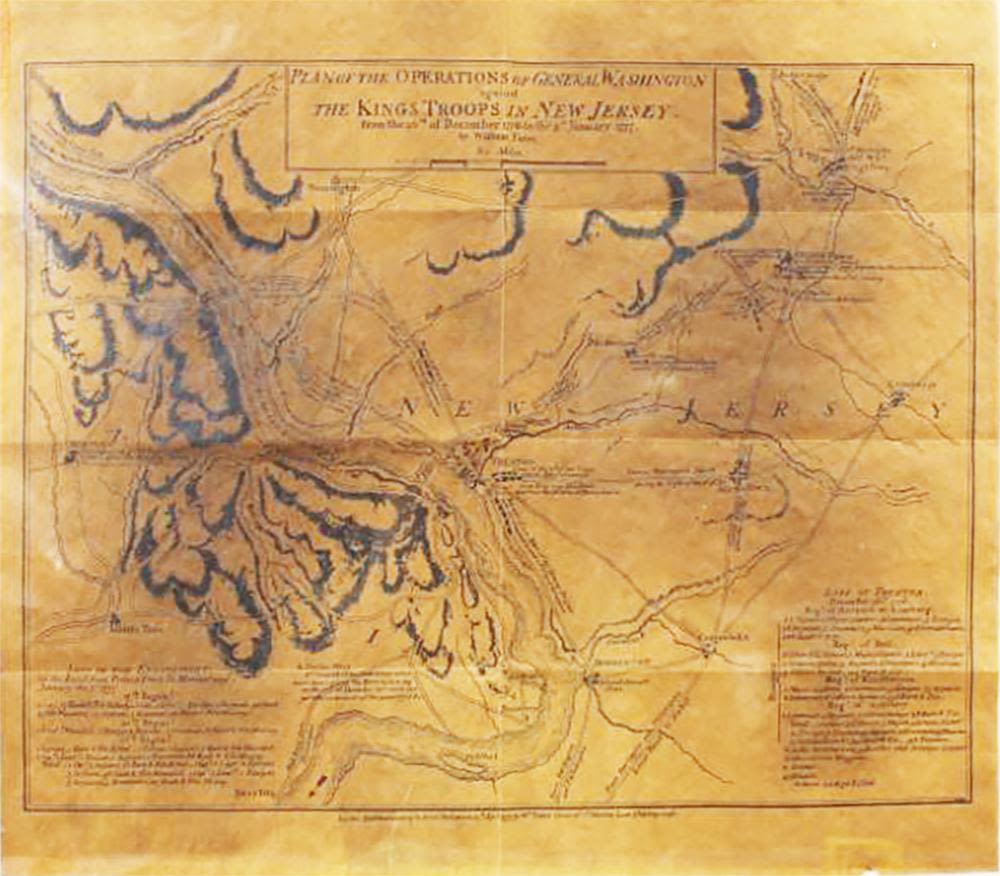
[NEED NEW PICS] Revolutionary War Battle Map Washington’s victory at the Battle of Trenton – Map of the Plan of the Operations of General Washington - Rare Battle Map of Washington’s victory at the Battle of Trenton Entitled “Plan of operations of General Washington against The Kings Troops in New Jersey, from the 26th of December 1776 to the 3rd January 1777 by William Faden” | Maker / Publisher: London: William Faden, 1777 | Image Size: 13.5 x 16 in.; With Frame: 16 x 18.5 | Map is framed / encased for storage behind archival glass. Fine early example of Faden’s Plan of the American Revolutionary War Battles of December 1776 and January 1777, including Washington’s crossing of the Delaware River on Christmas Day, 1776, one of the most important early battles of the American Revolution. Published originally just weeks after the last of the battles, Faden’s plan depicts a roughly 400 square-mile area of New Jersey and northern Pennsylvania. It documents key events of the Trenton-Princeton operation, including the crossing of the Delaware on December 25, 1776, the attack on Colonel Rall’s force at Trenton on the December 26, 1776, Cornwallis’ rush south from Fort Lee, and Washington’s end-around to hit Cornwallis’ flank at Princeton on January 2-3, 1777. Faden’s plan appeared only three months after the battles and probably just a few weeks after the news reached London. It is hard to overstate the impact it must have had on the British elite, who after the capture of New York had anticipated a swift and successful conclusion to the war. The map illustrates the Theater of War northeast of the Delaware River, depicting two important early American victories, which helped gain critical support and momentum for the American Revolution. By late 1776, Washington’s forces had been defeated in Boston and overwhelmed in New York by the British Navy, whose massive invasion of the city forced the Americans on the defensive. In December, 1776, the British had seized Newport, Rhode Island. By this time, the British Commander-in-Chief, Sir William Howe, had launched a successful invasion of New Jersey, which forced Washington to retreat to his winter quarters at Newtown, Pennsylvania, shown on the left side of Faden’s map. Washington realized that many troops would not renew their service contracts which were set to expire at year’s end and that dramatic action was required to turn the tide. On Christmas Day, while the British troops and Hessian mercenaries were celebrating the holiday, Washington, as noted by Faden’s annotation, “parade of the troops on the evening of the 25th of Decr. 1776,” marched his troops to the banks of the Delaware River and in a scene immortalized in Emanuel Leutze’s iconic painting Washington Crossing the Delaware (1851), led his force of 2,400 across the river at “McKenky’s Ferry, ” near Trenton, which was held by a force of 1,400 Hessians under Col. Johann Rall. As illustrated by Faden, Washington divided his force into two prongs, one commanded by John Sullivan, and the other by Nathaniel Greene. The two forces attacked and defeated the Hessians, with Faden noting the casualties by regiment, rank, and role in the table “Loss of Trenton.” On December 30th, a British force under Lord Cornwallis attacked the Americans at Trenton, but failed to retake the town. Washington left a token force in the town to light numerous campfires, fooling Cornwallis into thinking that Washington had decided to make a stand in Trenton. In reality, over the next couple of days the Americans stealthily moved most of their forces around the British positions. Washington dispatched a force under Greene to proceed up the main highway leading into Princeton, with the objective of diverting the British from being able to check a larger force under Sullivan, which was to attack the town from the west. In all, 4,600 American troops were to advance upon a British force. Greene’s advance brigade under Col. Hugh Mercer encountered formidable resistance from a British line under Col. Charles Mawhood. While Mercer was killed and Mawhood broke the American lines, the British were unable to hold the town from Sullivan’s force. On January 3, 1777, the American’s seized the British headquarters at Nassau Hall at the College of New Jersey (now Princeton). The Princeton to Maidenhead battle casualties are noted by Faden. Cornwallis realized that he had been tricked and tried to move his force towards Princeton, but was delayed as the key bridge over Stoney Creek had been sabotaged by the Americans. The Americans withdrew from Princeton to Somerset Courthouse (now Millstone), while the British retreated through a deserted Princeton to the relative security of New Brunswick. In summation, Washington’s bold strategy had succeeded in restoring the morale of his force,