Bidspirit auction | RUSSIAN ANTIQUE SILVER SPOON SET
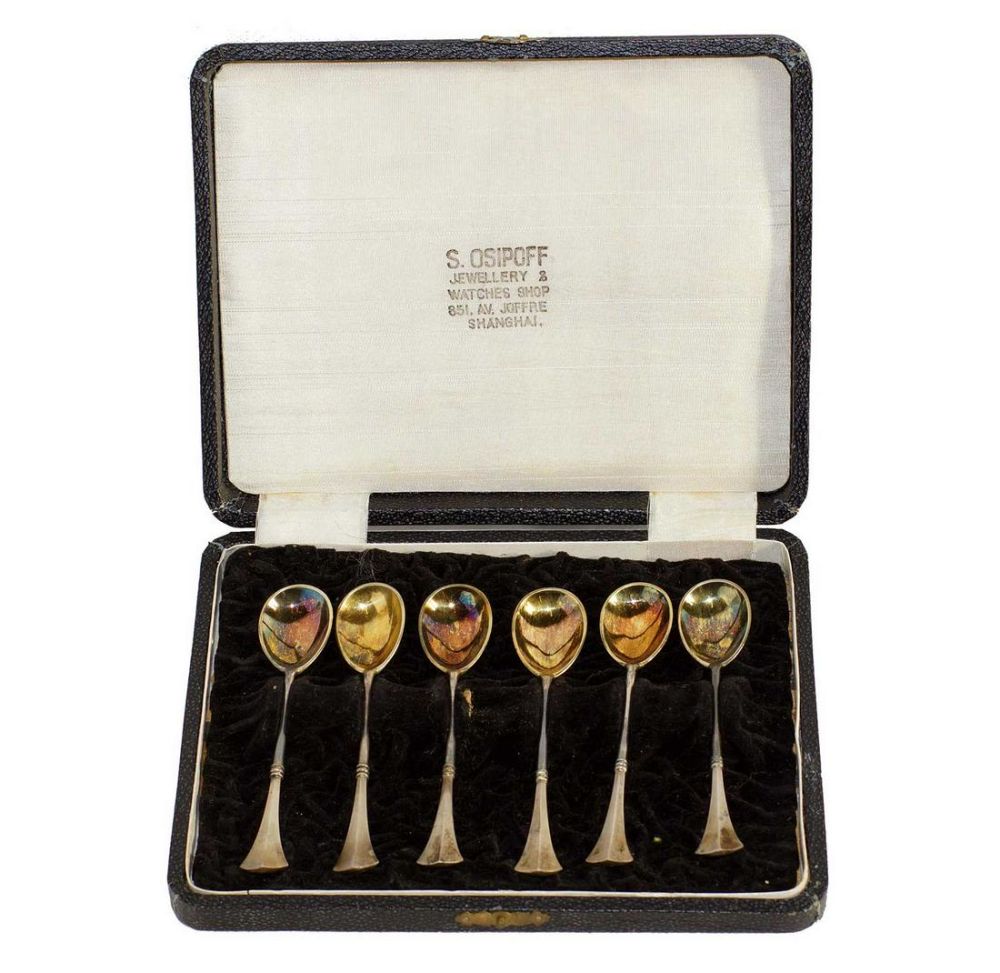
RUSSIAN ANTIQUE SILVER SPOON SET in BOX, HARBIN - RUSSIAN ANTIQUE SILVER SPOON SET in BOX, SHANGHAI - HARBIN Antique Russian 84 Silver Spoon Set (6) in Box. Made by S. Osipoff Jewellery. Each spoon marked with Russian kokoshnik mark, GS in Russian for workmaster Georgiy Sbitnev and 84 for silver. The set is made in Russian Harbin (SHANGHAI) - unknown period of Russian history - please read bellow. From real old collection! Please note: last image is for sample only. CONDITION : The item is described to the best of our knowledge. Please refer to pictures and email with any questions. SIZE : 4.25 inches. Weight 80 gram. ESTIMATE PRICE : $1000 - $1500. It is a great INVESTMENT. HISTORY of SALES : A few years ago Russian 6 Silver spoons (not from Harbin and not in a box) were sold on Live Auctioneer for $1550 and $2250 - please see the screenshots. OFFER : If an item is NOT SOLD, you can still give us a reasonable offer - please save the link of this page. PAYMENT : Credit Card payment, Wire transfer, Check or Money Order payment are also available. International bidder can use PayPal for payment. PAY in PARTS : You can pay for any item during 2-3 months. Just make a deposit 10% and the item will wait for you. SHIPPING : Let us Handle Your Shipping. We are one of the few places that offer full service shipping. For your convenience we will ship your item - shipping costs will be included in the invoice. Combined shipping is available - next item will be ONE DOLLAR for shipping. NEW : Returning customer will have FREE SHIPPING in USA and 50% DISCOUNT on international shipping. WIKIPEDIA : The first generation of Harbin Russians were mostly the builders and employees of the Chinese Eastern Railway. They moved to Harbin in order to work on the railroad. At the time Harbin was not an established city. The city was almost built from scratch by the builders and early settlers. Houses were constructed, furniture and personal items were brought in from Russia. After the Russo-Japanese War, while many Russians left Harbin, a lot of long-time residents decided to stay. By 1913, Harbin had become an established Russian colony for the construction and maintenance work on the China Eastern Railway. A record shows Harbin had a total of 68,549 people, most of which are of Russian and Chinese descent. There were a total of 53 different nationalities. Along with Russian and Chinese, there were 45 spoken languages used in Harbin at the time. Only 11.5% of all residents were born in Harbin. There were lively religious activities, too, by the Russians (Saint Sophia Cathedral in Harbin), Ukrainians (Church of the Intercession in Harbin), Poles (Sacred Heart Cathedral of Harbin), Germans (Harbin Nangang Christian Church), Danish (Danish Lutheran Church), and others. A few kilometers of Harbin there is a railway station of Asheng (Ashihe) which was a settlement of hundreds of white Russians till 1955. A large community, with orthodox church, independent college, library and a social club. The common language was Russian, with some Siberian variations. Many Czarist Imperial officers amongst ”old believers” contributed to maintain strong links to Russian culture, literature and music. Almost the entire population of Asheng emigrated, to Australia and Brazil.