Bidspirit auction | ANTIQUE 19th C SILVER RUSSIAN
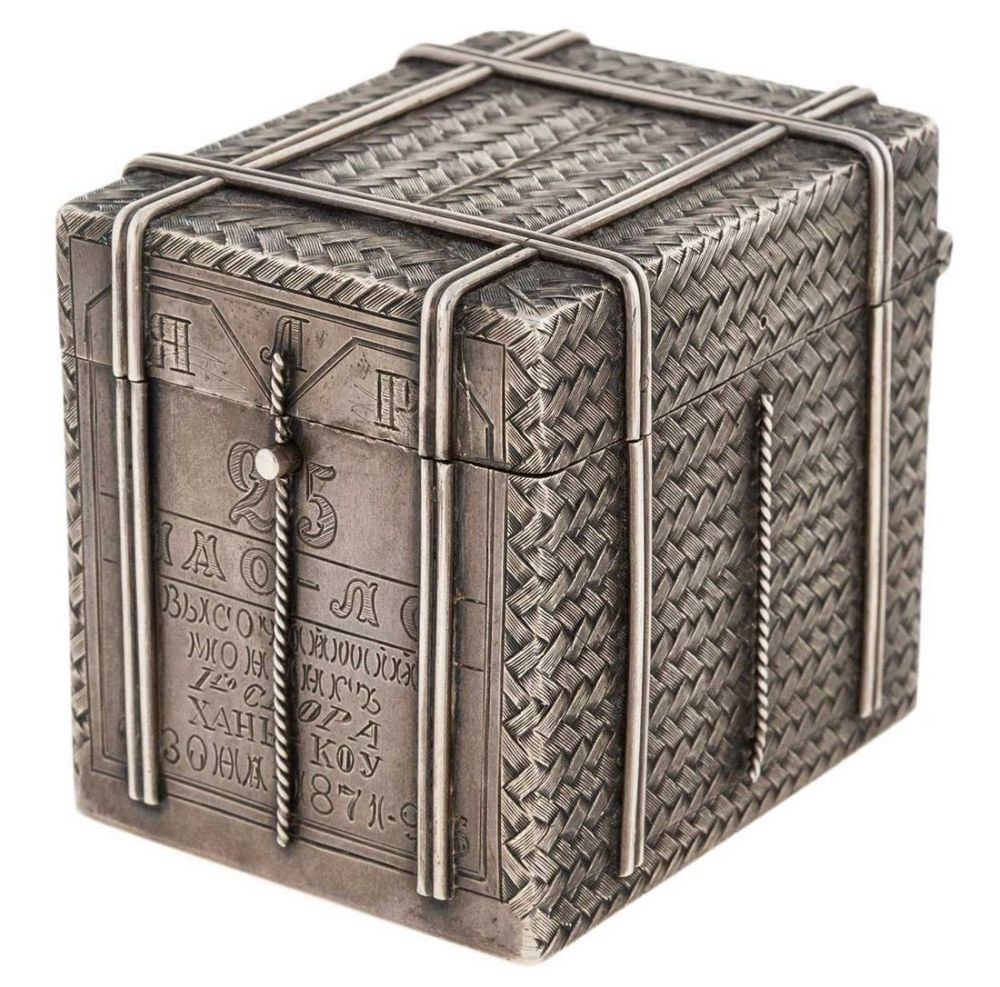
ANTIQUE 19th C SILVER RUSSIAN INKWELL fr. SHANGHAI - ANTIQUE 19th C SILVER RUSSIAN INKWELL from SHANGHAI Silver inkwell in the form of a chest with weaved design and a glass bottle insert. The inkwell has an inscription in Russia with Chianes accent. The item is made in Shanghai. CONDITION : The item is described to the best of our knowledge. Please refer to pictures and email with any questions. SIZE : 5 x 5 3/4 x 4 1/2 (2 x 2 1/4 x 1 3/4 in). ESTIMATE PRICE : $1000 - $1500. HISTORY of SALES : Recently Russian silver inkwells were sold on Live Auctioneer for $1500, $2400 and $4750 - please see the screenshots. Great potential investment. OFFER : If an item is NOT SOLD, you can still give us a reasonable offer - please save the link of this page. PAYMENT : Credit Card payment, Wire transfer, Check or Money Order payment are also available. International bidder can use PayPal for payment. PAY in PARTS : You can pay for any item during 2-3 months. Just make a deposit 10% and the item will wait for you. SHIPPING : Let us Handle Your Shipping. We are one of the few places that offer full service shipping. For your convenience we will ship your item - shipping costs will be included in the invoice. Combined shipping is available - next item will be ONE DOLLAR for shipping. NEW : Returning customer will have FREE SHIPPING in USA and 50% DISCOUNT on international shipping. WIKIPEDIA : The first generation of Harbin Russians were mostly the builders and employees of the Chinese Eastern Railway. They moved to Harbin in order to work on the railroad. At the time Harbin was not an established city. The city was almost built from scratch by the builders and early settlers. Houses were constructed, furniture and personal items were brought in from Russia. After the plague epidemic, Harbin's population continued to increase sharply, especially inside the Chinese Eastern Railway Zone. Research shows that only 11.5 percent of all residents were born in Harbin. By 1917, Harbin's population exceeded 100,000, with over 40,000 of them were ethnic Russians. After Russia's Great October Socialist Revolution in November 1917, more than 100,000 defeated Russian White Guards and refugees retreated to Harbin, which became a major center of White Russian emigres and the largest Russian enclave outside the Soviet Union. Karlinsky noted that a major difference with the Russian emigres who arrived in Harbin was: ”Unlike the Russian emigres who went to Paris or Prague or even to Shanghai, the new residents of Harbin were not a minority surrounded by a foreign population. They found themselves instead in an almost totally Russian city, populated mainly by people with roots in the south of European Russia.” The city had a Russian school system, as well as publishers of Russian-language newspapers and journals. Russian Harbintsy community numbered around 120,000 at its peak in the early 1920s. Many of Harbin's Russians were wealthy, which sometime confused foreign visitors who expected them to be poor, with for instance the American writer Harry A. Franck in his 1923 book Wanderings in North China writing the Russian ”ladies as well gowned as at the Paris races [who] strolled with men faultlessly garbed by European standards”, leading him to wonder how they had achieved this ”deceptive appearance”.