Bidspirit auction | Litzmannstadt Ghetto Milk Ration Card
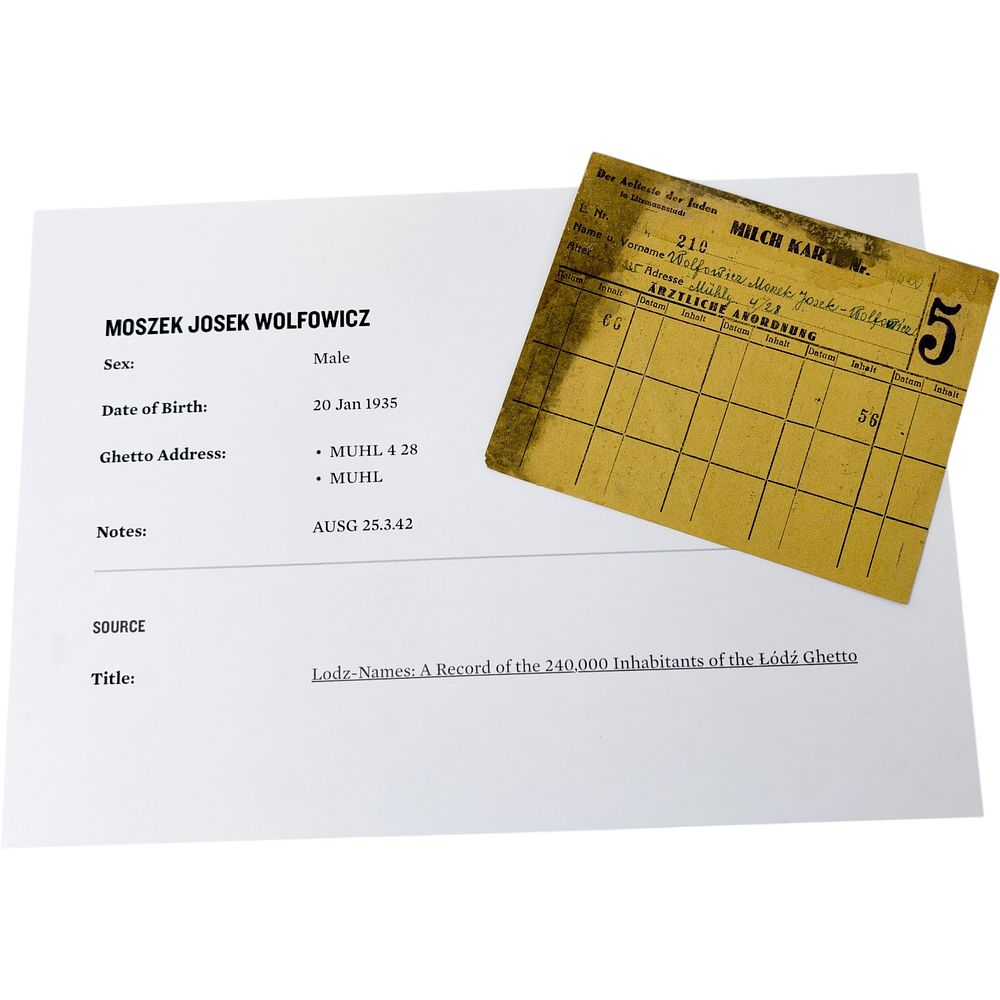
Litzmannstadt Ghetto Milk Ration Card Issued to Moszek Josek Wolfowicz - A printed ration card headed ”Der Aelteste der Juden in Litzmannstadt” and titled ”Milch Karte, ” issued to a named individual within the ghetto administration's food distribution system. The card bears a ledger number, handwritten name and address entries reading ”Wolfowicz Monek Josek” and ”Muehl 4/28,” a printed age field, and a grid of dated allotment columns with ink notations. A large printed numeral appears in the corner of the card. Accompanying the card is a printed research page citing the Lodz-Names database, listing the individual's full name, sex, date of birth (20 Jan 1935), ghetto address, and a notation reading ”AUSG 25.3.42.” The Litzmannstadt Ghetto, the German-imposed name for the Lodz Ghetto, operated a strict rationing system administered through the Jewish Council (Judenrat) under Mordechai Chaim Rumkowski. Milk and food cards such as this one governed the limited distribution of provisions to ghetto inhabitants, and surviving examples tied to named individuals, particularly children, are significant primary documents of daily life and administration within the ghetto. The Litzmannstadt Ghetto, established by German occupation authorities in the Lodz area from 1940, confined over 160,000 Jews under a Judenrat administration led by Mordechai Chaim Rumkowski, which managed internal affairs including the strict rationing of food. Milk cards were issued in limited numbers, generally prioritised for children and the sick, reflecting the chronic scarcity and controlled distribution that characterised ghetto life. The notation ”AUSG 25.3.42” corresponds to the mass deportations to the Chelmno extermination camp that took place in early 1942, during which large numbers of ghetto residents, including many children, were removed and murdered. Such personally named ration documents are valued as rare surviving traces of individual victims within the Holocaust's bureaucratic apparatus. The Litzmannstadt Ghetto, established by German occupation authorities in the annexed city of Lodz from early 1940, confined over 160,000 Jews under a Judenrat administration headed by Mordechai Chaim Rumkowski, which was made responsible for internal affairs including the tightly controlled rationing of food. Milk cards were issued sparingly, generally reserved for children and the infirm, reflecting the severe malnutrition and administrative regimentation that defined daily existence in the ghetto. The notation ”AUSG 25.3.42” falls within the period of mass deportations from the ghetto to the Chelmno extermination camp, during which tens of thousands of residents, including many children, were removed and murdered. Ration cards bearing the name of an identified individual, especially a young child, are valued as rare documentary traces connecting the bureaucratic machinery of the ghetto to a specific victim of the Holocaust.