Bidspirit auction | Lodz Ghetto Food Ration Card
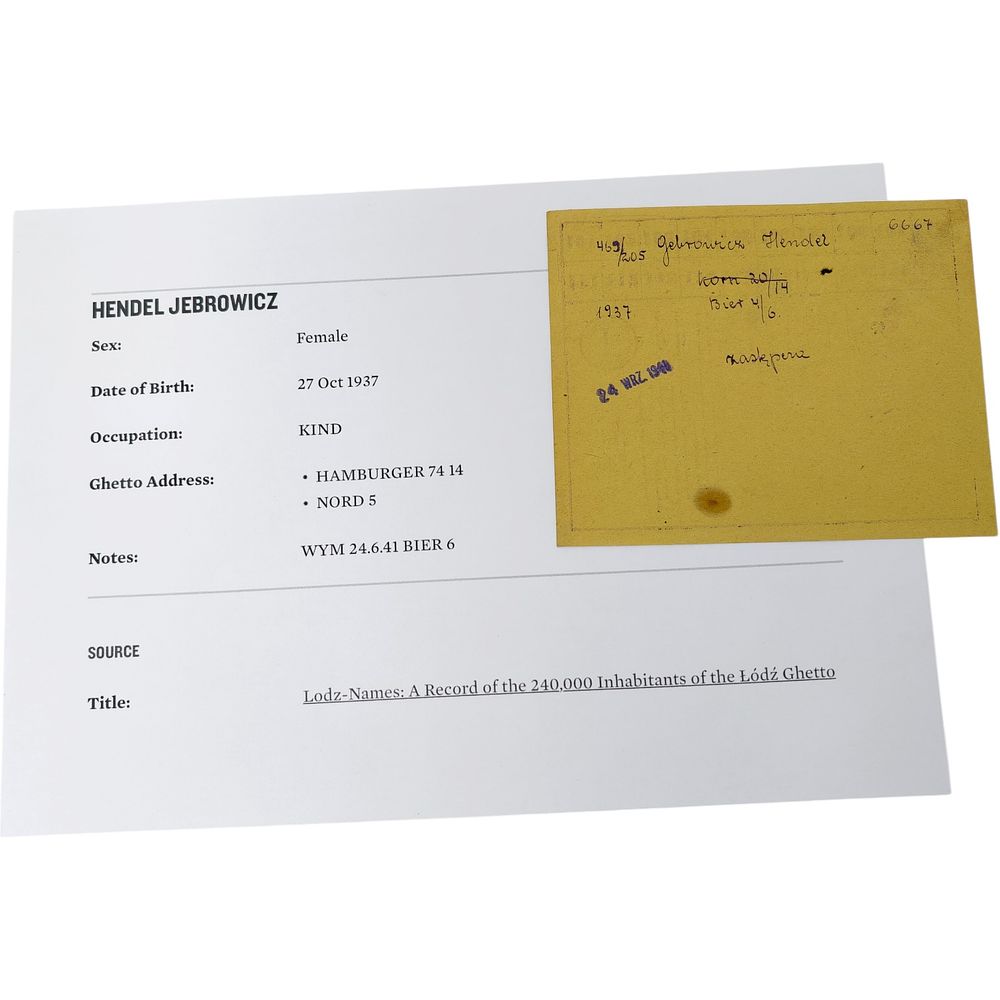
Lodz Ghetto Food Ration Card (Lebensmittel-Karte) with Owner Info - A printed ration card issued by the Jewish ghetto administration's Provisioning Department in the Lodz Ghetto, featuring numbered perforated coupons, a printed stamp reading ”Der Aelteste der Juden, ” and a signature. The reverse carries handwritten registry notations in ink, including a name, a birth year, address codes, and a purple ink date stamp. Ration cards of this type were distributed to registered ghetto inhabitants to control the allocation of food, and the accompanying research sheet cross-references the handwritten details with a published record of Lodz Ghetto residents, identifying the individual named on the card along with biographical particulars such as date of birth, ghetto address, and occupation. The Lodz Ghetto, established by German occupation authorities in 1940, was the second-largest ghetto in occupied Poland and existed until its liquidation in August 1944, when most surviving inhabitants were deported to Auschwitz-Birkenau and Chelmno. Internal administration, including food distribution, was managed by the Jewish Council under Chaim Rumkowski, whose office issued directives and documents under the title ”Der Aelteste der Juden” (Eldest of the Jews). Ration cards such as this regulated access to the severely restricted food supplies allocated to ghetto residents, and surviving examples with legible personal data are frequently used by researchers and memorial institutions to document individual fates during the ghetto's existence. The Lodz Ghetto, sealed by German occupation authorities in 1940, held over 160,000 Jews at its height and became the longest-surviving ghetto in occupied Poland, functioning until its liquidation in August 1944. Its internal Jewish administration, headed by Chaim Rumkowski under the German-imposed title ”Der Aelteste der Juden, ” oversaw food distribution through ration cards like this one, which controlled access to the meagre supplies allotted to registered inhabitants amid conditions of severe hunger and forced labour. Such documents, when bearing legible personal data, are used by researchers and memorial institutions to trace the identities and fates of individual ghetto residents, most of whom were ultimately deported to Chelmno or Auschwitz-Birkenau.