Bidspirit auction | Lodz Ghetto Milk Ration Card
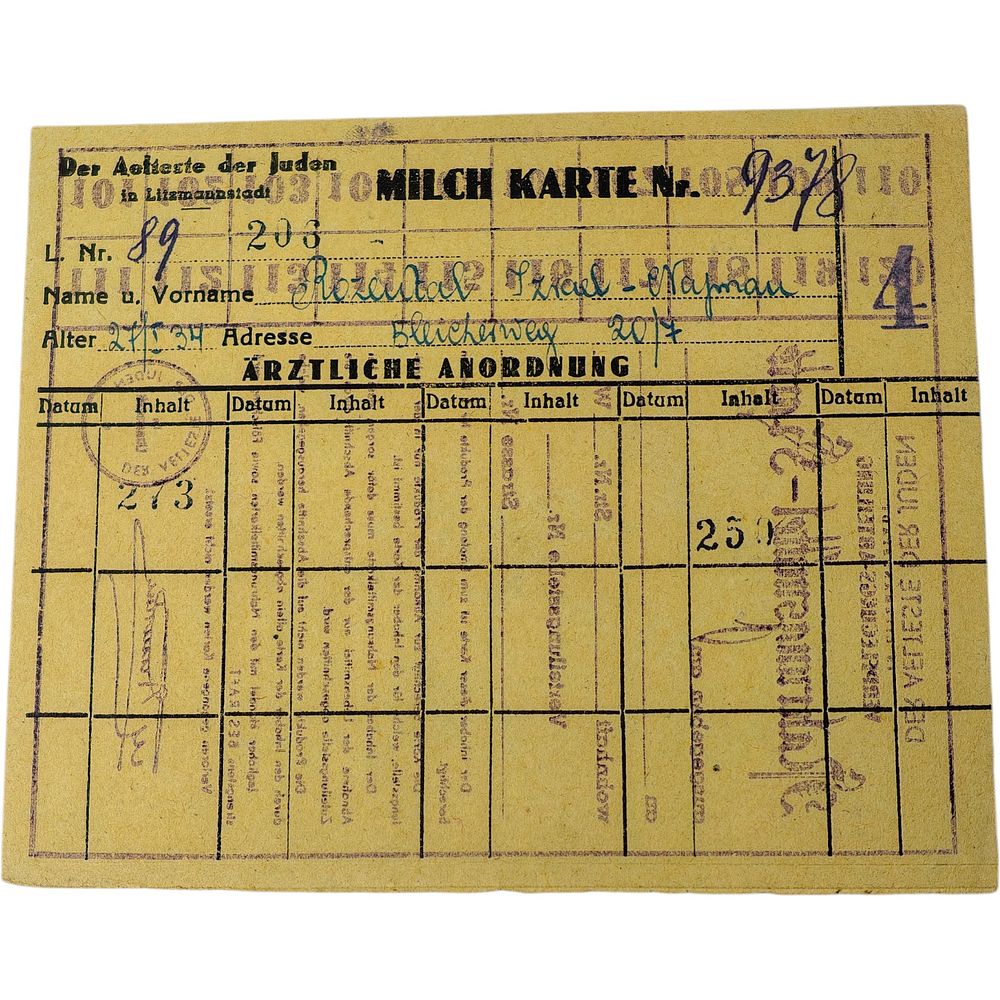
Lodz Ghetto Milk Ration Card (Milch Karte) Issued by the Aelteste der Juden - A printed ration card issued under the authority of ”Der Aelteste der Juden in Litzmannstadt, ” headed ”MILCH KARTE Nr.” with a handwritten card number, ledger number, and the name, birth year, and address of the recipient filled in by hand. The card includes a section titled ”Aerztliche Anordnung” (medical instruction) with a grid of dated entries and several ink stamps and signatures. The reverse carries a printed ”Nahrungsmittel-Karte” (food ration card) format from the Verpflegungs-Abteilung, with a numbered coupon grid running from 101 to 120, a printed number, blank fields for the holder's street and distribution point, printed usage regulations, a circular stamp of the issuing authority, and a signature. This type of card was issued within the Lodz (Litzmannstadt) Ghetto administration, which controlled the distribution of food and other rations to Jewish residents through the office of the Aelteste der Juden, headed by Chaim Rumkowski. This document originates from the Lodz Ghetto, established by German occupying authorities in occupied Poland in 1940 and administered internally through the Jewish Council of Elders (Aelteste der Juden) under Chaim Rumkowski, who was appointed by the Germans to oversee ghetto affairs including labour allocation and the strictly controlled distribution of food. Milk rations, allotted through such cards under medical instruction, were typically reserved for infants, children, the sick, and other categories deemed by the ghetto administration to require supplementary nutrition amid chronic food shortages. The Verpflegungs-Abteilung (Provisioning Department) managed the broader system of ration cards and coupons that determined access to scarce foodstuffs for the ghetto's roughly 160,000200,000 inhabitants before mass deportations to Chelmno and later Auschwitz between 1942 and 1944. Surviving ration documentation of this kind provides material evidence of the bureaucratic mechanisms of ghetto administration and the conditions of deprivation faced by its Jewish population. The Lodz Ghetto, sealed off in 1940 in the German-occupied Polish city renamed Litzmannstadt, was administered internally by the Aelteste der Juden under Chaim Rumkowski, who was tasked by the German authorities with organising labour and rationing amid severe shortages. Milk allocations, requiring medical authorisation as reflected on such cards, were generally restricted to infants, children, and the ill, reflecting the ghetto administration's tight control over already scarce supplementary nutrition. The Verpflegungs-Abteilung oversaw the wider food coupon system governing daily survival for the ghetto's population before the deportations to Chelmno and Auschwitz that destroyed most of its inhabitants between 1942 and 1944.