Bidspirit auction | Litzmannstadt (Lodz) Ghetto Ration Card
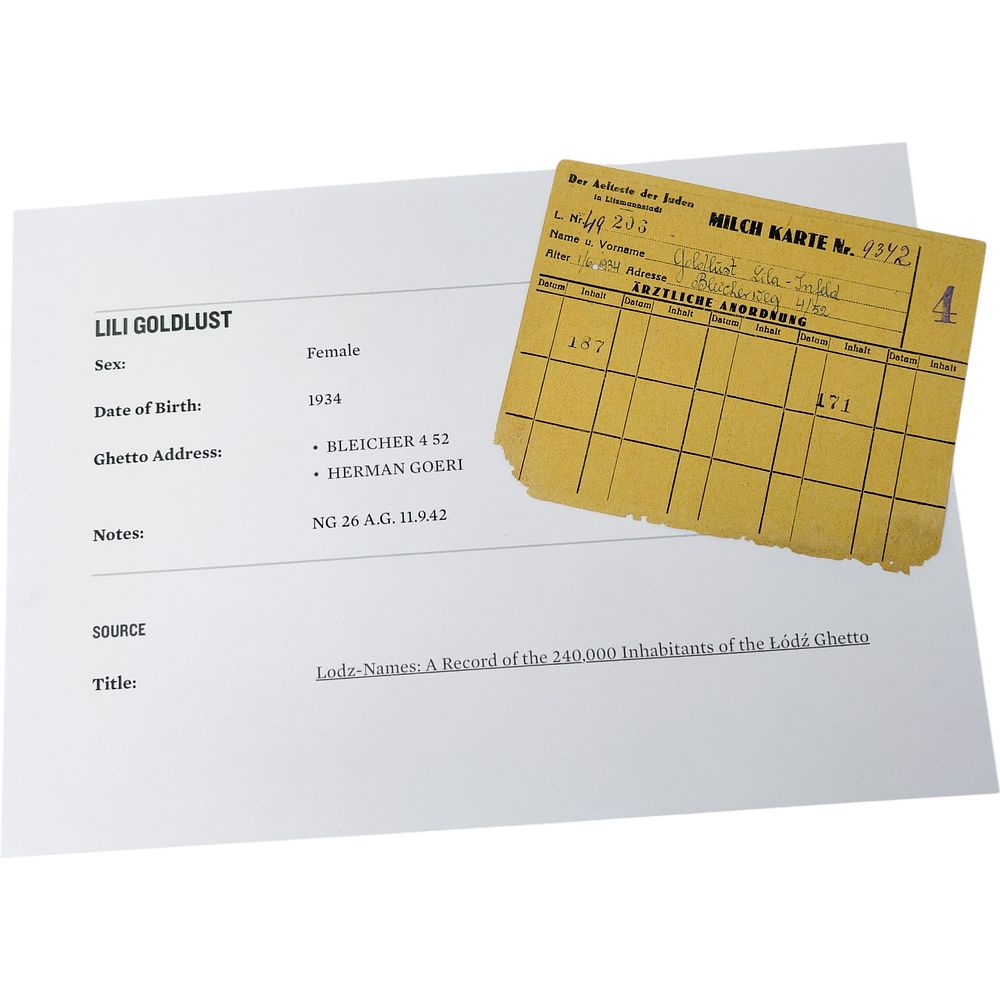
Litzmannstadt (Lodz) Ghetto Ration Card for Lili Goldlust - Ghetto-issued ration cards printed on card stock in yellow, each headed ”Der Aelteste der Juden in Litzmannstadt.” Milch Karte (milk card) numbered 9342, recording the name Goldlust Lila-Infeld, a birth date of 1/6 1934, and an address at Bleicherweg 4/52, with entries in the aerztliche Anordnung grid. Back shows Nahrungsmittel-Karte (food ration card) numbered 262036, printed with distribution rules and a series of tear-off ration numbers along its edge, bearing an office stamp and signature. Accompanying the cards is a printed research reference sheet citing ”Lodz-Names: A Record of the 240,000 Inhabitants of the Lodz Ghetto, ” listing the same individual - Lili Goldlust, female, born 1934, residing at Bleicher 4/52 and Herman Goeri - with a reference notation ”NG 26 A.G. 11.9.42.” These cards document the tightly controlled rationing system imposed on Jewish residents of the Lodz (Litzmannstadt) Ghetto under the Jewish Council administration, where food and milk allotments were tracked individually by card number, name, and address. The Lodz (renamed Litzmannstadt by the German occupation authorities) Ghetto, established in 1940, was the second-largest Jewish ghetto in occupied Poland, confining over 200,000 people under the nominal administration of the Jewish Council (Judenrat) headed by Mordechai Chaim Rumkowski, which the Germans used to enforce rationing, labour conscription, and later deportation. Food and milk allocations, especially for children, were minimal and strictly documented through individual ration cards such as this, reflecting the chronic starvation conditions engineered within the ghetto. The reference to ”Lodz-Names, ” a postwar documentation project compiling ghetto residency records from surviving administrative sources, indicates this card has been cross-referenced to establish the identity and fate of the named child, Lili Goldlust, born 1934. Most ghetto inhabitants, including the majority of children, were deported to Chelmno or Auschwitz-Birkenau during the ghetto's liquidation in 1944. Established in the Warthegau region of occupied Poland in early 1940, the Lodz Ghetto held over 200,000 Jews under the Judenrat administration of Mordechai Chaim Rumkowski, who oversaw internal rationing and labour conscription enforced by the German occupation authorities. Milk and food cards issued to individual residents, particularly children, reflect the severely restricted caloric allotments that produced widespread malnutrition and death within the ghetto. The cross-reference to ”Lodz-Names, ” a postwar compilation drawn from surviving ghetto administrative records, allows individual residents such as the child named here to be traced through the ghetto's documentary record. The great majority of the ghetto's population, including most children, were deported to the Chelmno extermination camp or to Auschwitz-Birkenau during the ghetto's dissolution in 1944.