Bidspirit auction | Lodz Ghetto Food Ration Card
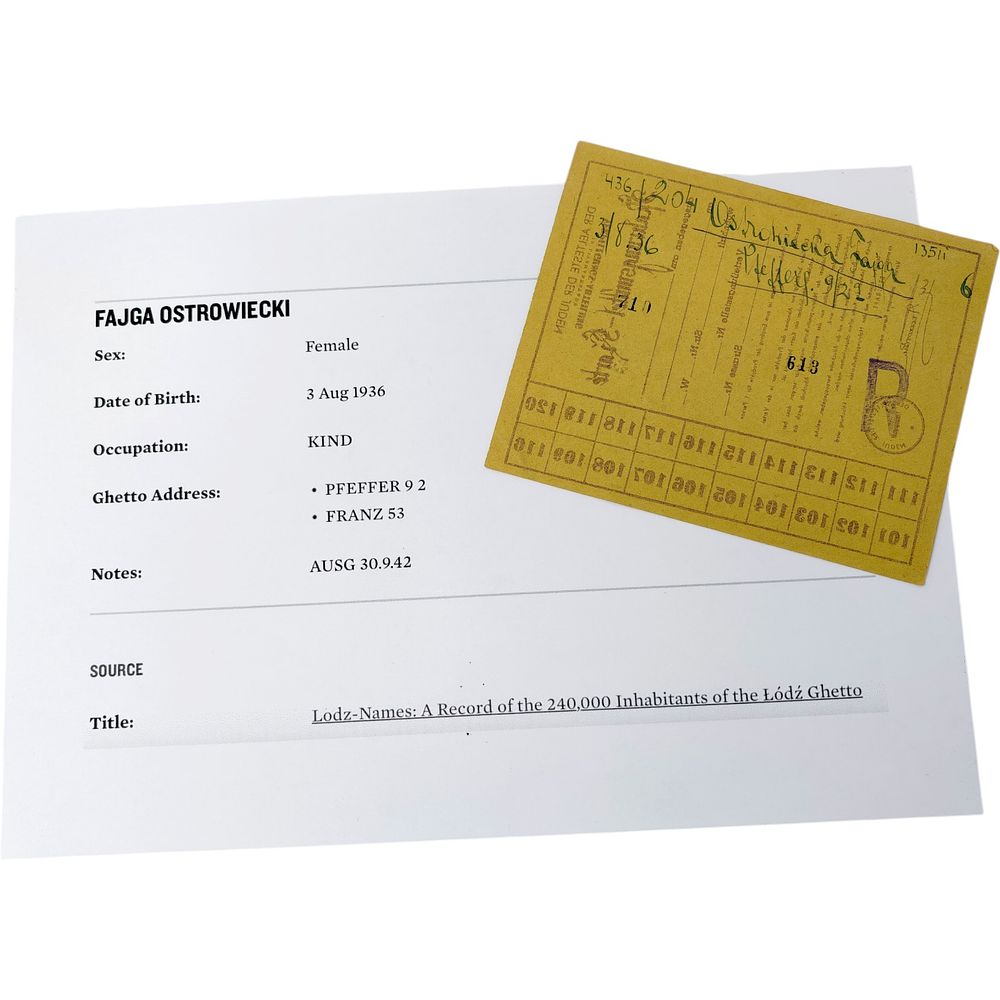
Lodz Ghetto Food Ration Card (Nahrungsmittel-Karte) with Identification Research Sheet - A printed ration card issued by the Jewish administrative authority of the Lodz (Litzmannstadt) Ghetto, headed ”Der Aelteste der Juden in Litzmannstadt, Verpflegungs-Abteilung” with the printed title ”Nahrungsmittel-Karte, ” a numbered series stamp, a facsimile signature, and a circular administrative stamp. The reverse carries handwritten entries including a name, address, registration numbers, and a date, along with a grid of printed reference numbers used for ration distribution. Accompanying the card is a printed research page citing the published record ”Lodz-Names: A Record of the 240,000 Inhabitants of the Lodz Ghetto, ” giving a name, sex, date of birth, occupation, ghetto addresses, and a notation dated September 1942. The Lodz Ghetto, established by German occupation authorities in the city renamed Litzmannstadt, was administered internally by an appointed Jewish council under Mordechai Chaim Rumkowski, which issued ration cards such as this one to control the distribution of food and daily provisions to the confined population. Such cards, tied to individual residents through registration numbers and addresses, are among the surviving bureaucratic records documenting daily life and administration within the ghetto. The Lodz Ghetto, sealed in early 1940, was the second-largest Jewish ghetto established by Nazi Germany in occupied Poland, ultimately confining over 160,000 people under conditions of severe overcrowding, forced labour, and chronic food shortages. Its internal Jewish administration, the Aeltestenrat led by Chaim Rumkowski, operated a rationing bureaucracy that issued cards such as this to regulate the meagre food allotments permitted by German authorities, making survival dependent on registration and documentation. The September 1942 notation falls within the period following the mass deportations of that year, when large numbers of ghetto inhabitantsparticularly children, the elderly, and the sickwere sent to the Chelmno extermination camp. The ”Lodz-Names” record cited references postwar documentation efforts to reconstruct the identities of the ghetto's population from surviving registers and cards. The Lodz Ghetto, sealed in early 1940 in the city renamed Litzmannstadt by German occupation authorities, became the second-largest ghetto in occupied Poland, confining over 160,000 Jews under conditions of severe overcrowding and chronic hunger. Its internal Jewish administration, the Aeltestenrat headed by Mordechai Chaim Rumkowski, issued ration cards such as this to control the distribution of the meagre food allotments permitted by the Germans, tying survival directly to registration and bureaucratic documentation. The September 1942 date falls shortly after that year's mass deportations, in which thousands of children, the elderly, and the sick were sent from the ghetto to the Chelmno extermination camp. The cited ”Lodz-Names” record reflects postwar efforts to reconstruct the identities of ghetto inhabitants from surviving administrative registers.