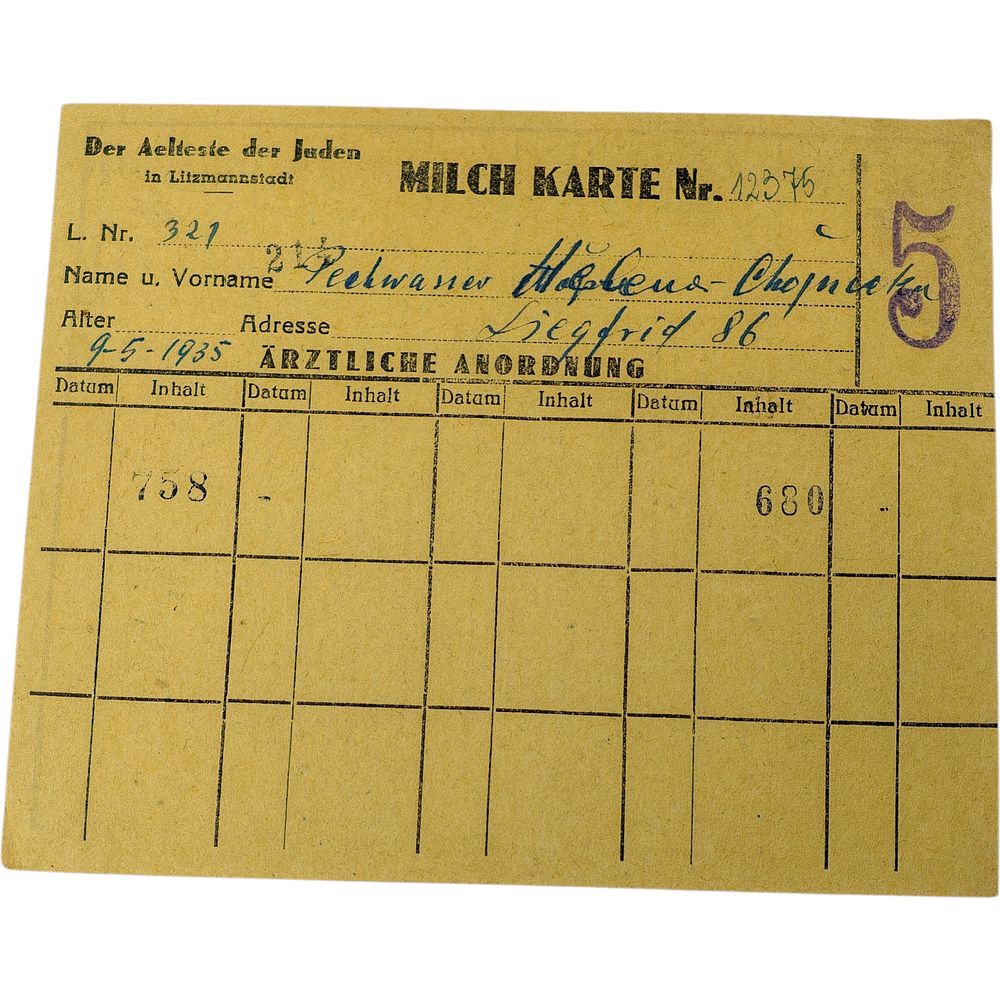
Bidspirit auction | WWII Litzmannstadt (Lodz) Ghetto Ration
WWII Litzmannstadt (Lodz) Ghetto Ration Card - Judenrat Issue - A printed ration card issued under the authority of ”Der Aelteste der Juden in Litzmannstadt” (The Eldest of the Jews in Litzmannstadt), the Jewish Council administering the ghetto in German-occupied Lodz. One side is headed ”Milch Karte Nr. 12375” with handwritten entries for a name, address (”Siegfried 86”), a date, and issue numbers 758 and 680 stamped in the ledger grid; a purple handwritten ”5” appears in the corner. The other side is headed ”Nahrungsmittel-Karte” (foodstuffs card), printed with a numbered coupon grid (101-120), instructional text on distribution and penalties for misuse, a circular stamp reading ”Der Aelteste der Juden in Litzmannstadt, ” and a signature. Litzmannstadt was the German-imposed name for Lodz following its 1939 annexation, and its ghetto, established the same year, became one of the largest in occupied Poland. Rationing of food and milk within the ghetto was administered through the Jewish Council under Mordechai Chaim Rumkowski, with cards of this type controlling the limited allotments distributed to registered residents. This ration card documents the tightly controlled subsistence system imposed on the roughly 160,000 Jews confined to the Lodz ghetto from 1940, one of the longest-surviving Jewish ghettos under German occupation, liquidated only in 1944. The Jewish Council (Judenrat), headed by Mordechai Chaim Rumkowski and formally titled ”Der Aelteste der Juden, ” administered internal affairs including labour, housing, and the distribution of severely restricted food and milk allocations through numbered coupon cards such as this one. Such documents functioned as instruments of survival and control, with strict penalties for misuse reflecting the German authorities' use of the ghetto administration to manage scarcity and enforce compliance among the confined population. This ration card documents the food-control system imposed on the roughly 160,000 Jews confined to the Lodz ghetto, renamed Litzmannstadt by German occupying authorities following the 1939 annexation of the city. Internal administration, including the rationing of food and milk, was delegated to the Jewish Council (Judenrat) under its head, Mordechai Chaim Rumkowski, who bore the title ”Der Aelteste der Juden in Litzmannstadt.” Established in 1940, the ghetto became one of the largest and longest-surviving in German-occupied Poland, sustained in part through forced labour production, before its liquidation in 1944 when most remaining inhabitants were deported to Auschwitz-Birkenau and Chelmno. Cards such as this regulated the meagre allocations available to registered residents amid conditions of severe hunger engineered by the occupation.