Bidspirit auction | WWII Litzmannstadt Ghetto Milk Ration
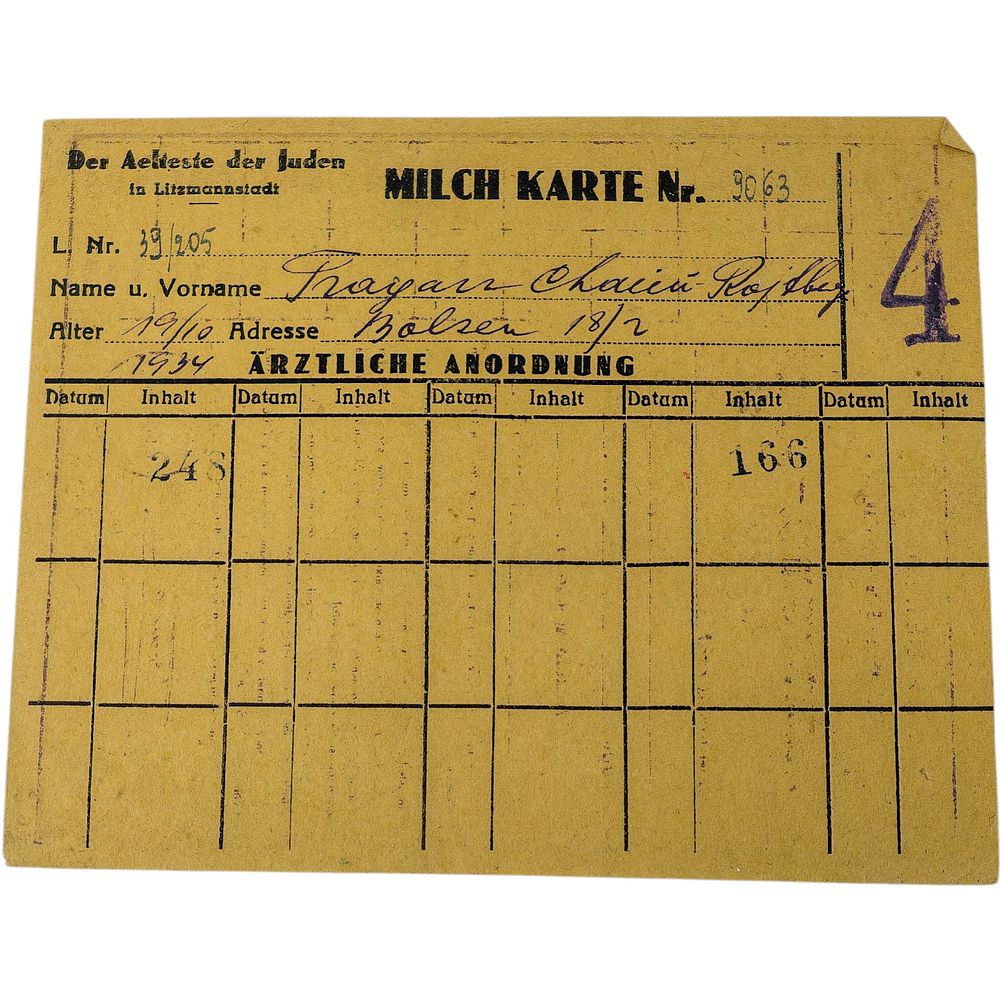
WWII Litzmannstadt Ghetto Milk Ration Card - A printed ration card issued by ”Der Aelteste der Juden in Litzmannstadt” (Jewish Council of Elders of the Litzmannstadt/Lodz Ghetto), headed ”Milch Karte” with a printed number and a handwritten name, age, and address filled in along with a large hand-numbered digit. The reverse carries a numbered coupon grid for staged collection along with printed distribution regulations for a ”Nahrungsmittel-Karte” (food ration card), a handwritten registration number, an official round stamp of the Council of Elders, and a signature. Such cards were part of the internal food-rationing system administered by the Jewish Council within the ghetto, used to regulate and record the distribution of scarce foodstuffs, including milk, to registered residents. The Lodz Ghetto (renamed Litzmannstadt by the German occupying authorities) was established in 1940 and became the second-largest Jewish ghetto in occupied Poland, holding over 160,000 people at its height. Internal administration, including the rationing of food, was delegated to the Jewish Council of Elders under Chaim Rumkowski, which issued cards such as this to control the distribution of severely limited supplies like milk, often prioritised for children, the sick, and the elderly. Chronic starvation was a defining feature of ghetto life, and such documents survive as records of the bureaucratic mechanisms through which scarcity was administered under German occupation before mass deportations to Chelmno and Auschwitz emptied the ghetto in 1944. The Lodz Ghetto, renamed Litzmannstadt by the German occupying authorities, was established in 1940 and became the second-largest Jewish ghetto in occupied Poland, holding over 160,000 people at its height. Internal administration, including food rationing, was delegated to the Jewish Council of Elders under Chaim Rumkowski, which issued cards such as this to regulate distribution of severely limited supplies like milk, often prioritised for children, the sick, and the elderly. Chronic starvation was a defining feature of ghetto life, and such documents survive as records of the bureaucratic mechanisms through which scarcity was administered before mass deportations to Chelmno and Auschwitz emptied the ghetto in 1944.