Bidspirit auction | Litzmannstadt (Lodz) Ghetto Milk Card
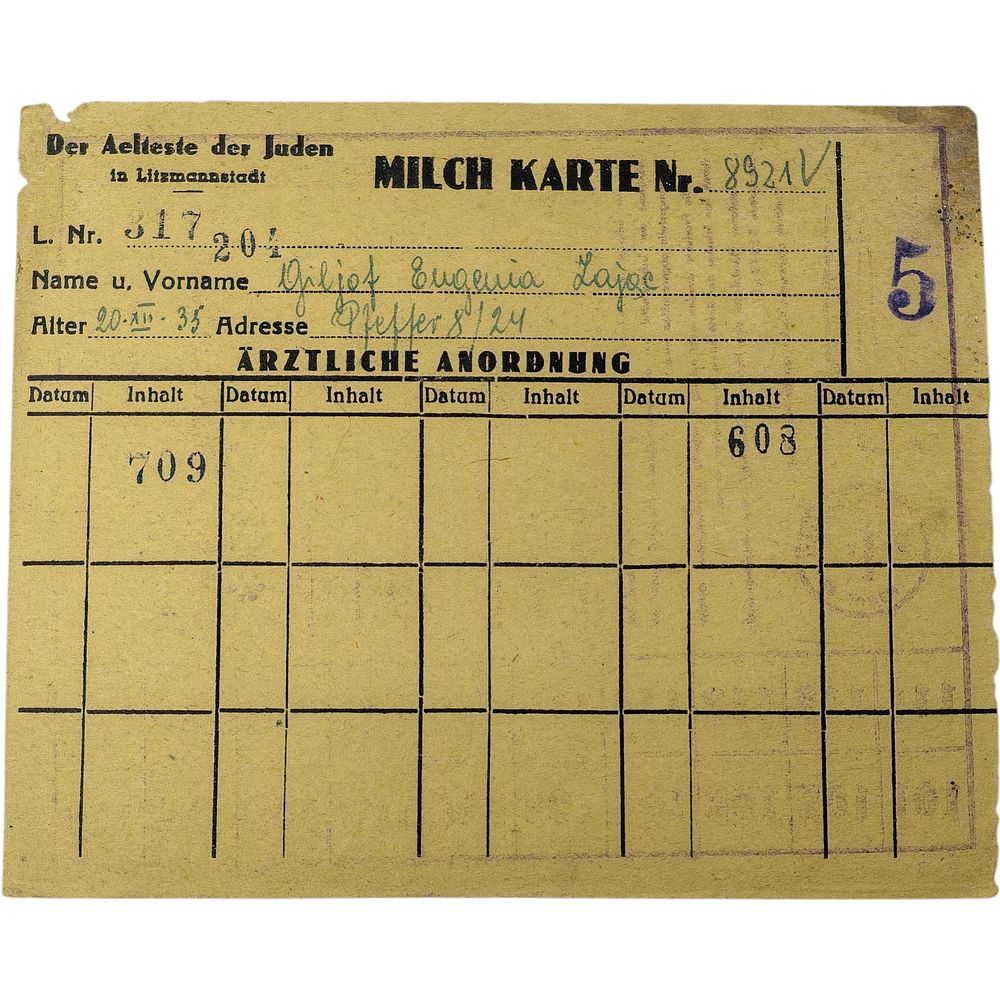
Litzmannstadt (Lodz) Ghetto Milk Card - Milch Karte Issued by Der Aelteste der Juden - A ration card printed for the Litzmannstadt Ghetto administration, headed ”Der Aelteste der Juden in Litzmannstadt” and printed ”MILCH KARTE Nr. 8921”. The front is completed in ink with an L. Nr., a name and given name, an age/birthdate, and an address, along with a ledger of dates and entry numbers under the heading ”Aerztliche Anordnung” (medical directive), with a numeral 5 stamped in the corner. The other side is printed as a general provisions distribution card (”Verpflegungs-Abteilung”), with printed regulations regarding use of the card, a numbered ration grid, a printed circular stamp reading ”Der Aelteste der Juden in Litzmannstadt”, and a signature. The Litzmannstadt Ghetto, the German-imposed name for the Lodz Ghetto, was administered by a Jewish Council (”Der Aelteste der Juden”) under Chaim Rumkowski, which issued ration cards controlling distribution of food including milk, generally reserved for children, the elderly, or the ill. Surviving ration documentation of this kind provides a direct record of the bureaucratic control of daily sustenance imposed on ghetto inhabitants during the German occupation of Poland. Milk was among the most tightly rationed provisions in the Litzmannstadt Ghetto, allocated by medical directive to children, nursing mothers, the elderly, and the sick under the ghetto administration headed by Chaim Rumkowski. The German civil authorities relied on this Jewish Council to organise internal distribution of scarce food, embedding the ghetto's population in a system of enforced scarcity and close bureaucratic surveillance from 1940 until its liquidation in 1944. Such cards, individually issued and tracked through numbered entries, document the mechanisms by which daily survival was regulated for the roughly 200,000 Jews confined in the ghetto, the great majority of whom did not survive the war. Milk was among the most tightly rationed provisions in the Litzmannstadt Ghetto, allocated by medical directive to children, nursing mothers, the elderly, and the sick under the ghetto's Jewish Council, headed by Chaim Rumkowski as ”Der Aelteste der Juden.” The German civil administration relied on this council to organise internal distribution of scarce food, embedding the ghetto's population in a system of enforced scarcity and close bureaucratic surveillance following the German occupation of Poland from 1940 until the ghetto's liquidation in 1944. Individually issued and tracked through numbered entries, such cards document the mechanisms by which daily survival was regulated for the roughly 200,000 Jews confined there, the great majority of whom did not survive the war.