Bidspirit auction | Lodz Ghetto Milk Ration Card
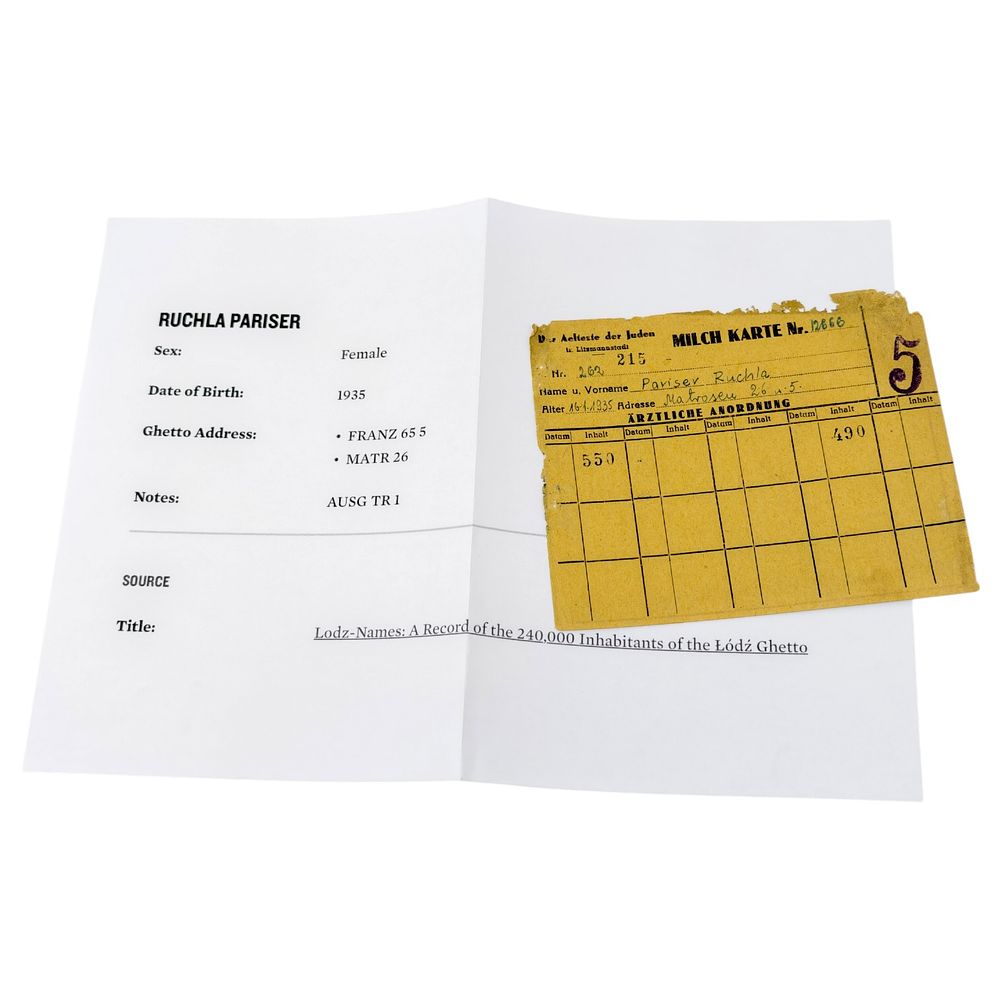
Lodz Ghetto Milk Ration Card (”Milch Karte”) Issued to Ruchla Pariser - Lodz Ghetto Milk Ration Card (”Milch Karte”) Issued to Ruchla Pariser A printed ration card headed ”Der Aelteste der Juden in Litzmannstadt” (Office of the Eldest of the Jews in Litzmannstadt, the German-imposed name for Lodz), designated ”Milch Karte Nr. 12666”. The card is filled in by hand for ”Pariser Ruchla”, born 16.1.1935, residing at Matroseu 26 m.5, with a printed ”Aerztliche Anordnung” (medical directive) grid recording ration entries including quantities of 550 and 490. A purple numeral ”5” is stamped at upper right. The card is accompanied by a modern printed research sheet citing the source ”Lodz-Names: A Record of the 240,000 Inhabitants of the Lodz Ghetto”, listing Ruchla Pariser's sex, date of birth, ghetto address, and file notations. The Lodz Ghetto, established by German occupation authorities in 1940 in the renamed city of ”Litzmannstadt, ” was administered internally through the Jewish Council (Judenrat) headed by the ”Eldest of the Jews, ” Chaim Rumkowski, whose office issued ration cards controlling the severely limited food supplies allotted to the ghetto's population. Milk rations of this kind were typically restricted to children, the elderly, and the ill, allocated under medical directive amid conditions of chronic malnutrition that claimed thousands of lives before mass deportations to Chelmno and Auschwitz-Birkenau emptied the ghetto in 1944. Such surviving documents, tied to named individuals, form part of the postwar documentary effort to record the identities and fates of the roughly 204,000 Jews who passed through the Lodz Ghetto. The Lodz Ghetto was the second-largest Jewish ghetto established by Nazi Germany in occupied Poland, sealed in early 1940 and administered under Chaim Rumkowski's Judenrat, which issued ration cards such as this to regulate the meagre food supplies permitted to inhabitants. Milk allocations, restricted to children, the sick, and the elderly under medical order, reflect the chronic starvation conditions that pervaded the ghetto before its liquidation in 1944, when most survivors were deported to Chelmno and Auschwitz-Birkenau. Documents naming individual residents, like this one issued to Ruchla Pariser, have become important postwar tools for reconstructing the identities and fates of the ghetto's population, most of whom did not survive.