Bidspirit auction | Slashchev Ya. Crimea in 1920
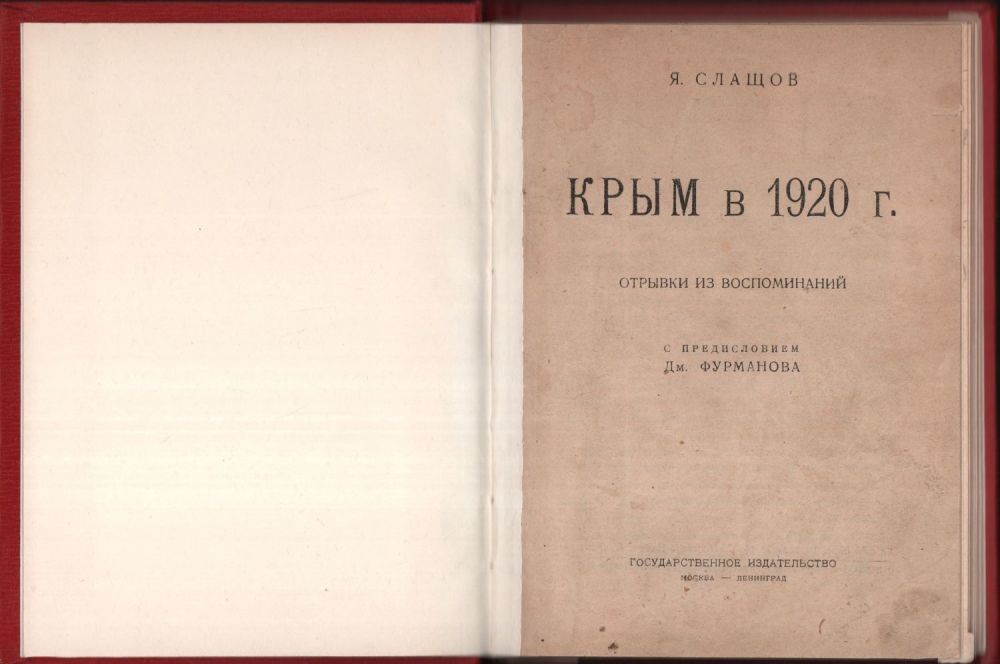
Slashchev Ya. Crimea in 1920 Excerpts from the memoirs. - M-L. State publishing house. b / g. 148 p. Owner's hard cover, size 13.5 x 18.3 cm Good condition, notes in the text. Yakov Alexandrovich Slashchev-Krymsky (December 29, 1885 [January 10, 1886] - January 11, 1929, Moscow) was a Russian and Soviet military commander and military educator, Lieutenant General, and an active participant in the White movement in southern Russia. In 1905, he graduated from the Pavlovsk military school, from which he was released as a Lieutenant in the Finnish life guard regiment. On December 6, 1909, he was promoted to Lieutenant. In 1911, he graduated from the Nikolaev military Academy in the 2nd category, without the right to be assigned to the General staff because of an insufficiently high average score. On March 31, 1914, he was transferred to the page corps with the appointment of a Junior officer and enlistment in the guards infantry. In the page corps, he taught tactics. December 27, 1919 at the head of the corps took the fortifications on the Perekop isthmus, preventing the capture of the Crimea by the Reds. In the winter of 1919-1920-head of defense of the Crimea. Since February 1920-Commander of the Crimean corps (former 3 army). On March 25, 1920, he was promoted to Lieutenant General with the appointment of commander of the 2nd army corps (former Crimean). On April 5, 1920, General Slashchev submitted a report to the commander-in-chief of the Russian Army in the Crimea and Poland, General P. N. Wrangel, indicating the main problems at the front and with a number of proposals. Since may 24, 1920 commander of the successful white landing at Kirillovka on the coast of the sea of Azov. In August 1920, after the inability to eliminate the Kakhovsky red bridgehead, supported by large-caliber guns TAON (special purpose heavy artillery) of the Reds from the right Bank of the Dnieper, he submitted his resignation and was recalled to the command of the commander-in-chief. August 18, 1920 by Order of General Wrangel received the right to be called ”Slashchev-Krymsky”. In November 1920, as part of the Russian army, he was evacuated from the Crimea to Constantinople. He was fearless, constantly led the troops to attack by personal example. He had nine wounds, the last of which-a concussion in the head-was received at the Kakhovsky bridgehead in early August 1920. Many of his injuries were sustained almost on his feet. To reduce the unbearable pain from a stomach wound in 1919, which did not heal for more than six months, he began to inject himself with an analgesic — morphine, then became addicted to cocaine, which gave him the ”fame” of a drug addict. After emigration, he lived in Constantinople, engaged in gardening and vegetating in poverty. In Constantinople, he sharply and openly condemned the Commander-in-chief and his staff, for which, by the verdict of the ”court of honor”, he was dismissed from service without the right to wear a uniform. In response to the court's decision, in January 1921, he published the book ”I Demand the court of society and publicity. Defense and surrender of the Crimea (Memoirs and documents)”. On November 3, 1921, on the anniversary of the capture of the Crimea, the Central Executive Committee of the RSFSR declared Amnesty to participants of the White movement. Slashchev in Constantinople entered into negotiations with the Soviet authorities and was granted Amnesty. On November 21, 1921, with the help of a former sailor and volunteer recruited by the Cheka, Batkin, along with white Cossacks, returned to Sevastopol, from where he left for Moscow in Dzerzhinsky's private car. He appealed to the soldiers and officers of the Russian Army to return to Soviet Russia. In 1924, he published the book ” Crimea in 1920 Excerpts from memories.” Since June 1922-teacher of tactics of the school of the comsostav ”Shot”. On January 11, 1929, Yakov Slashchev was killed in Moscow in his room at the school by three shots at point-blank range from a revolver. The killer is a cadet of the Moscow infantry school named after him. Unshlikht Lazar L. Kolenberg.