Bidspirit auction | Marian Huttner Grunbaum (1894-2000)
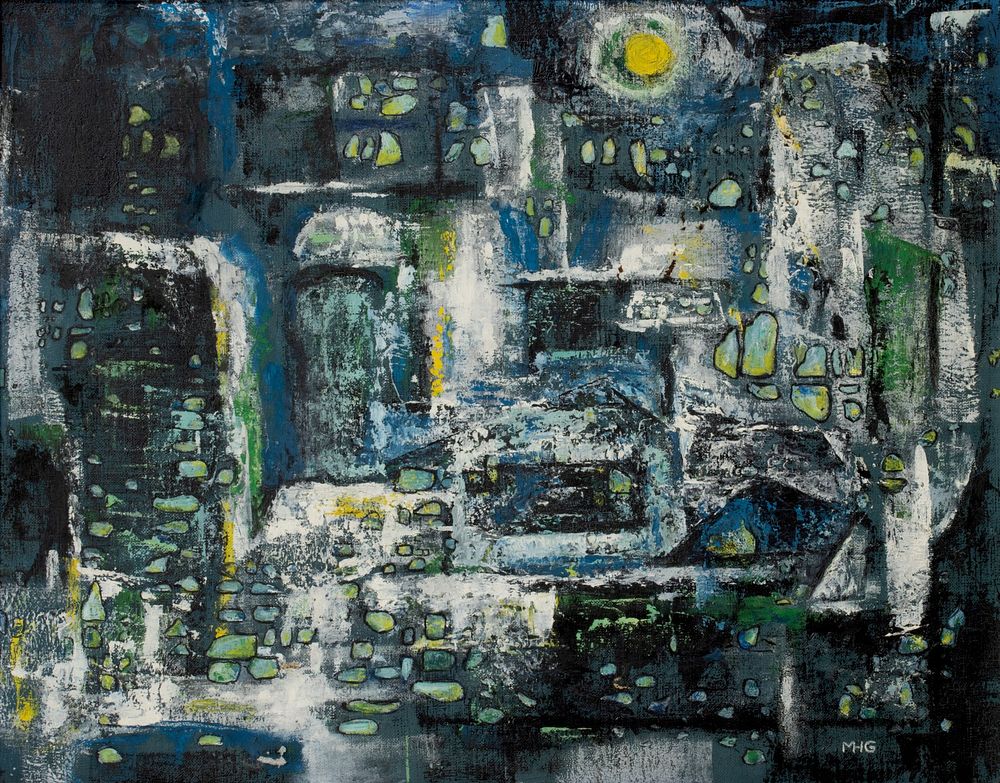
Marian Huttner Grunbaum (1894-2000) - MARIAN HUTTNER GRUNBAUM (1894-2000) OIL ON CANVAS BOARD. Marian Huttner Grunbaum (1894-2000) Let There be Apathy Under the Stars 1953 The oil on canvas in the artist's unique painting technique is signed by monogram lower right. It was purchased by Smith College at a traveling exhibition of Texas artists' work in 1953 and bears a related label verso. In a 1980 oral history interview conducted for the Smithsonian Institution's Archives of American Art, Marian Hettner Grunbaum discussed the origins of this present painting, Let There Be Apathy Under the Stars (1953), describing it as an early and stylistically distinct work in her career. She explained that the painting emerged from a process involving chance effects on a painted surface allowed to dry overnight, a method she associated with Surrealist practices. From these accidental patterns, Grunbaum envisioned a devastated urban landscape, ' a destroyed city, where the moonlight shone through the gaping holes that once had been windows , ' a vision that informed the painting's somber mood and imagery. Grunbaum noted that the work was included in the traveling Texas General exhibition and was acquired directly from that exhibition by Smith College after being seen by art historian Henry-Russell Hitchcock. Reflecting later on the painting, she characterized it as part of an earlier, more emotionally driven phase of her work, developed when she studied with Robert Preusser, while maintaining that it remained, in her view, 'a very good painting' despite its early style. Source: Marian Hettner Grunbaum, oral history interview by Sandra Curtis, Archives of American Art, Smithsonian Institution, transcript excerpt. Marian Hettner Grunbaum was born in Dresden, Germany. She began painting as a child, although her family did not encourage her artistic pursuits; instead, she aspired to be an accomplished violinist. Grunbaum studied humanities at the University of Heidelberg, where she met her husband, a Jewish doctor. The threat of World War II prompted her family to emigrate to the United States and they settled in Houston in 1937 where Marian played the violin with the Houston Symphony for three years, contributing to the orchestra's early development. After her children left home, Grunbaum returned to painting, enrolling in a design course at the University of Houston taught by Robert Preusser. In the previously mentioned interview, she mentioned that critics often trace her painting style back to the Bauhaus, particularly in terms of her understanding of color effects and design principles. She acknowledged that the Bauhaus taught her the importance of color theory and the logical rules of art, which she incorporated into her work. Her approach to color involves using complementary and adjacent colors to create a sense of vibrancy, transparency, and softness, which aligns with the Bauhaus emphasis on the interplay of colors and design. Canvas measures 16 x 20 with a framed size of 22 x 25.75 inches. Without proof of exemption, be aware that internet sales tax applies to all Internet transactions and local sales tax may apply to local pick-up transactions. We happily provide seamless in-house packing and shipping services on nearly everything we sell. Until further notice, we cannot offer international shipping in-house. Dimensions Canvas measures 16 x 20 with a framed size of 22 x 25.75 inches. Condition Very good original untouched condition. There are no issues of relining, scratches, losses, repairs, in-painting or touch-up, as confirmed under UV light. Provenance Private Collection Kansas City. Skinner Auction, Boston, 2007.