Bidspirit auction | Albert Bloch (Kansas / Missouri,
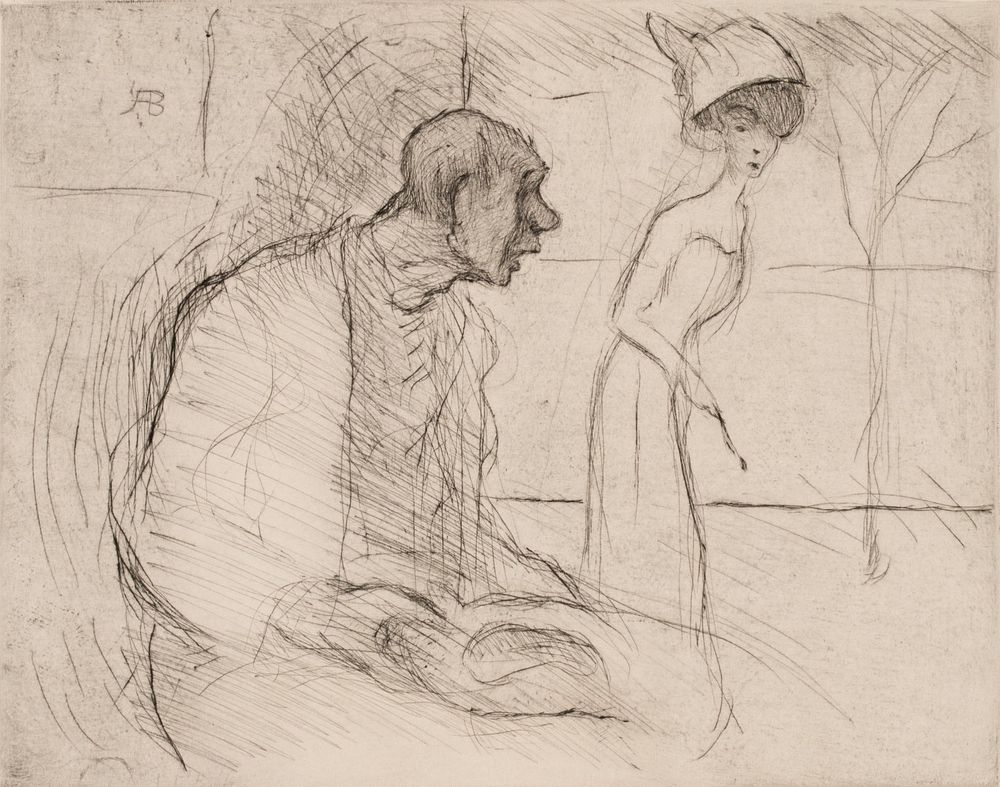
Albert Bloch (Kansas / Missouri, 1882-1961) - ALBERT BLOCH (1882-1961) PENCIL SIGNED DRYPOINT. Albert Bloch (Kansas / Missouri, 1882-1961) Circa 1910 The fine, rare and early drypoint is signed by Albert Bloch in pencil below the image lower right, and initialed in the plate upper left. Works by Albert Bloch rarely appear at auction. No record of this image having ever been offered could be found in any sources. To find an example from this earliest period in near mint condition is remarkable. Dr, David Cateforis Chair, History of Art Department, KU University in Lawrence, Kansas has provided an essay on the drypoint printmaking technique and the historical context of this print. A significant figure in the history of 20th-century art in the American Midwest, Albert Bloch headed the Department of Drawing and Painting at the University of Kansas from 1923 to 1947. His main claim to art-historical fame, however, is as the only American artist to exhibit with the Munich-based expressionist group der Blaue Reiter (the Blue Rider) in 1911 and 1912. Led by Vasily Kandinsky and Franz Marc, the Blue Rider artists generally conceived of art as an elevated, spiritual calling - an attitude that Bloch embraced from the time of his association with the group. Born and raised in Saint Louis, Bloch studied at the Saint Louis School of Fine Arts from 1898-1900 and started his career as an illustrator, cartoonist, and caricaturist, principally for the weekly Saint Louis magazine, The Mirror. He moved with his family to Munich in 1909 and continued to work as an illustrator for the next few years while he taught himself to paint by studying the Old Masters and modern French and German painting. Among the works Bloch created during his early years in Munich were several prints executed with the drypoint technique. In drypoint, the artist cuts lines into a metal printing plate using a needle with a sharp metal or diamond tip. The needle raises ridges of metal along the sides of the cut called the burr. Ink inheres in the incised lines and burr after the surface of the inked plate is wiped clean. The artist lays damp paper over the plate and runs it through a press to transfer the ink to the paper. The burr produces a slightly fuzzy line when printed. Bloch's observation of people in the streets of Munich's bohemian Schwabing quarter may have inspired his drypoint The Princess and the Beggar (1910). The setting is an urban environment with a background wall at the left and a spindly tree at the right. Bloch placed his early monogram, a combined blocky A and B, in the window. The striking composition features the imposing figure of a male beggar seated in the foreground, his hat in hand resting on his lap. With a hollow-eyed, open-mouthed, pleading expression, he looks in profile toward the willowy princess passing by in the middle ground. An implied diagonal line runs from the beggar's right shoulder and shadowed bare head to the tip of the princess's oversize hat, emphasizing the contrast between their social and economic standing. The agitated lines around the beggar's back and head suggest his torment as the princess peers inscrutably in his direction. Will she help him or walk on by? Bloch provides no answer, inviting the viewer to imagine what will happen next. Image measures 8 x 10, sheet is 10 x 15 inches. Without proof of exemption, be aware that internet sales tax applies to all Internet transactions and local sales tax may apply to local pick-up transactions. We happily provide seamless in-house packing and shipping services on nearly everything we sell. Until further notice, we cannot offer international shipping in-house. Dimensions Image measures 8 x 10, sheet is 10 x 15 inches. Condition Very good condition, the full untrimmed sheet with deckle edges, not laid down, no damage, stain, punctures, tears or repair; framed to archival standards in acid free mounts.