Bidspirit auction | Important ”Early Consular” French 1st
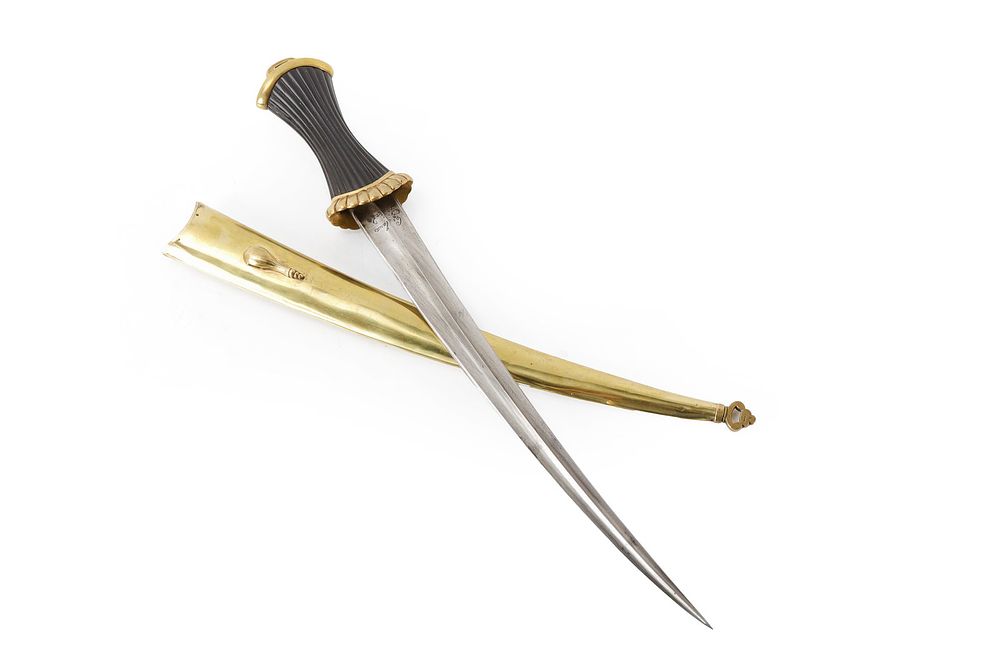
Important ”Early Consular” French 1st Empire Mameluke Poignard Dagger, c. 1801-1804 (Early Consular - Important ”Early Consular” French First Empire Mameluke Poignard Dagger, Circa 1801 - 1804 (Early Consular / Early Empire Period). The slightly curved blade is inscribed near the forte ”Coulaux Freres”, on the otherside of the dagger it reads ”manufacture de Klingenthal”. Blackened wooden handle with diagonal fluts. Brass knob held to the handle by two small nails and an orifice to let the safety cord pass. The end of the hilt is decorated with a small hollow hole bearing on one side the hallmark of the letter V for ”v?rifi?” and ”LE PAGE” om full, on the other side a ”B” for Boutet. Note: High-end officer and honorary versions were designed by legendary gunsmiths and artists, notably Nicolas-Noel Boutet (Versailles) and Jean Le Page (Paris), often bearing the Lepage or Versailles stamps as this example does. Coulaux & Cie was a renowned French manufacturer of swords, bayonets, and fencing foils. The Coulaux family operated the royal forge and sword factory at Klingenthal from 1801 to 1838. This piece dates to the rare Early Consular / Early Empire period. Most early Mameluke gear was entirely lost or destroyed during the disastrous Russian Campaign of 1812. Because of this loss, Napoleon ordered factories to reproduce these weapons in 1813. 1798 Egyptian Campaign: Napoleon Bonaparte defeated Egypt's ruling military caste, the Mamelukes, at the Battle of the Pyramids. Profoundly impressed by their fierce cavalry tactics and exotic weapons, Napoleon recruited a specialized squadron of these warriors and brought them back to France, they were integrated into the Chasseurs ? Cheval of the Imperial Guard. Their colorful Oriental uniforms and Middle Eastern arms became an absolute sensation in French high society. Historical Battles include; Battle of Shubra Khit (July 13, 1798) The first tactical clash where French infantry and gunboats successfully held off Mameluke (Ottoman) cavalry probing attacks on the march toward Cairo. Battle of the Pyramids (July 21, 1798) The decisive clash. Napoleon utilized ”divisional square” formations to completely shatter Murad Bey's elite Mameluke cavalry charges. This victory allowed Napoleon to capture Cairo and recruit defeated and volunteering Mamelukes into his own forces. Battle of Austerlitz (December 2, 1805) Their ultimate glory. The Mameluke squadron was unleashed alongside the Chasseurs ? Cheval to counterattack the Russian Imperial Guard cavalry. They broke through the Russian lines and captured over 100 prisoners. The Dos de Mayo Uprising (May 2, 1808) Deployed to Spain, the Mamelukes engaged in fierce, bloody urban warfare against Spanish insurgents on the streets of Madrid. Battle of Wagram (July 5-6, 1809) Engaged in massive, heavy cavalry charges against the Austrian Empire, securing a strategic French victory. The Russian Campaign (Winter 1812) The Mamelukes fought through Smolensk and Borodino. During the subsequent catastrophic winter retreat, the vast majority of the squadron's unique, original early-regime weaponry was lost or abandoned in the snow. The Reconstitution (1813) Having lost nearly all their standard equipment in Russia, a new wave of specialized weapons had to be frantically reproduced by imperial factories in 1813 to re-arm the surviving veterans. Measurements total length 52 cm; 22”L blade 36cm; 14”L Materials: Steel blade, brass scabbard and mounts. Ancienne collection de Monsieur P. Benoit, qui a re?u cette arms de Monsieur SAINT AUBIN en octobre 1937, Ex-Laguna Beach Fine Art Collection Condition: Fantastic overall presentation, with age related wear. Brass mounts and scabbard show rubbing, small surface marks, and handling wear. Inscription remains visible.