Bidspirit auction | Rare: Machzor for Shalosh Regalim,
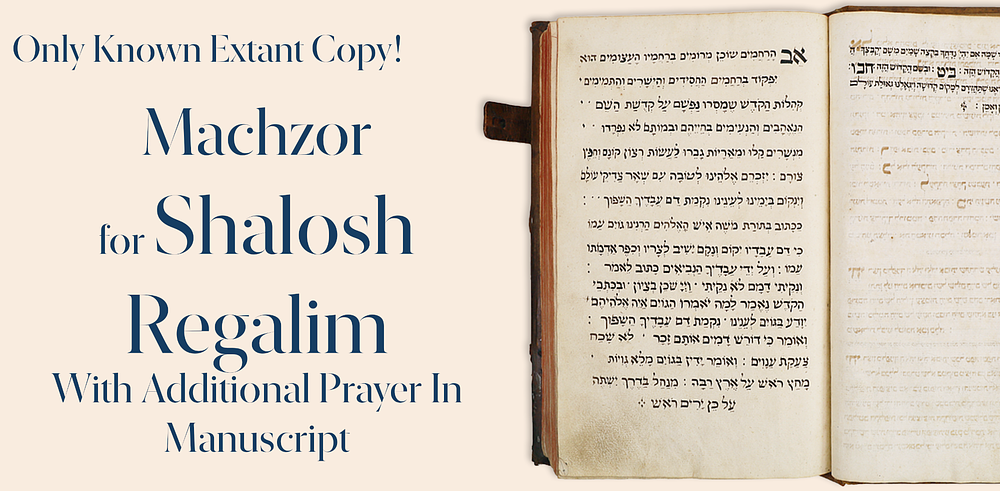
Rare: Machzor for Shalosh Regalim, Sulzbach 1782 - With Additional Prayer In Manuscript - Only Known Extant Copy - Presented here is the Sulzbach edition of the Machzor for Shalosh Regalim (i.e. Sukkot, Pesach, Shavuot), printed in 1782. Although this edition is fairly common, this copy however is an exceptionally unique variant, and contains an additional two pages in manuscript. After pp. 45 the printer inserted four additional blank pages to be filled in by hand, only to continue on pp. 46. Two pages were left blank, and another two are filled with the “Av HaRachamim” prayer said before Mussaf, as well as another memorial prayer, as detailed below. To the best of our knowledge, this “blank-page” variant along with a remarkable Kinnah commemorating a pogrom in the Tach V’Tat era, is the only extant copy. During the Shacharis service, we find a moving prayer added in manuscript, intended to be said in addition to the standard “Av HaRachamim” prayer. It is unique to this copy only, and is not found in any other existing prayer book. The prayer provides vivid details into a major tragedy which had befallen the Jewish community of Pila (a suburb of Poznań), and gives us a true depiction of what actually occurred then. One stanza is particularly striking: “[They took] all our precious Holy books and Sifrei Torah and made them into shoes, whatever was leftover, they trampled and burned”. It is composed of ten four-line stanzas, each ending in a rhyme. Each beginning line spells out the name of the author: “Alexander Gutkind ben Moreinu Moshe HaKohen from Pila” - אלכסנדר גוטקינד בן מוהר”ר משה הכהן מק”ק פילא. In the early 20th century, a German publication named Tiferes Yisroel (Breslau, 1911), dedicated an entire chapter to this Prayer and its origin (pp. 872-881). Researchers were very intrigued by this seemingly unknown passage, and were determined to discover more. The researcher, M. Brann relates that he had found an old Machzor printed in Hamburg in 1737. It contained an additional few pages of manuscript pages, this prayer among them. Upon further research in the archives of the Poznań Jewish Community, he discovered that Alexander Gutkind, who composed this prayer, was a well-respected member of the Pila community, who lived in the early-mid 1600’s. Also recorded in the community ledger, was a terrible massacre which took place in 1656 where 33 Jewish men, women and children were brutally killed. The Sifrei Torah were and holy artifacts were destroyed as well. One lone survivor of this massacre was R. Alexander Gutkind, who in turn composed this moving prayer. Based on the above research, it is clear that we have before us an extremely scarce and virtually unknown prayer documenting a pogrom which took place in the town of Pila near Poznań, just several years after the Chmielnicki massacres of 1648-49. It should be noted that other than the Machzor found by Brann in 1911, he was unaware of any other surviving copy of this prayer. We can safely assume that the Hamburg Machzor which he had seen did not survive the destruction of the Holocaust, thus rendering our copy the only extant copy in which this remarkable prayer is recorded. This Kinnah is recorded in Otzar HaShirah V’Hapiyut, Israel Davidson, The Univ. of Michigan Press, 1924. no. 3797, and in Sefer HaDimaot, Shimon Bernfeld, Vol. III, pp. 197, Berlin 1926. Both authors cite Tiferes Yisroel. They, too, never actually saw this Kinnah but relied on Brann as their only source. Interestingly, this edition was printed with the approbation of R. Yechezkel Landau of Prague, author of Noda B'Yehuda, who writes that his approbation is given on condition that the printer will not print anything derogatory to the King or the nations amongst whom they were living. As such, the standard “Av HaRachamim” prayer, which mentions the massacre of Jewish communities by Non-Jews during medieval times, was omitted from this edition. In the present copy however, it has been added in manuscript on one of the specially added pages, as mentioned above. In overall good condition, bound in original wooden binding. One leather clasp partially intact. Few old paper repairs, sometimes affecting text; leaf 7 lacking. Ancient ownership inscription seen on verso of pp. 237. [1], 45, [4]; 46-58, [8], 237, 11 pp.