Bidspirit auction | Classic: Teshuvos R. Levi Ibn
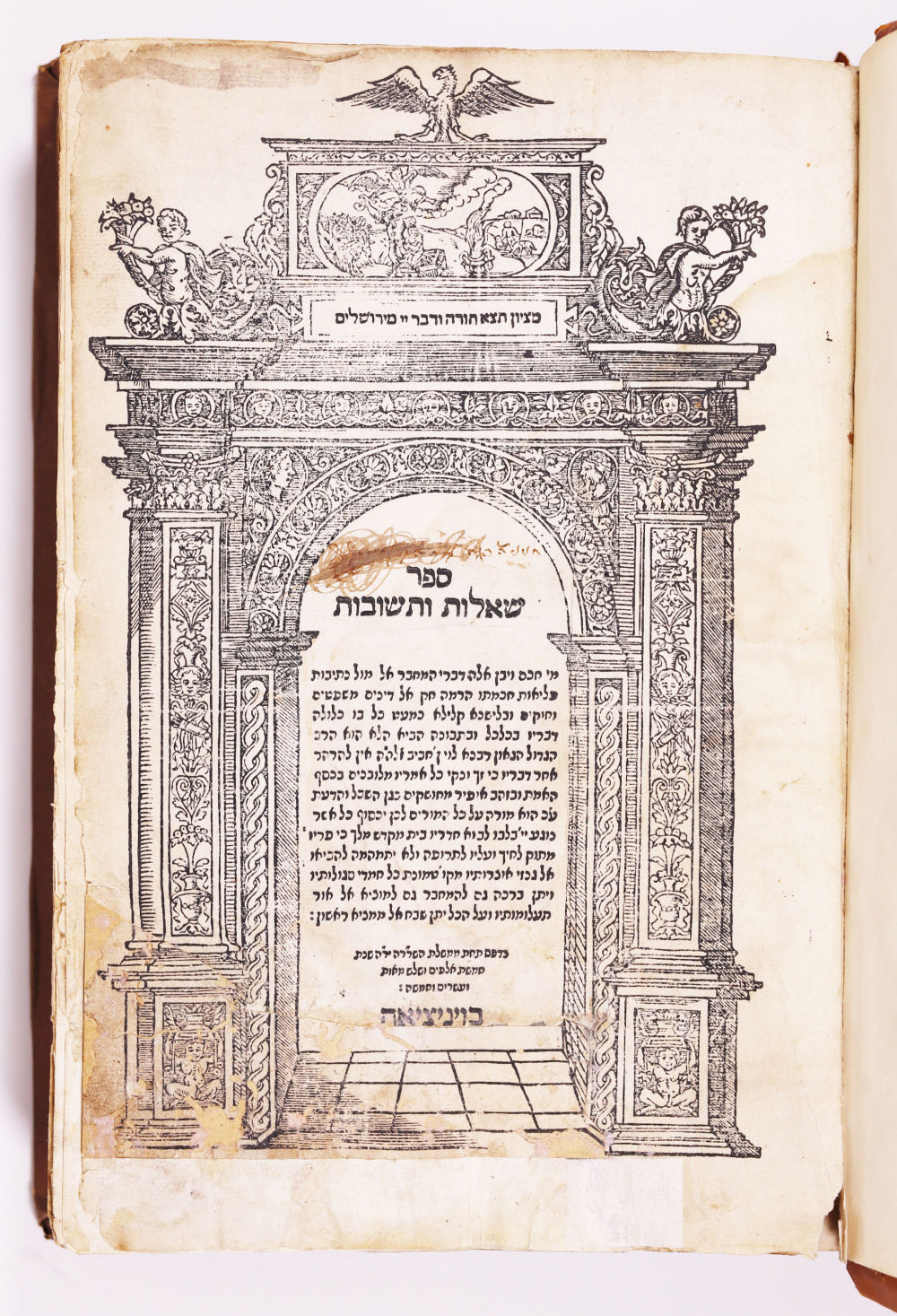
Classic: Teshuvos R. Levi Ibn Chaviv - Maharalbach, Venice 1565. First Edition. - The first edition of the fundamental responsa work by R. Levi Ibn Chaviv (c. 1480 – c. 1545), commonly known as the Ralbach. THE GREAT SEMICHA DEBATE - AS DISCUSSED IN THIS WORK During the period immediately following the Spanish exile, the Jewish masses exhibited an unusual expectation for the imminent Messianic redemption. The great suffering of Jews throughout the world, as well as the geo-political upheaval caused by Turkey’s aspirations for world domination over Christian Europe, were all regarded as a harbinger of better days being ushered in. A genuine yearning for penance manifested itself which, it was hoped, would accelerate the course of events leading to the Redemption. The awarding of Tiberias and its environs to Don Nasi also marked the first time that a central city in the Holy Land had now passed to exclusive Jewish control. Tiberias also marked the last time that a fully recognized Sanhedrin had been able to assemble in Israel. One of the various proposals towards this end, was the controversy surrounding the proposed renewal of the institution of semicha. According to Torah law, many judicial functions - among them the power to inflict corporal punishment - require that the court be composed of judges duly accredited with proper semicha ordination. The conferring of semicha on a rabbinic candidate was in turn part of an unbroken chain of ordinations reaching all the way back to Moses himself. This ordination was only considered to be valid if conferred in Eretz Yisroel. Unfortunately this ordination had become obsolete during the persecutions of the Romans in the 4th and 5th centuries. Should semicha be renewed, a penitent might then be able to appear before a duly ordained tribunal, confess his sins, accept the punishment of lashes, and then be freed of his sins. It was additionally argued that the advent of the Messiah was to be preceded by the appointment of duly ordained judges, as prophesied by Isaiah (1:26). There were numerous difficult halachic questions during that time period that a universally accepted Sanhedrin could decide upon for all Jewry. Among these questions were the status of conversos wishing to return to Judaism, issues of lost husbands and abandoned wives, Jewish apostates and informers, new technology, and increased Jewish immigration to Eretz Yisroel. Only a central rabbinic organization would have the authority to halachically deal with all these varied issues. Towards these ends, R. Yaakov bei Rav, venerated rabbi and rosh yeshiva in Safed, proposed in 1538 that the scholars of Safed, then the overwhelming majority of sages in Israel, should confer semicha upon him. He, in turn, would then be empowered to confer semicha upon others. R. Yaakov based his proposal upon a ruling of Rambam, Hilchos Sanhedrin 4:11, that even an unordained assembly comprised of all the sages of Eretz Yisroel had the powers of a duly ordained Sanhedrin, and they in turn could legally confer ordination to others. All the assembled sages in Safed unanimously and enthusiastically agreed to this proposal and ordained R. Yaakov, who then ordained an additional group of scholars, including R. Yosef Karo, R. Moshe Trani, and R. Levi ibn Chaviv. R. Levi ibn Chaviv was the rabbi of the small Jerusalem community and one of the outstanding scholars of that period. He had received his semicha in writing as he was not present at the ordination assembly. However, upon receiving this semicha, he refused to accept it, arguing that the entire process was invalid and had no real basis in halacha. Even Rambam had stipulated that all the sages of Eretz Yisroel had to consent in order to validate this semicha. Since the sages of Jerusalem had not participated in this consent, this ordination was invalid. The matter was debated back and forth several times without any clear result. R. Levi refused to retract his opposition, and R. Yaakov refused to declare his ordination invalid. This debate put a damper upon the semicha enthusiasm, and with the passage of time, the proposed renewal just withered away. The rabbis of Egypt had also disapproved of this rabbinic ordination, and looked askance at the establishment of a Sanhedrin at this juncture of time. Additionally, the rabbis of the Ashkenazic world also opposed such controversial moves at this point of history. Interestingly none of the disciples of R. Yaakov bei Rav, most notably R. Yosef Karo and R. Moshe Trani, alluded to the granting of semicha in the slightest way. Through their silence they attested to their confirmation of the negative position of R. Levi ibn Chaviv. By the time of R. Yaakov bei Rav’s death in 1546, the controversy surrounding the general acceptance and re-establishment of a universally accepted Sanhedrin had petered out. In overall good condition, with repairs to title page.