Bidspirit auction | Sefer Pischei Teshuvah - Yoreh
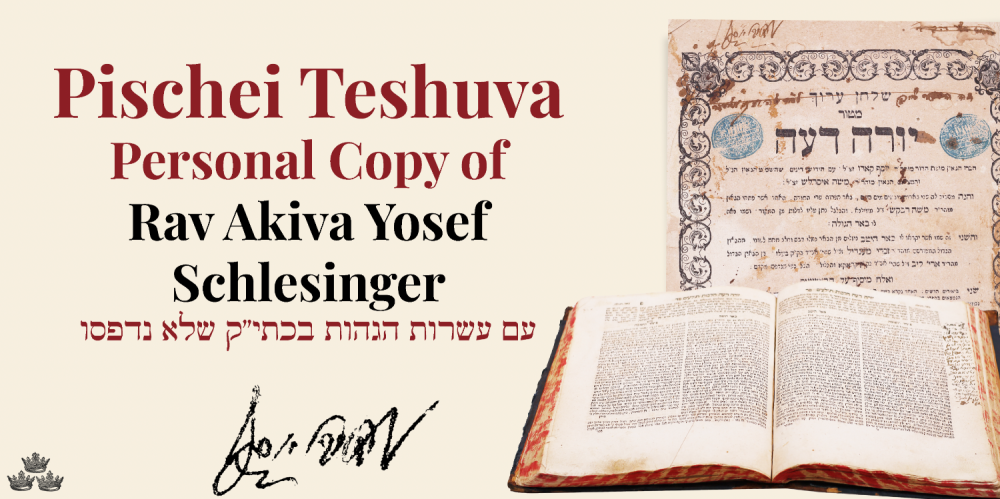
Sefer Pischei Teshuvah - Yoreh De'ah, Lemberg 1852. Personal Copy of R. Akiva Yosef Schlesinger - With Many Marginal Glosses. - Sefer Pischei Teshuvah - Yoreh De'ah, printed in Lemberg in 1852. Sefer Pischei Teshuvah was written by R. Avraham Zvi Eisenstadt (1812-1868) at a young age. It was first published in Vilna in 1836, and was met with high acclaim even amongst leading Torah scholars. R. Yosef of Slutsk - one of the leaders of the generation (1796-1864), was highly impressed by this work and said that ”this young man has been granted by heaven to write this important and much needed work” (See: Raboseinu Shebagolah, Vol. II pp. 247). R. Akiva Yosef Schlesinger (1835-1922) author of 'Lev Haivri' was born in Pressburg; the Chasam Sofer served as his Mohel at his Bris. He was a disciple of the Kesav Sofer and Maharam Schick and was a fierce opponent of the Reform movement. In the year 1870 he emigrated to Jerusalem and was recognized as a great Torah scholar and zealot. The personal autograph and stamps of R. Akiva Yosef Schlesinger are seen on title page. There are tens of marginalia and glosses; at times short and at times lengthy. There are at least 30 handwritten glosses throughout. To the best of our knowledge, they were never printed and remain unknown. Interestingly, the Lemberg-Lvov edition of Pischei Teshuvah is quite rare, and is not listed by Vinograd. See 'Raboseinu SheBagolah' (Vol. II pp. 247), that the author himself was upset at the printers of Lemberg-Lvov, who printed his work without his permission and caused him a loss of money because of it. He penned a letter to R. Yosef Shaul Nathanson of Lvov, asking him to intervene on his behalf. He writes there that many have advised him to sue the printers and bring them to court, but he doesn't feel that bringing a fellow Jew to court is proper… In overall good condition. Title page and first 2 leaves are detached. Light water stains; small worm holes not affecting text. Old binding with signs of wear. The Sefer abruptly ends in the middle of Siman 182, mirroring the first Vilna edition of 1836. [3], 130 leaves.