Bidspirit auction | John Zwara, Hungary / Indiana
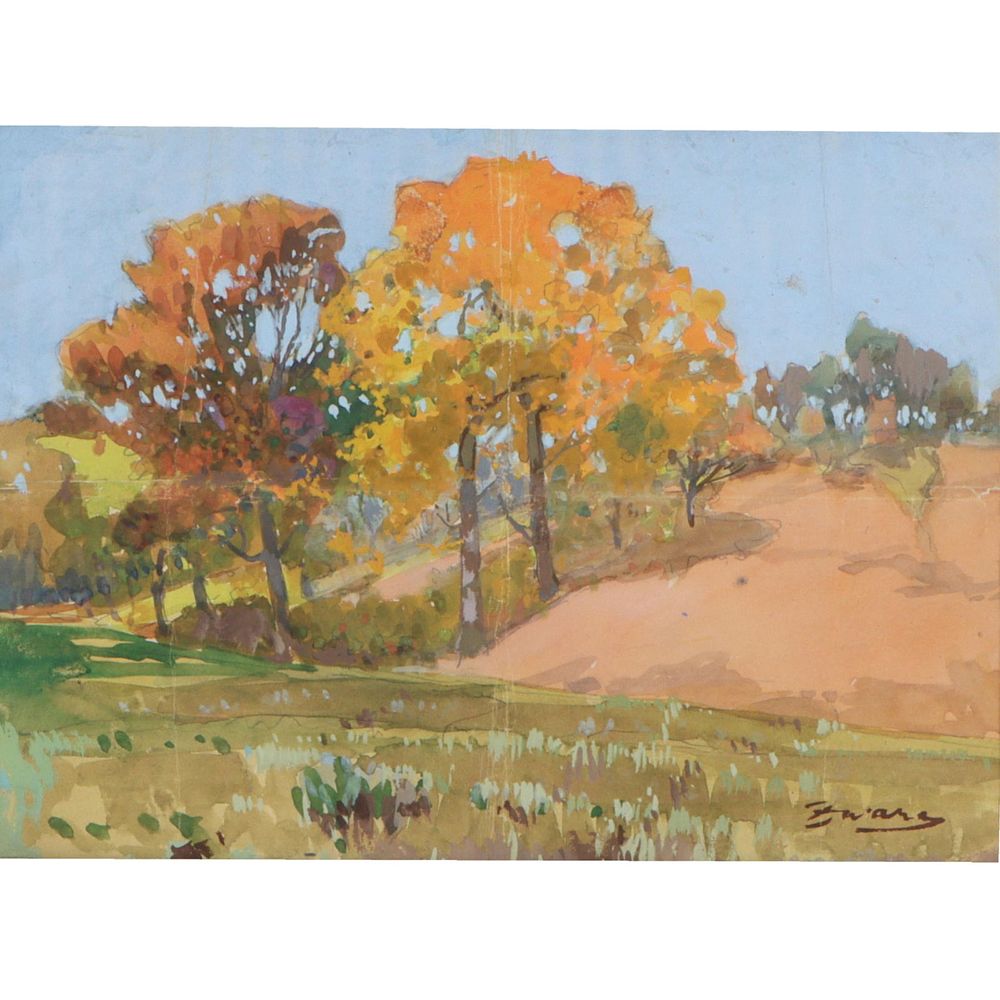
John Zwara, Hungary / Indiana (1880 - 1951), Autumn Hills landscape, watercolor on paper, 8 1/4”H x - John Zwara Hungary / Indiana (1880 - 1951) Autumn Hills landscape watercolor on paper signed lower right. creases throughout, minor tear on edge. Biography from the Archives of askART: The following, submitted April 2005, is from Edward Bentley, art collector and researcher from Lansing, Michigan. Commenting on the appeal of the Omaha, Nebraska landscape featured in his work, the artist John Zwara stated in an interview in 1927: ”We are indebted to nature for everything we have and we should love and enjoy her beauty. People have eyes and see not. They hurry by the most wonderful pictures, the natural beauty of streams, forests and fields.” But to the people of Indiana that is not the artist anyone is familiar with. Indeed, the only known artist named Zwara was a bedraggled schizophrenic who spoke only through the beauty and appeal of his artwork. Furthermore, although Indiana has been the location of the majority of the painter's known work, it currently represents only a portion of his life. Jan Zwara (he changed his name to John upon entry into the U.S.) was born December 27, 1880, in Horni Stepanov, Hungary, now a part of the Czech Republic. He was the son of Joseph and Mary Zwara. The family eventually moved to Turdossin, a city now part of Slovakia. His primary education consisted of three years at the grammar school in nearby Trsztenen - from 1891 to 1894 - and four years at ”Civic” school (our High School). His father, a wealthy businessman, was able to provide his son with four years of artistic training; one year at the Academy of Fine Art in Prague (1900/1901) under Professor Roubalik, and three more years in Poland at the Warsaw Academy of Art. Further study has also been mentioned in biographies of the artist that include Hungary and Berlin, Germany but cannot be documented because of the destruction caused by World War II. Commencing his life's work, John Zwara took advantage of a brother in Chicago who offered to set him up there with his own studio. No doubt he realized the unique opportunity that America presented a beginning artist. Coming to this country at about the age of 24, the artist soon succumbed to wanderlust. When his studio was open he would be gone sketching. The studio was a failure. For the next eighteen years he workedand wandered. In 1928 the ”Omaha World-Herald” published an article by Bobbie O'Dare - a revealing piece in praise of the artists' paintings that also described how he lived and worked. With help from personal writings kept by Zwara, the author traced the artist's route from Chicago and Pittsburgh to Cleveland and Wisconson; from Ohio and Billings, Montana to Nevada and San Bernadino: from Los Angeles and San Francisco to Salt Lake City and then Denver. Zwara worked at any and all kinds of menial jobs in mines, smelters, lumber camps, on the railroad and even digging ditches, all the while living in seedy hotels, hovels and even among the hoboes. While time on the job usually varied from several days to several months, he did spend six years on the construction of the Los Angeles aquaduct. And the jobs could be rather interesting. While in Chicago he spent several weeks modeling; ”For the ladies sculpture class, ” declared Zwara, with a twinkle in his eye. Commenting on his wanderings Zwara stated: ”I get tired. I go.” On one job in California for a Mr. Dunn, cattle king, he commented: ”I paint his house. I paint him pictures of his ranch till his house is full of them. He tell me to go out and paint the barn. I go, but not to paint that barn.” It was during his time in Salt Lake City spray painting locomotives that he entered an exhibit sponsored by the railroad. ”I put in my paintings.” he stated, ” I got First prize and at night the big building burn down, the paintings burn up.” Finally arriving in Omaha sometime in 1922, the artist was befriended by Albert J. Samuelson of the Acorn Press. Samuelson purchased some of Zwara's work and helped him sell others. In 1927 he entered four landscapes in the Sixth Annual Exhibition of Nebraska Artists where one of his paintings was the first to be sold. This was a few months after his ”discovery” by Marion Reed, art supervisor for the Omaha schools, who declared him a genius. A short time later an exhibit of his work was held in the art department of the Anton Hospe Music Publishing Company warehouse where 19 of his 22 paintings sold. He was finally a success. But then Zwara's constitution began to fail him. The hard lifestyle he had made for himself, the almost fanatical quest for the next sketch, his bad eating habits and eventually his personal hygiene began to change. As late as 1931 the artist maintained a residence in Omaha, but by the time of the artists' next ”discovery” in Indiana, the people of Omaha would not have known him. In 1931 and 1932 the artist could be found in the Salt Lake City, Utah, area.