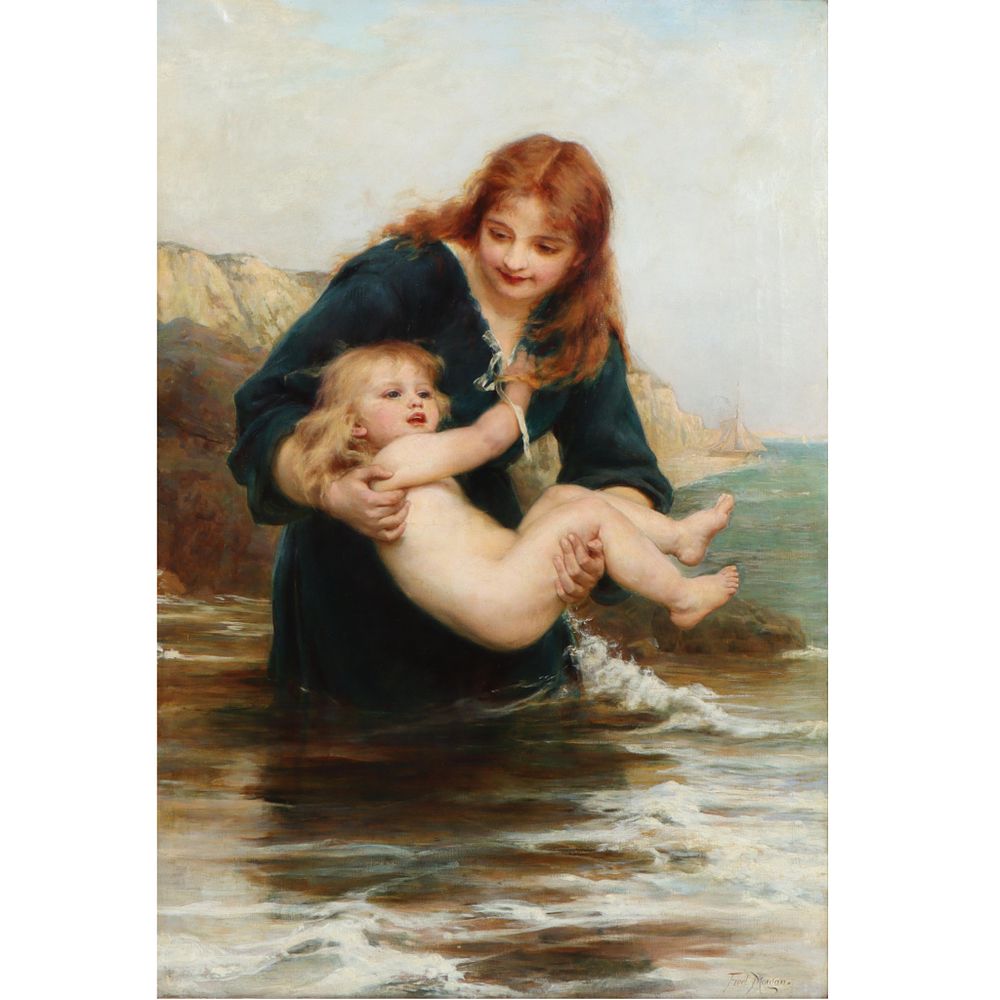
Bidspirit auction | Fred (Frederick) Morgan, UK /
Fred (Frederick) Morgan, UK / England (1847/56 - 1927), Mother and Child by the Sea, oil on canvas - Fred (Frederick) Morgan UK / England (1847/56 - 1927) Mother and Child by the Sea oil on canvas signed lower right. The painting is set in an ornate, gilded frame. Biography from Rehs Galleries, Inc.: During the nineteenth century in England, domestic subjects of family at home, children at play and others of the same sort were among the most popular type of genre paintings. Frederick Morgan was one of the greatest British genre painters of his time specializing in happy childhood scenes. His works were very popular as attested by the large number of reproductions created and sold during his lifetime. In an article entitled ”The Art of Mr. Fred Morgan” (The Windsor Magazine, June 1905, pg. 18), John Oldcastle wrote: ”An artist of his era in his choice of child-subjects, he is also of his generation in his methods, reminding us in his sympathies now of this contemporary, now of that. Yet, he has kept to his own chosen way with the vigilance of a palmer, the shrine of childhood always before him as his goal. Where is the child, his Holy Land is there. On that heavenly city he has kept a single eye.” Frederick Morgan was born in London, England. His father John Morgan (1823-1886) was a genre artist who received his training in Paris France under the French painter and teacher Thomas Couture (1815-1879). He was known as ”Jury Morgan,” after the success of one of his pictures entitled The Gentlemen of the Jury, and was a member of the Society of British Artists, as well as a regular exhibiter at the Royal Academy. (Oldcastle, pg. 4) As John Morgan firmly believed in the importance of learning art at a young age, he took his son Fred (as he was called) out of school when he was fourteen years old to begin his art instruction with him. Young Fred began his art training with his father and took some art lessons in Edinburgh. However, it was his father that greatly influenced his artistic career, as he said ”He taught me how to make a picture.” (Oldcastle, p. 5) At age sixteen, Fred sent a painting entitled The Rehearsal to the Royal Academy, which depicted two old musicians practicing for the village choir. Much to his astonishment, it was accepted and was ”hung in one of the small rooms on the wall, near the ground,” and was purchased by a collector at the Private View, for £20. (Oldcastle, pg. 8) After this initial success, Fred did not progress as he should have because ”perhaps, being the only boy in the town of Aylesbury following the profession, thus lacking emulation, and also not being very robust in health, I seemed to lose heart.” (Oldcastle, pg. 8) Three years later, his father informed him that he was not qualified to become a painter and that he should look for another occupation. To that end, Fred's father gave him five pounds and sent him to London, where he unsuccessfully searched for various jobs in warehouses or offices. He then returned home and decided with his family to once more try to become a successful artist. Fred worked for three years as a portrait artist in Aylesbury and was engaged by a photographic firm to paint family portraits for those clients who were not satisfied with photographs only. After showing samples of his work to other photographic firms in London, he received numerous portrait commissions and was thus able to make a sufficient income. The years that he spent working for the photographers proved to be a good training for Fred, as it ”taught him how to observe closely and to give the greatest attention to detail.” (Oldcastle, pg. 15) In addition to portraits, he painted other subjects that included rustic idealized peasants and domestic genre mostly of happy childhood scenes. Starting 1874 Messers Agnew and Sons purchased all his work for a number of years. During this period he produced many of his successful paintings such as The Doll's Tea Party (1874), Emigrants Departure (1875), School Belles (1877), which were mostly painted in the village of Shere close to Guildford, a favorite artists' retreat. Later, he produced other paintings in Normandy, which included Midday Rest (1879) and An Apple Gathering (1880). Fred's popularity increased, as did the demand for his paintings of children scenes. Although he was an excellent child portraitist, he ”had a problem painting animals,” as noted by Terry Parker in Golden Hours, The Paintings of Arthur J. Elsley, 1860-1952 (Somerset, England: R. Dennis, 1998, pg. 9) As a result, he cooperated with other artists for his images that depicted children with their pets. Among them were the artist Allen Sealey (1850-1927) who specialized in canine portraits, and the genre artist Arthur J. Elsley (1860- 1952). The latter took on that role when he moved into Fred's studio at 7 North Bank, St, John's Wood in 1889. Together they produced Ruff Play (c. 1889, once owned by Rehs Galleries),