Bidspirit auction | Export Nanking Cargo Blue &
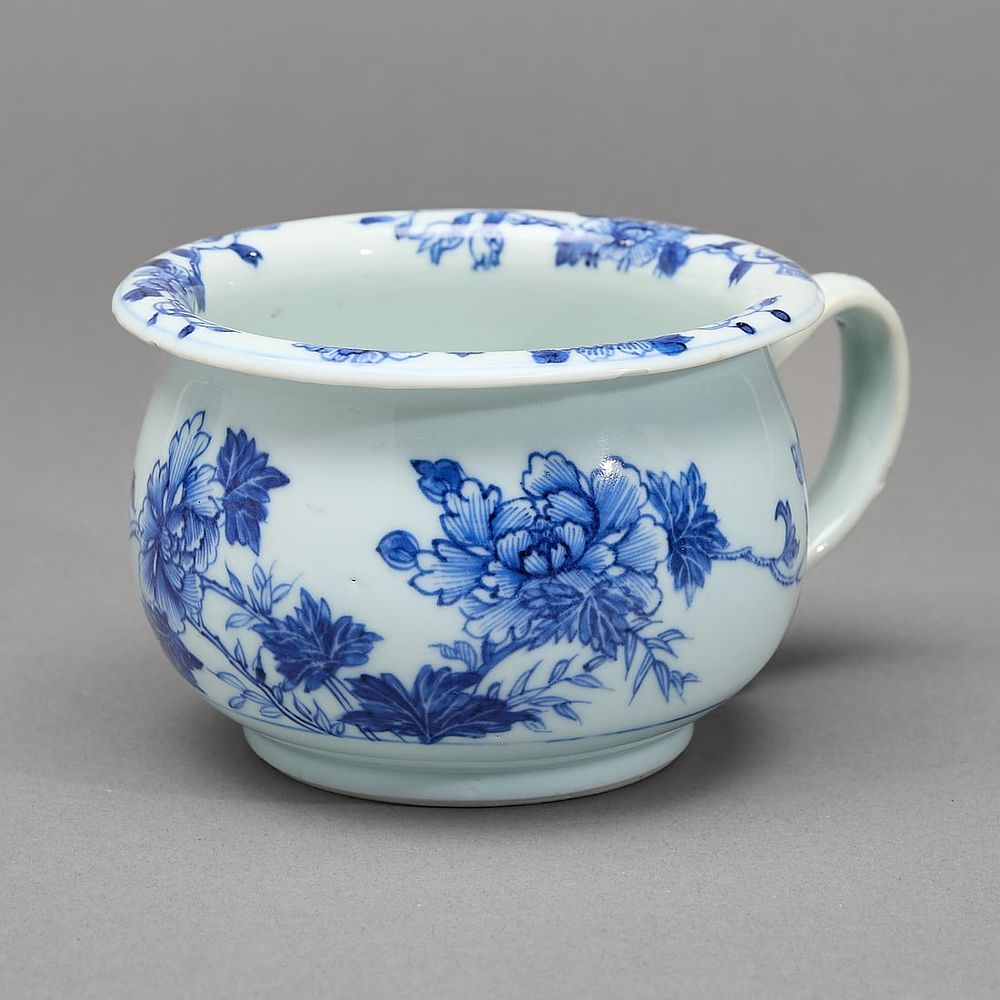
Export Nanking Cargo Blue & White Vomit Pot - Chinese export Nanking Cargo blue and white vomit pot, Qianlong ca. 1750. Decorated along the sides with large peony sprays. Sometimes referred to as a children's chamber pot for it's resemblance to those similarly-sized vessels. Illustrated in Howard, ”Choice of the Private Trader, ” pg. 228-9, no. 270. Provenance: Christie's, Amsterdam, ”The Nanking Cargo - Chinese Export Porcelain and Gold, ” 28 April 1986, Lot 1103; The Distinguished Collection of Leo & Doris Hodroff. Reference: Jorg, ”The Geldermalsen, ” pg. 80-1. Lot Essay: Fortunately the fashion of over-eating and then vomiting was only in vogue during this time for perhaps five years. The first order of pots of this kind were placed in 1745 and subsequently their import was forbidden by 1750 by the Dutch directors. Shipwrecked two years later in 1752, the Geldermalsen manifest mentions some 606 of these vessels, 495 of which were salvaged by Captain Michael Hatcher, invoiced on the cargo manifest as being ”in the manner of a water pot, ” perhaps to mislead the directors. It is possible that these found their way to the Geldermalsen as a private venture on the part of the supercargo as a way to clear the stock of a Chinese merchant who had these unsold from the years before the ban was in place. In the Christie's 1986 sale of the cargo, these pots were erroneously referred to as children's chamber pots, possibly reflecting the secretive nature of their transport. From the wreck of the Geldermalsen, a Dutch East India Company merchant ship traveling from China to the Netherlands when it hit a coral reef and sank in the South China Sea, 1752. British explorer and marine salvage expert Michael Hatcher recovered porcelain and gold ingots from the shipwreck in 1985. Height: 3 1/2 in x width: 6 1/2 in x diameter: 5 in. Condition: There are no restorations visible under UV light. A few small chips to the rim and handle. Small hairline near the bottom of the handle.