Bidspirit auction | Monumental 32' Shen Quan Birds
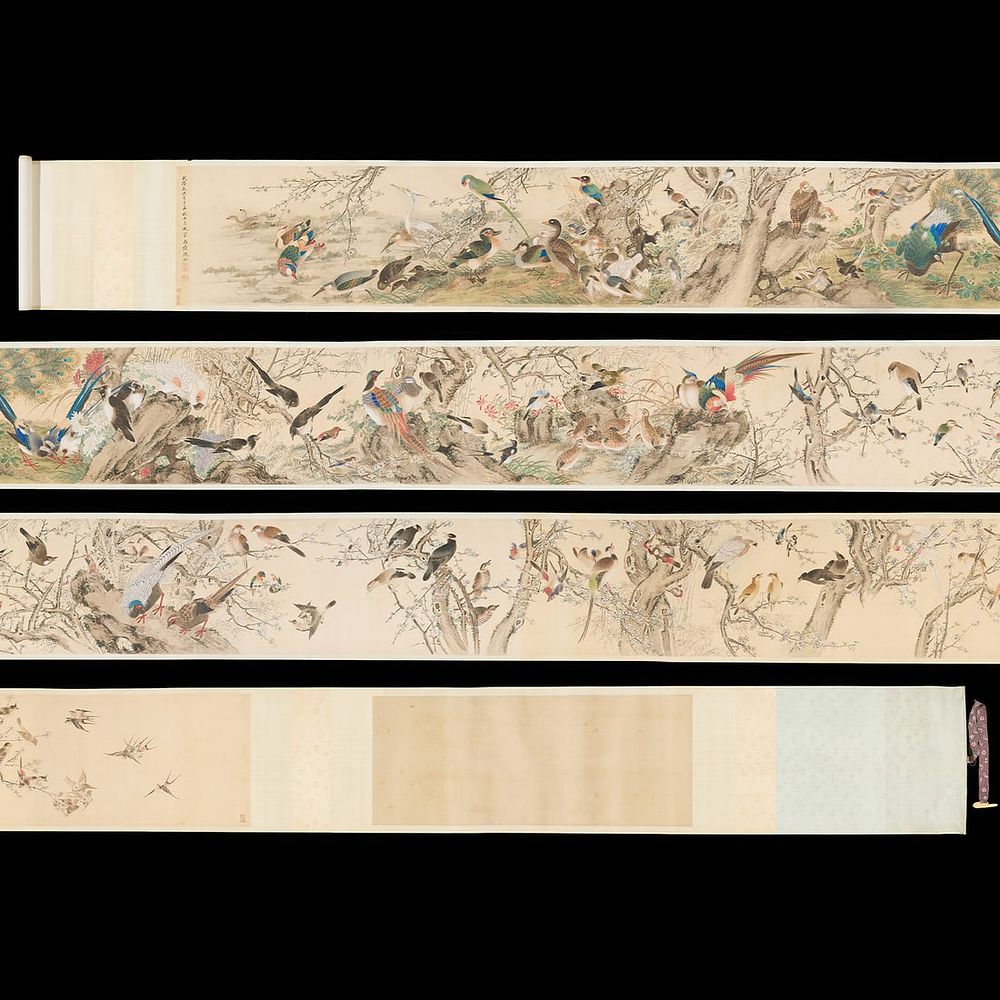
Monumental 32' Shen Quan Birds & Flowers Scroll - Shen Quan (Chinese, 1682-ca.1760). Monumental hand-painted hand scroll. Ink and color on silk. Signed Nanping Shen Quan, dated Qianlong ji si, 1749, autumn, seventh month, and with two seals of the artist, Qian Long Ji Si Shen Quan Hua Yin and Nan Ping Shi, and three collectors' seals. With a fitted wooden box. The scroll depicting pairs and groups of birds and fowl among blooming foliage and brush. Including parakeets, parrots, peacocks, pheasants, golden pheasants, mandarin ducks, among many other species. The variety and execution of the fauna depicted showcase the technical strength and skill of Shen Quan's artistry. Provenance: Sotheby's New York, ”Fine Chinese Paintings, ” 6 December 1989, Lot 117; Private Collection; Sotheby's, London, ”Fine Chinese Ceramics, Works of Art and Paintings Including Export Porcelain, ” 12 June 2003, Lot 198; The Distinguished Collection of Leo & Doris Hodroff. Reference: Marco Meccarelli, ”Chinese Painters in Nagasaki: Style and Artistic Contaminatio during the Tokugawa Period (1603-1868), ” Asia Orientale, Ming Qing Studies 2015, Pages 175-236. Lot Essay: Traditional bird-and-flower paintings (huaniaohua) have a long tradition in China, dating to the Tang dynasty. The subjects of these paintings extends beyond birds and flowers to fish, insects, pets, etc. The intention of these paintings goes beyond simple representation of the subjects to convey personality and ideas of the artist, often utilizing Chinese symbology to imbue the paintings with auspicious meanings, principles, and virtues. Shen Quan (active ca. 1725-1780), also known by the names Nanpin (or Nanping) and Hengzai, was a native of Dequing, Zhejiang province. Influenced by Ming artists Bian Jingzhao and Lu Ji of the Academy, Shen was a skilled painter of these bird-and-flower paintings, specializing in realistic and detailed flowers, birds, and beasts. Upon his return from working two years in Nagasaki, Japan, his works became highly sought after and fashionable and he acquired a number of students who were eager to learn his style of painting. Among his many pupils was Kumashiro Yuhi, who taught So Shiseki and Kakutei. Other artists influenced by Shen Quan include Katsushika Hokusai, Maruyama Okyo, and Ganku. Today, his paintings can be found in numerous prestigious institutions including the Metropolitan Museum of Art and the British Museum. While in Japan, Shen Quan was likely exposed to the thriving mercantile port in Nagasaki, which facilitated the spread of Western knowledge. Japanese interest in Western natural sciences as well as Chinese culture included treatises and the spread of knowledge on subjects including botany, zoology, and mineralogy. These treatises, both Chinese and Western, possibly inspired artists like Shen Quan to create these highly detailed paintings, which one scholar has likened more to ”flora and fauna decorative paintings” than traditional bird-and-flower paintings. This decorative aspect is further emphasized as paintings of the Nanpin school, and possibly Shen Quan himself, had to satisfy the taste of merchants. His works have sold at auction before, though none as monumental as the present lot. Several examples include Christie's (26 May 2021, Lot 875; 25 November 2014, Lot 1070; 27 May 2013, Lot 710) as well as Sotheby's (6 April 2015, Lot 3106; 13 September 2018, Lot 562). Height: 17 1/8 in x width: 384 in. Condition: Overall the colors are bold and bright. The original silk painting is backed to a modern silk backing. Along the left edge, where the inscription is, there is an uneven area of toning, likely due to uneven light exposure. Similar area of toning to the right edge of the painting. There is a small loss to the backing silk along the upper edge just above this inscription. Throughout the extreme edges of the original silk, especially along the lower edge, there are minute tears which do not extend beyond 1/8” inch in length. A few very minute tears along the backing silk along the extreme edges. A few areas, such as along the geese, where there are creases. Small scattered areas of soiling or foxing. To the backing silk there are small pieces of archival framer's tape. There are a few areas where this tape has come loose and a few areas of skimming to the backing silk. Light wear to the box.