Bidspirit auction | 19th c. Chinese Export Owl
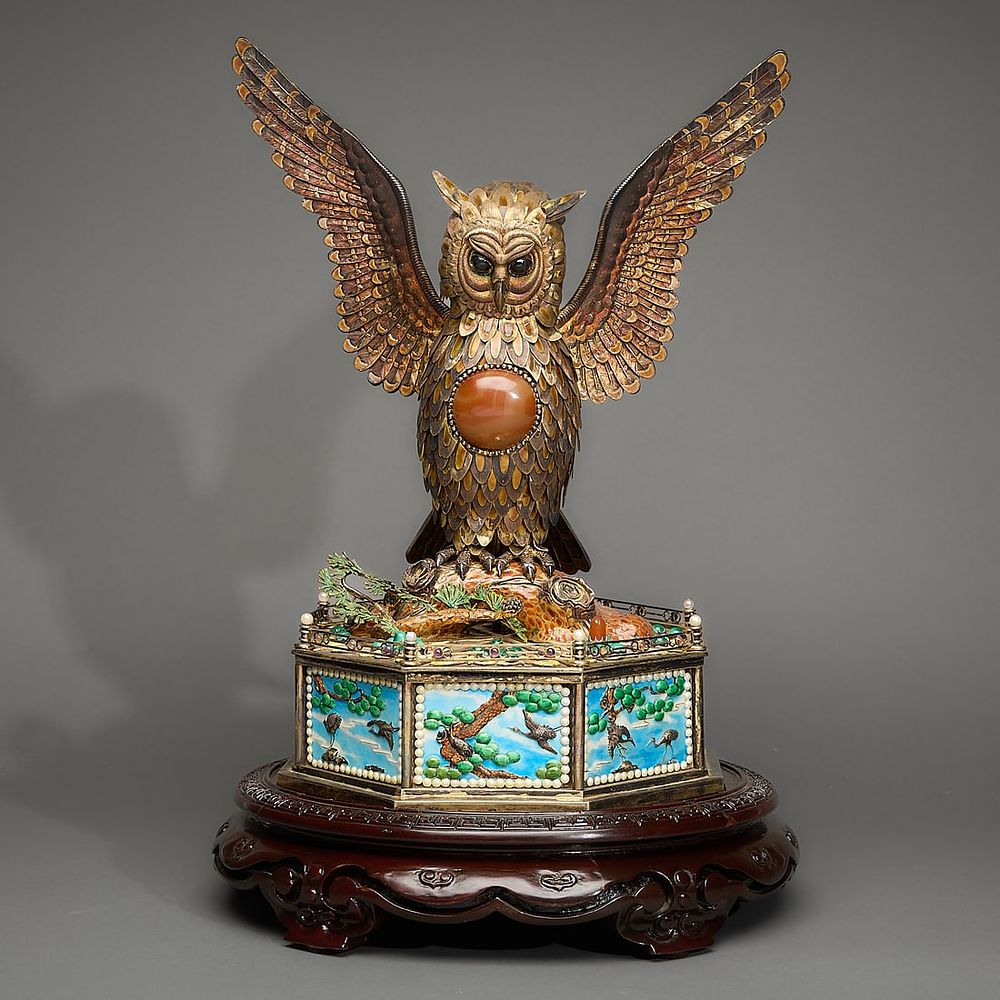
19th c. Chinese Export Owl Automaton Sculpture - Chinese Export gilt copper and Canton cloisonne enamel automaton, ca. 19th century. A large carnelian-colored glass amulet along the center of the owl's chest echoes the a similarly toned dial rising from the octagonal base. When the dial is rotated, the owl, flutters its feathers and fans its wings as the chest cabochon illuminates in a rhythmic display. Perched on a gnarled branch, the owl rises from an octagonal base adorned with Canton cloisonne enameled panels depicting cloudy blue skies, overlay enameled trees, and filigree cranes, framed by borders of small and beaded white enamel accents set beneath openwork rails. Accented by untested hardstones appearing to be malachite, amethyst, and quartz. Accompanied by a carved hardwood stand. Lot Essay: Automata flourished across the nineteenth century, when advances in precision machinery brought mechanical wonders out of royal cabinets and into a growing consumer market. In Europe, the earlier achievements of makers like Jaquet-Droz and Maillardet gave way to a thriving commercial industry, centered in Paris and Switzerland, producing singing birds, dancing figures, and animated tableaux for a bourgeois clientele. Smaller workshops and, later, firms such as Vichy, Roullet-Decamps, and Bontems refined mechanisms that could mimic breathing, flutter wings, and move with convincing naturalism. These were objects of entertainment as much as of technical pride, often housed in gilt cases or paired with clocks and music boxes. Chinese automata had a far longer lineage. Mechanical figures are recorded in texts dating from the Han dynasty and earlier, and the arrival of European striking clocks, known as zimingzhong (“self-sounding bells”), added a new technical vocabulary to this existing tradition. Between the imperial workshops of the court and the export workshops of Canton, Chinese craftsmen adapted these ideas to local materials, combining gilt copper, enamel, and hardstones with moving figures drawn from the natural world and the Chinese decorative repertoire, exemplifying a convergence of these traditions. (Including base) Height: 21 in x diameter: 14 in. Condition: The automaton turns on and functions; however, it has not been tested for long-term functionality. Tarnishing to the metal components and some losses to the gilt. There is a break to one of the branches near the owl's feet; the element is present, however is no longer attached to the overall structure. Scattered, small losses to the enamel along the owl's feathers. There are a few bends to the feathers along the owl's body. There are some small bends to the feathers along the right side of the owl's head and to the right of the amulet inset into the chest. Crazing to the enamel. A few minute areas of verdigris patination, particularly along the base of the automaton. There are two lengths of tape affixed to the underside. There are signs of repair to the carved wooden base. There is a large split along the center of the base that extends through the diameter of the base. Separation to the joints. Two felt tabs affixed along the underside of the wooden stand.