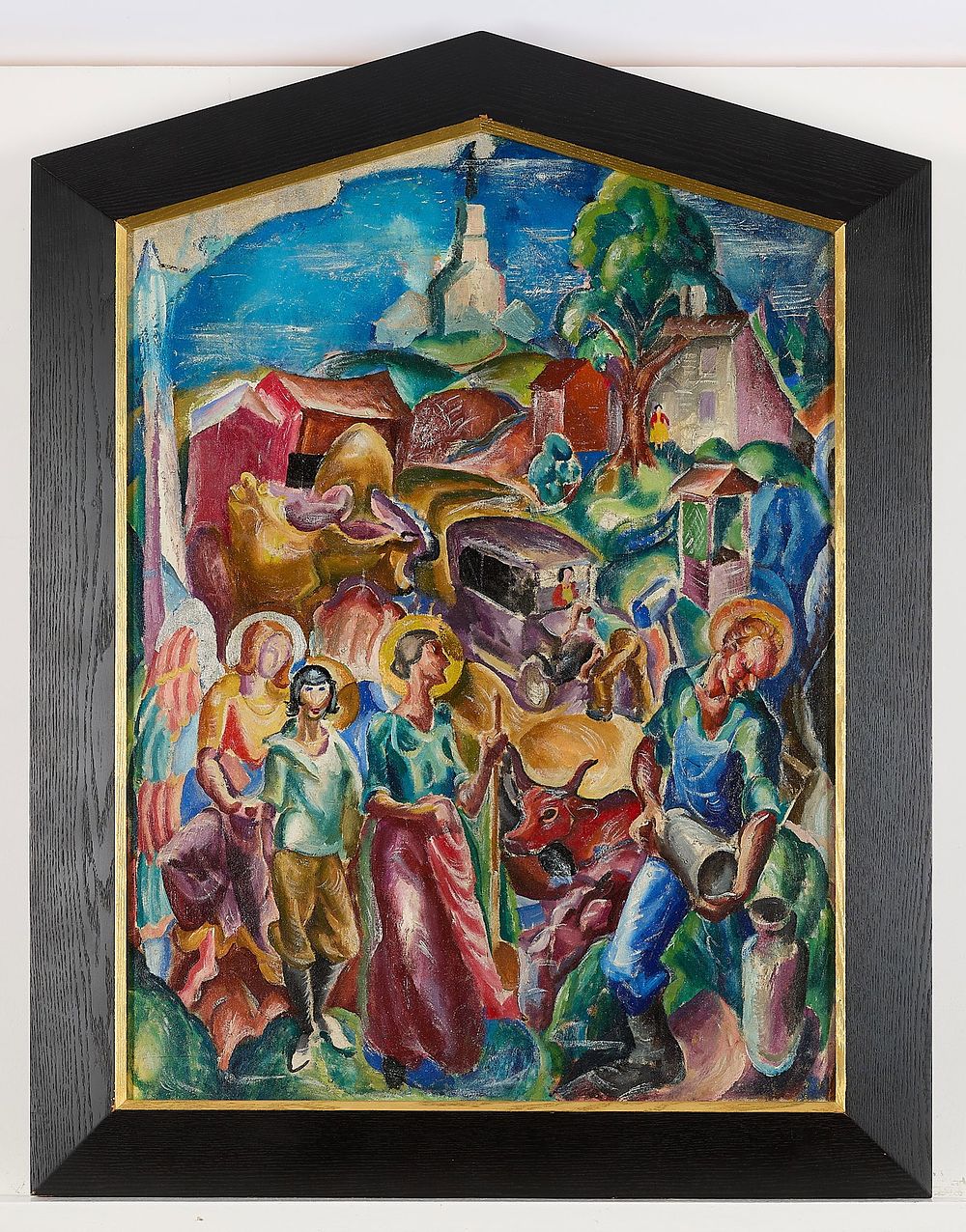
Bidspirit auction | James Daugherty ”New Ford Car”
James Daugherty ”New Ford Car” Oil on Canvas - James Henry Daugherty (American, 1889-1974). Oil on canvas painting titled ”Rural Life, Holy Milly and the New Ford Car.” Depicting a bustling American country scene blending traditional farming with early 20th century modernization. In the foreground, stylized figures with halos are surrounded by farm animals and rustic structures under a bright blue sky. At the center of the composition, a new Ford car stands out as a symbol of technological change transforming rural life. With a Bonham's label adhered along the verso listing artist attribution, title, medium, and provenance. With a Daugherty Estate stamp along the verso. Provenance: Artist's Estate; Wright Auctions, Chicago, IL, December 3, 2000, Lot 143; Private Massachusetts Collection; Bonhams, New York, NY, ”American Art, ” May 26, 2002, Lot 87; Private Minnesota Collection. Lot Essay: James Henry Daugherty (1887-1974) was a prominent American artist closely associated with Connecticut, where he spent much of his life and worked for the Connecticut WPA Federal Arts Project. Trained at the Corcoran Gallery’s Free School, the Pennsylvania Academy of the Fine Arts under William Merritt Chase, and the London School of Art with muralist Frank Brangwyn, Daugherty developed a broad artistic foundation. His travels in Europe and early work as an illustrator in New York helped shape a career that embraced abstraction, early modernism, Fauvism, Futurism, Realism, and Synchromism. Inspired by the 1913 Armory Show, Daugherty became an early modernist known for his bold use of color. Working alongside Arthur B. Frost Jr., he explored abstract techniques and Synchromism, while his experience in a World War I camouflage unit further deepened his experimentation with color. By the early 1920s, he had established a reputation for vibrant, innovative paintings that reflected the evolving language of modern American art. After 1922, Daugherty shifted toward representational painting and became best known for his large-scale murals, combining heroic figures with vivid color influenced by artists such as Rubens, El Greco, and Titian. During the Great Depression, he created murals through federal arts programs, including the WPA Federal Arts Project, producing some of the era’s most celebrated public artworks. Beyond murals, he illustrated more than fifty children’s books in collaboration with his wife, Sonia, including the Newbery Award-winning ”Daniel Boone, ” 1939. His work is represented in the collections of the Whitney Museum of American Art, the Yale University Art Gallery, and the Smithsonian American Art Museum, reflecting his lasting impact on American art. Sight; height: 39 1/2 in x width: 28 3/4 in. Framed; height: 48 in x width: 37 in x depth: 1 1/4 in. Condition: There are no visible tears, repairs, or losses. No evidence of in painting under UV light inspection. The canvas is relined. Light toning to the varnish, particularly evident along the upper edge. Light wear to the frame. Work not inspected out of frame.