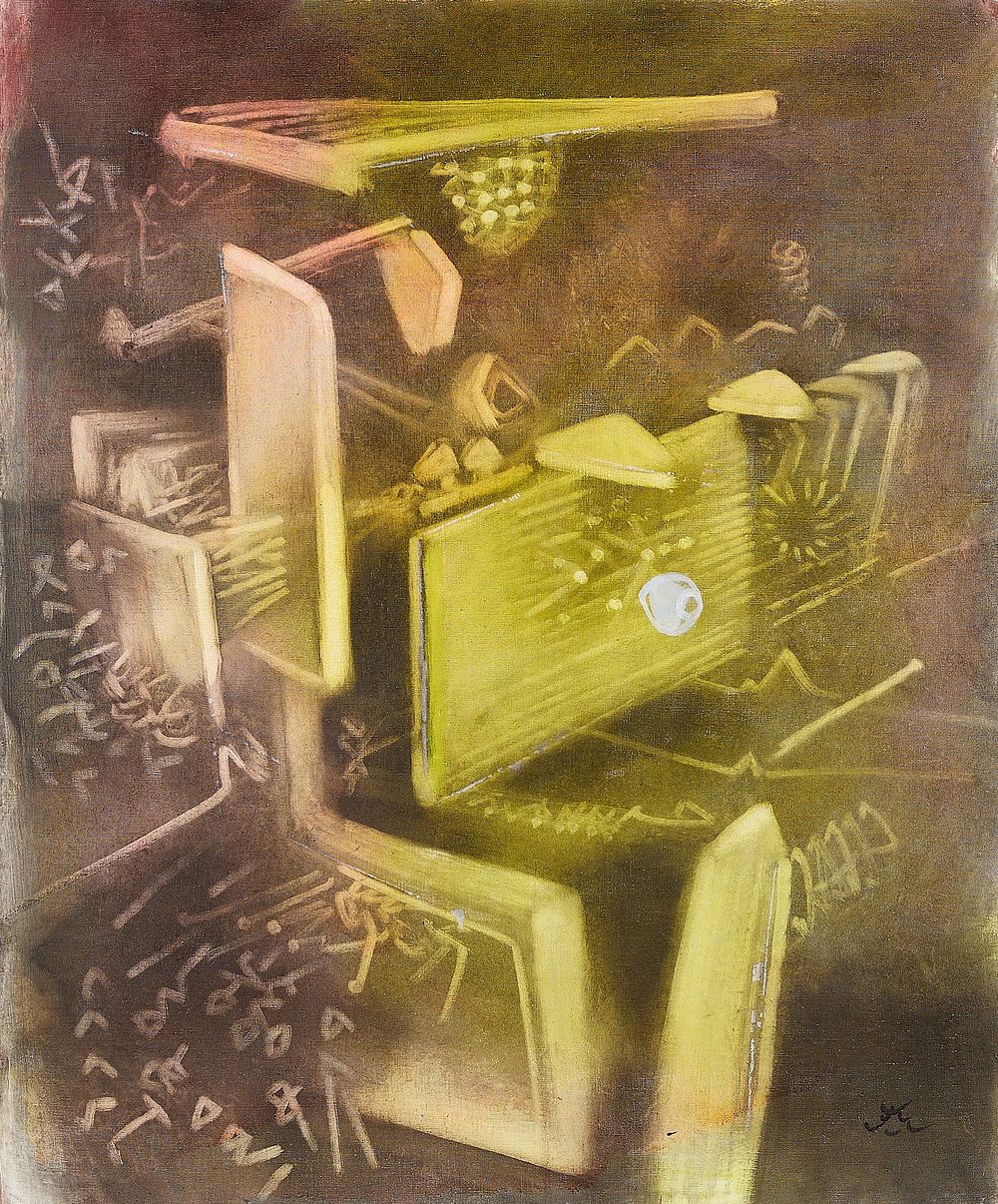
Bidspirit auction | Roberto Matta ”Un moment d'inquietude”
Roberto Matta ”Un moment d'inquietude” Painting - Roberto Antonio Sebastian Matta Echaurren (Chilean, 1911-2002). Oil on canvas painting titled ”Un moment d'inquietude” (A moment of anxiety), 1974-1975. Depicting a biomechanical, schematic composition, including scribbled glyph-like markings, sharp angles, and a central white oval form. Featuring a dark, muted background overlaid with fractured, architectural shapes rendered in shades of yellow and cream. Signed along the lower right. With a Certificate of Authenticity from Digitarchives signed by the artist's son, Ramuntcho Matta. With a Galerie Thomas R. Monahan, Chicago, Illinois, label adhered along the verso. Lot Essay: Roberto Matta was born in Santiago, Chile, on November 11, 1911. He studied architecture at the Colegio del Sagrado Corazon and the Pontificia Universidad Catolica de Chile before moving to Paris in 1933, where he worked as a draftsman in Le Corbusier's studio until 1937 and trained briefly with Walter Gropius in London. While visiting family in Spain and Portugal, he met poets Federico Garcia Lorca, Gabriela Mistral, and Pablo Neruda; through Garcia Lorca he was introduced to Surrealism and to Salvador Dali, who in turn connected him with Andre Breton. After showing Breton his fantastical architectural drawings, Matta joined the Surrealist group in 1937 and took part in the Pavilion of the Spanish Republic at the 1937 Paris exhibition alongside Picasso and Miro. In 1938 Matta participated in the International Exhibition of Surrealism, where he met Marcel Duchamp. That same year, experimenting alongside Yves Tanguy and Gordon Onslow-Ford, he produced his first paintings; bright, biomorphic works he called ”inscapes” or ”psychological morphologies, ” blending architectural space with organic, vital forms that unsettled conventional visual expectations. Due to WWII, Matta emigrated to the United States in 1939, where, as one of the youngest and most multilingual Surrealist expatriates, he quickly integrated into New York's emerging art scene. There he formed close relationships with William Baziotes, Arshile Gorky, Robert Motherwell, and Jackson Pollock, introducing them to gestural automatism and playing a formative role in the rise of Abstract Expressionism. By the mid-1940s, troubled by the devastation of World War II, he shifted toward what he called ”social morphologies, ” paintings and drawings confronting the era's societal crises through increasingly anthropomorphic, rather than purely abstract, imagery; a shift that also coincided with his gradual withdrawal from the American art scene. Matta's first solo exhibition took place in 1940 at the Julien Levy Gallery in New York, and he went on to show at the Pierre Matisse Gallery and Peggy Guggenheim's Art of This Century. In 1948 he returned to Paris, only to find himself expelled from the Surrealist group; his focus shifted from personal, inner symbolism toward universal social experience expressed through recognizable forms. He lived in Rome from 1950 to 1954 before settling again in Paris, becoming a French citizen in 1969, and later dividing his time among London, Milan, Paris, and Italy. In the 1960s and 1970s he grew politically engaged, supporting the Cuban revolution and the muralists aligned with Chilean president Salvador Allende. His work was honored with major retrospectives at MoMA (1957), the Centre Pompidou (1985), the Reina Sofia in Madrid (1999), and in 2006 the San Diego Museum of Art paired his paintings with those of his son, artist Gordon Matta-Clark. Roberto Matta passed away in Civitavecchia, Italy on November 23, 2002, eleven days after his 91st birthday. Unframed; height: 40 in x width: 33 in. Framed; height: 44 1/4 in x width: 37 1/4 in x depth: 1 1/2 in. Condition: The colors are bold and bright. There are no tears, losses, or signs of restoration. Along the verso, there is a white accretion along the lower half that appears to obscure an inscription. Light wear to the frame. Not inspected out of frame.