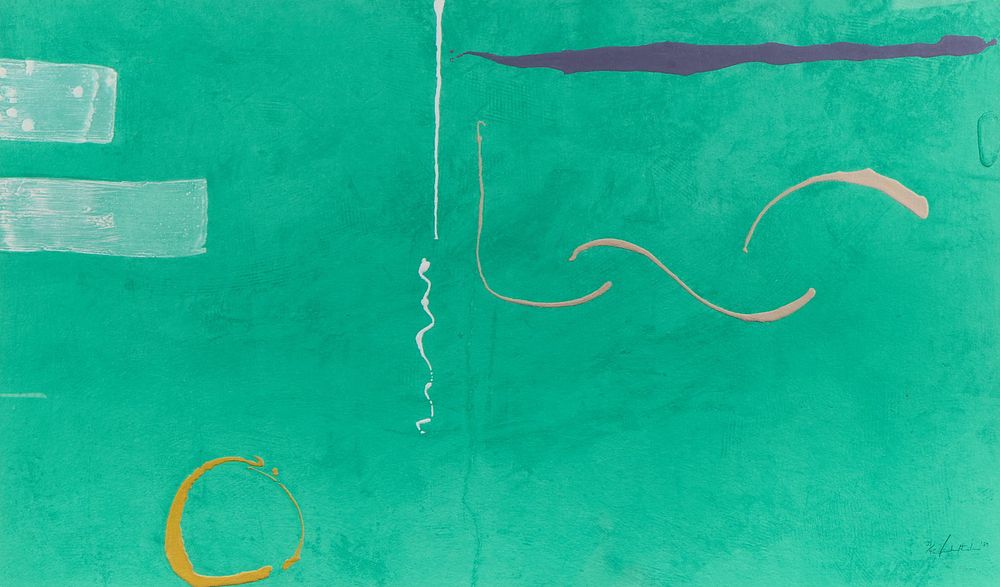
Bidspirit auction | Helen Frankenthaler ”Tahiti” Mixografia 1989
Helen Frankenthaler ”Tahiti” Mixografia 1989 - Helen Frankenthaler (American, 1928-2011). Mixografia in colors on handmade paper print titled ”Tahiti, ” 1989. Depicting a vibrant green background punctuated by minimal abstract elements. Featuring textured white blocks anchoring the left side, balanced by a delicate, vertical white line down the center, and a sharp, dark, horizontal stroke across the upper right. Along the right, light pink waves fluidly glide across the paper, while a vibrant ring of yellow accents the lower left. Pencil signed, dated, and numbered 39/45 along the lower right corner. Lot Essay: Helen Frankenthaler was a pivotal American painter whose innovations helped shape the course of 20th-century art. Associated with the second generation of Abstract Expressionists, she is best known for developing the soak-stain technique in the early 1950s, in which she poured diluted oil paint onto raw canvas, allowing it to seep into the fibers to create luminous, fluid fields of color. This approach, first exemplified in her breakthrough painting Mountains and Sea (1952), had a profound influence on the Color Field painters, particularly Morris Louis and Kenneth Noland, who adapted her method into their own styles. Frankenthaler's work bridged Abstract Expressionism and Color Field painting, marking a critical transition in postwar American art. Frankenthaler was deeply embedded in the New York art scene and maintained connections with major figures such as Grace Hartigan, Jackson Pollock, Willem de Kooning, and Franz Kline. She studied with Hans Hofmann and was married to fellow painter Robert Motherwell, a leading Abstract Expressionist. Throughout her career, Frankenthaler remained committed to experimentation, later exploring printmaking, acrylics, and sculpture. Her work was featured in numerous major exhibitions, including at the Museum of Modern Art and the Whitney, and she represented the United States at the Venice Biennale in 1966. As one of the few women to gain early recognition in a male-dominated movement, she played a crucial role in shaping modern American painting and left a lasting legacy on generations of artists. Mixografia was developed in the 1970s in a collaboration between engineer Luis Remba and artist Rufino Tamayo at the Taller de Grafica Mexicana. This new method allowed for the production of three-dimensional prints with elements of relief, texture, and fine surface details. Sight; height: 32 in x width: 53 1/2 in. Framed; height: 42 1/4 in x width: 64 in x depth: 2 in. Condition: The colors are bold and bright. There are no visible tears, losses, or signs of repair. Light wear along the extreme edges including two minute creases along the upper right and lower left corners. Floated in frame atop a non-acidic mat. Framed under plexiglass. Light wear to the frame. Not inspected out of frame.