Bidspirit auction | Willie Cole ”Luba 600” Wood
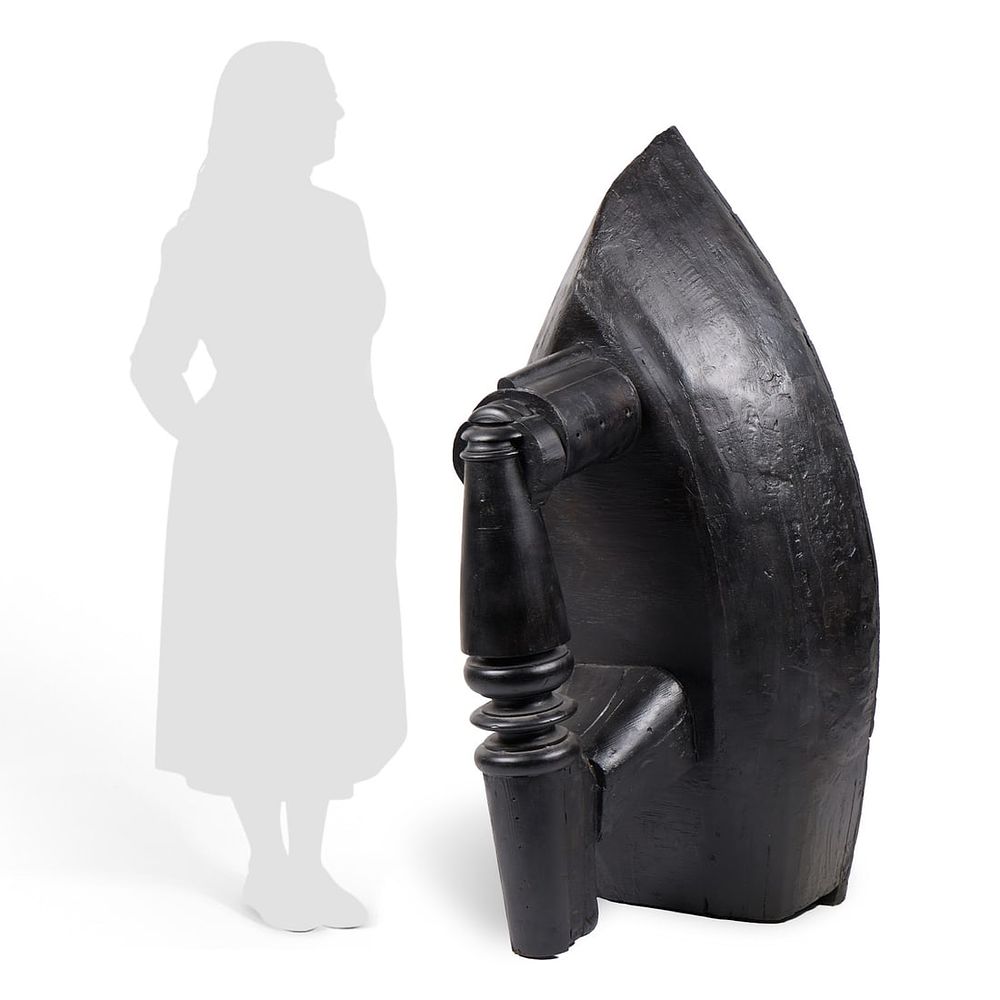
Willie Cole ”Luba 600” Wood Sculpture 1996 - Willie Cole (American, b. 1955). Contemporary carved plywood with found banister, wood stain, and putty sculpture titled ”Luba 600,” 1996. Depicting a steam iron of monumental scale. Provenance: Alexander and Bonin, New York, 2000; Private Corporate Collection. Exhibition: ”Willie Cole Iron Works, ” The Avram Gallery, Southhampton College, Long Island University, Southhampton, New York, October 20-November 30, 1999. Lot Essay: Born in 1955 in Somerville, New Jersey, Willie Cole went on to study at the Newark Museum and the School of Visual Arts in New York before developing into one of the most inventive sculptors of his generation. Cole transforms discarded materials of everyday domestic life ranging from irons and shoes to bicycle parts and hairdryers into sculptures that probe questions of identity, history, and cultural memory. Working without preliminary sketches, Cole instead builds extensive word lists for each object he engages, allowing its visual, historical, and metaphorical associations to accumulate over years of handling and reinterpretation. Cole's achievements have been affirmed through major institutional attention, including his 2006 exhibition at Alexander and Bonin Gallery in New York, the traveling retrospective ”Afterburn, ” and a survey curated by Patterson Simms at the Montclair Art Museum. Central to Cole's practice is the household steam iron. Scorched onto plywood panels or canvas, the iron's heated surface becomes a branding tool, its repeated triangular burns simultaneously evoking decorative African textile patterns, domestic labor, and connotations of slavery, a duality made explicit in titles such as ”Branded Irons.” Elsewhere, Cole enlarges the iron to monumental scale, such as the 600% larger model featured in this lot. Height: 59 in x width: 28 in x depth: 28 in. Condition: Wear throughout commensurate with age and the use of found materials. There are several vertical splits forming along the base of the handle and the iron itself; the splits are painted over, consistent with the rest of the work and are possibly also inherent to the material. Some chips along the extreme edges, particularly along the base of the handle.