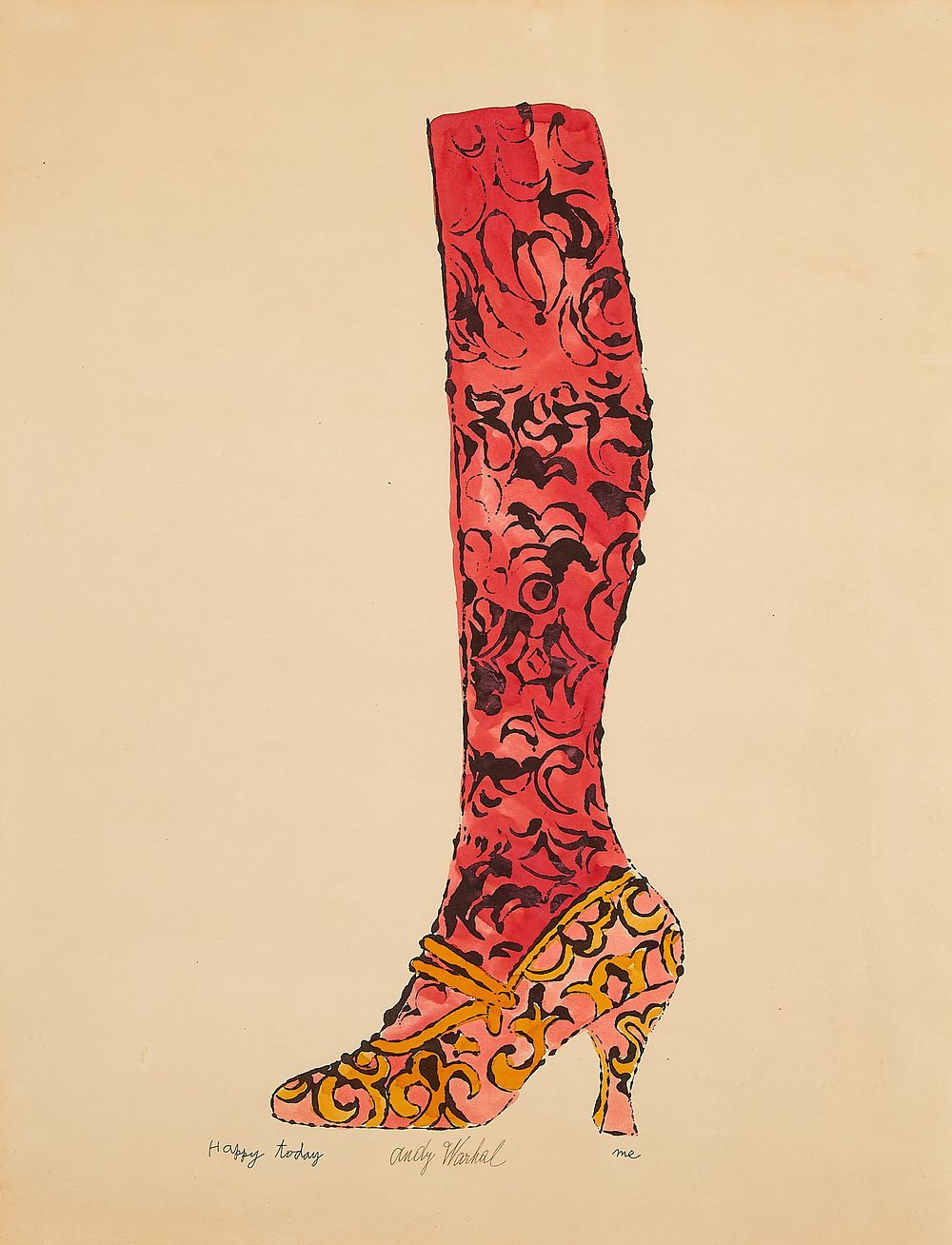
Bidspirit auction | Andy Warhol ”Shoe and Leg”
Andy Warhol ”Shoe and Leg” Hand-Colored Lithograph - Andy Warhol (American, 1928-1987). Lithograph print with hand-coloring on paper titled ”Shoe and Leg, ” circa 1955. Signed and inscribed ”Happy today” and ”me” along the lower center. With a letter from the Museum of Modern Art, New York, dated October 18, 1956, contained within a envelope adhered along the verso. ”Shoe and Leg” is an iconic piece produced before Warhol became famous for his silkscreens and Campbell's soup cans. The work dates back to his highly successful career as a commercial illustrator in New York during the 1950s. It is a standout piece from his famous ”A la Recherche du Shoe Perdu” portfolio, which was a playful visual homage to fashion and footwear. Reference: Frayda Feldman and Jorg Schellmann, ”Andy Warhol Prints: A Catalogue Raisonne 1962-1987,” entry no. IV.85b. Lot Essay: Andy Warhol, born Andrew Warhola in 1928 in Pittsburgh, Pennsylvania, became a leading figure in the art movement known as Pop Art. As a child, Warhol was frequently kept home from school due to a chronic illness. During this time, Warhol immersed himself in drawing and became captivated by the visual culture of the time, surrounded by snapshots of celebrities, comic books, magazines, and commonplace items, laying the foundation for a later fascination with the intersection between artistic expression and commercial success. Warhol pursued formal art education at the Carnegie Institute of Technology and found initial success as a commercial illustrator in New York City during the 1950s. However, it was in the 1960s that Warhol catapulted to fame with the emergence of Pop Art. His Campbell's Soup Cans, Marilyn Monroe portraits, and Coca-Cola bottle paintings became iconic symbols of the movement. Warhol's unique approach drew inspiration from commercialism, mass media, and consumer culture, making him a distinctive voice in the 20th-century art scene alongside contemporaries like Roy Lichtenstein and Jasper Johns. His innovative studios, particularly ”The Factory, ” served as avant-garde hubs of creativity, attracting diverse talents. Here, Warhol embraced screen printing, a technique that allowed for mass production of art. This method became a hallmark of his work, enabling him to blur the boundaries between art and consumer culture. Sight; height: 26 in x width: 19 3/4 in. Framed; height: 32 1/4 in x width: 26 in x depth: 1 1/4 in. Condition: The sheet is unevenly toned, particularly along the perimeter. There are minute areas of foxing along the upper center, the left quadrant, and the extreme edges. Light undulation to the sheet. There are two possible repaired tears along the upper left quadrant and one along the upper right corner. Light creases and handling marks along the extreme edges. Some skimming along the upper right corner. Floated in frame atop a nonacidic mat. Framed under plexiglass. Light wear to the frame. Not inspected out of frame.