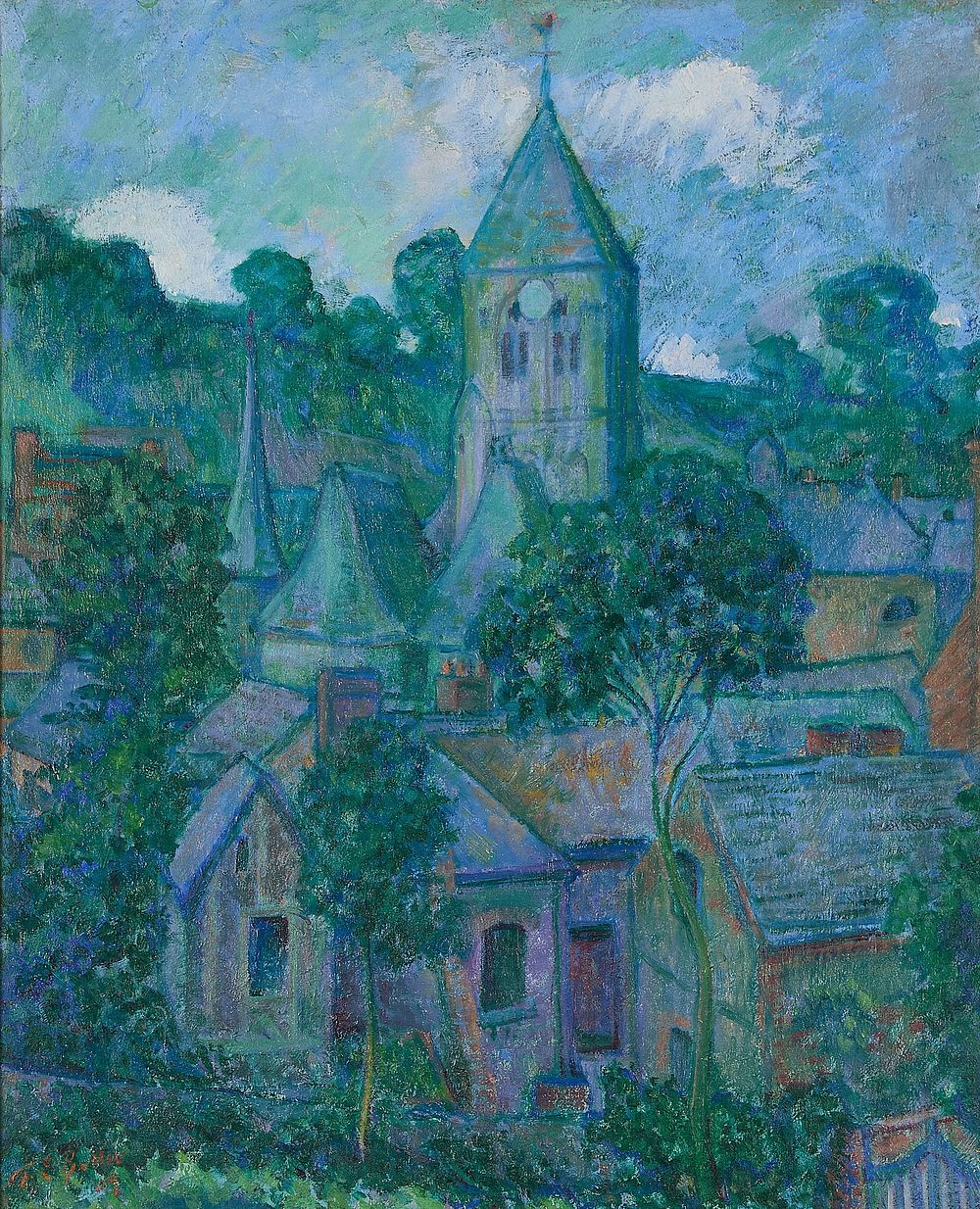
Bidspirit auction | Theodore E. Butler ”Veules-les-Roses at
Theodore E. Butler ”Veules-les-Roses at Night” Oil - Theodore Earl Butler (American, 1861-1936). Oil on canvas impressionist painting titled ”Veules-les-Roses at Night, ” 1909. Depicting a nocturnal view of the village Veules-les-Roses in France; dominated by a central church tower, rendered in deep blues, greens, and purples. The stone church tower featuring a clock face reaches high into the cloudy night sky. The tower is surrounded by a cluster of small houses and dense green trees and foliage. Signed and dated along the lower left. Provenance: Galerie R. Truffier, Les Andelys, France, purchased from artist; Private Collection, 1982; Sotheby's, New York, NY, December 1, 1999, Lot 114; Private Collection; Christie's, New York, NY, ”Fine American Paintings, Drawings and Sculpture, ” September 27, 2004, Lot 114; The Distinguished Collection of Leo & Doris Hodroff. Lot Essay: Theodore Earl Butler was born in Columbus, Ohio, in 1861. He attended Marietta College in Ohio, graduating in 1882 before moving to Paris to pursue his artistic career alongside other promising young American artists. While in Paris, Butler studied at the Art Students League and continued his training at La Grande-Chaumiere, Academie Colarossi, and Academie Julian. After years of experimentation with different styles and techniques, he traveled to Giverny, which had become a thriving community for American expatriate artists. In the summer of 1888, Butler settled in Giverny, where he befriended Claude Monet and became a devoted follower of Impressionism. His connection to the Monet family deepened in 1892 when he married Monet's stepdaughter, Suzanne Hoschede. Their wedding was commemorated in Theodore Robinson's painting ”The Wedding March.” Following the marriage and the birth of their children, Butler focused increasingly on intimate domestic scenes, often painting indoors or in his garden. During this period, Monet's influence is especially evident in Butler's luminous color palette and Impressionist approach. Tragedy struck in 1899 when Suzanne died after a prolonged illness. In the years that followed, Butler turned his attention primarily to landscape painting. That same year, he returned to the United States, where he held several successful one-man exhibitions in New York. After six months, however, he returned to Giverny and married Suzanne's sister, Marthe Hoschede. In 1914, Butler and his family traveled to New York to complete a mural commission. The outbreak of World War I prevented their return to France, and they remained in the United States throughout the war. During this time, Butler continued to paint, became active in the New York art community, and helped found the Society of Independent Artists. In 1921, the family returned to Giverny to help care for the aging Claude Monet. Butler remained there for the rest of his life, continuing to paint until his death in 1936. Unframed; height: 29 in x width: 24 in. Framed; height: 33 1/2 in x width: 28 in x depth: 1 1/2 in. Condition: The colors are bold and deep. There are no signs of restoration or inpainting under UV light. Some light wear along the extreme edges including small possible losses/flaking. Light wear to the frame.