Bidspirit auction | Thomas Hart Benton ”Central Park”
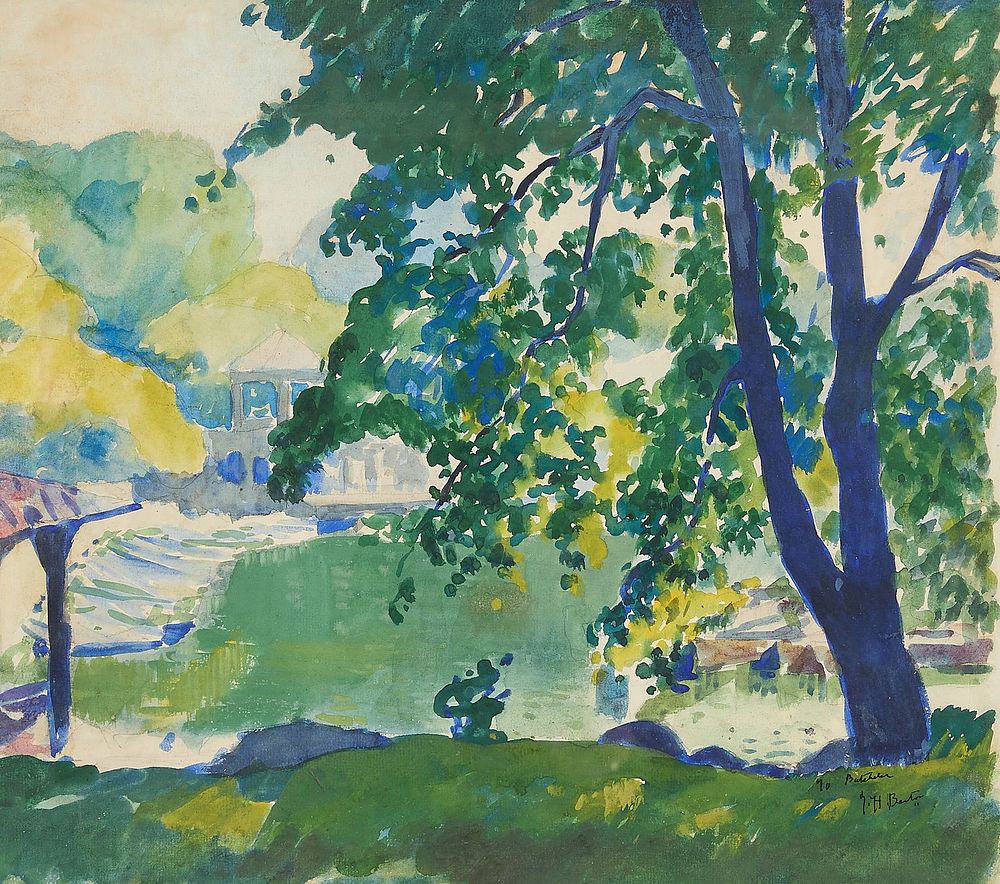
Thomas Hart Benton ”Central Park” Watercolor - Thomas Hart Benton (American, 1889-1975). Watercolor on paper painting titled ”Central Park, ” 1912. Depicting a lush, vibrant summer landscape of Central Park in New York City. Featuring a prominent, darkly contoured tree in the foreground framing a bridge crossing over a body of water to a pergola. Signed, dated, and inscribed ”To Batchelor” along the lower right. The painting was a gift to Benton's friend Clarence Daniel Batchelor, more commonly known as C.D. Batchelor. He was an editorial cartoonist for the New York Daily News and won the Pulitzer Prize for Editorial Cartooning in 1937. Provenance: Christie's, New York, NY, ”American Watercolors, Drawings, Paintings and Sculpture of the 19th and 20th Centuries, ” September 30, 1988, Lot 375; The Distinguished Collection of Leo & Doris Hodroff. Lot Essay: Throughout his career, Thomas Hart Benton challenged both the political and artistic establishment, emerging as a passionate advocate for rural Midwestern America. As one of the leading figures of American Regionalism, he created murals that were accessible to broad audiences while offering unflinching portrayals of American life; a reflection of his own outspoken character. Although Benton is best known for monumental works such as ”America Today” and ”Arts of Life in America, ” his artistic legacy also includes thousands of drawings, paintings, sculptures, lithographs, and watercolor landscapes that reveal the breadth of his artistic practice. Born on April 15, 1889, in Neosho, Missouri, Benton left high school at the age of seventeen to work as a cartoonist for the Joplin American newspaper. In 1907, his father agreed to support his artistic ambitions, allowing him to enroll at the Art Institute of Chicago. A year later, Benton traveled to Paris to study at the Academie Julian, where he met California artist Stanton Macdonald-Wright. Under Macdonald-Wright's influence, he experimented with Synchromism, an abstract movement that emphasized color and form. After returning to the United States in 1911, Benton settled in New York City, where his work reflected the modernist influences he had absorbed in Europe. It was during this formative period that he completed ”Central Park” which demonstrates his early interest in abstraction before his embrace of Regionalism. Following his service in World War I, Benton returned to New York and married fellow artist Rita Piacenza. Throughout the early 1920s, he continued to produce modernist and abstract works until a pivotal trip to Missouri in 1924 to visit his ailing father. Reconnecting with the people and landscapes of his home state inspired Benton to reject modernism in favor of a distinctly American style rooted in Regionalism. This shift established the visual language for which he became best known, celebrating the character and labor of rural America through dynamic murals and expressive landscapes. His growing reputation culminated on December 24, 1934, when he became the first artist to have a work, a self-portrait, featured on the cover of Time magazine. By then, Benton was widely recognized, alongside Grant Wood and John Steuart Curry, as one of the three leading American Regionalist painters. During this same period, he also taught at the Art Students League of New York, where one of his students was the future Abstract Expressionist Jackson Pollock. In 1935 Benton left New York and permanently settled in Kansas City, Missouri, where he died in 1975 just after putting the finishing touches on a mural for the Country Music Hall of Fame in Nashville, Tennessee. Sight; height: 14 1/4 in x width: 16 in. Framed; height: 21 1/2 in x width: 23 1/2 in x depth: 1 in. Condition: The sheet is lightly toned, most visible in the sky in the upper left quarter. There are no visible tears, losses, or restorations. Some light undulation to the sheet. Housed under glass. Light wear to the frame. Not inspected out of frame.