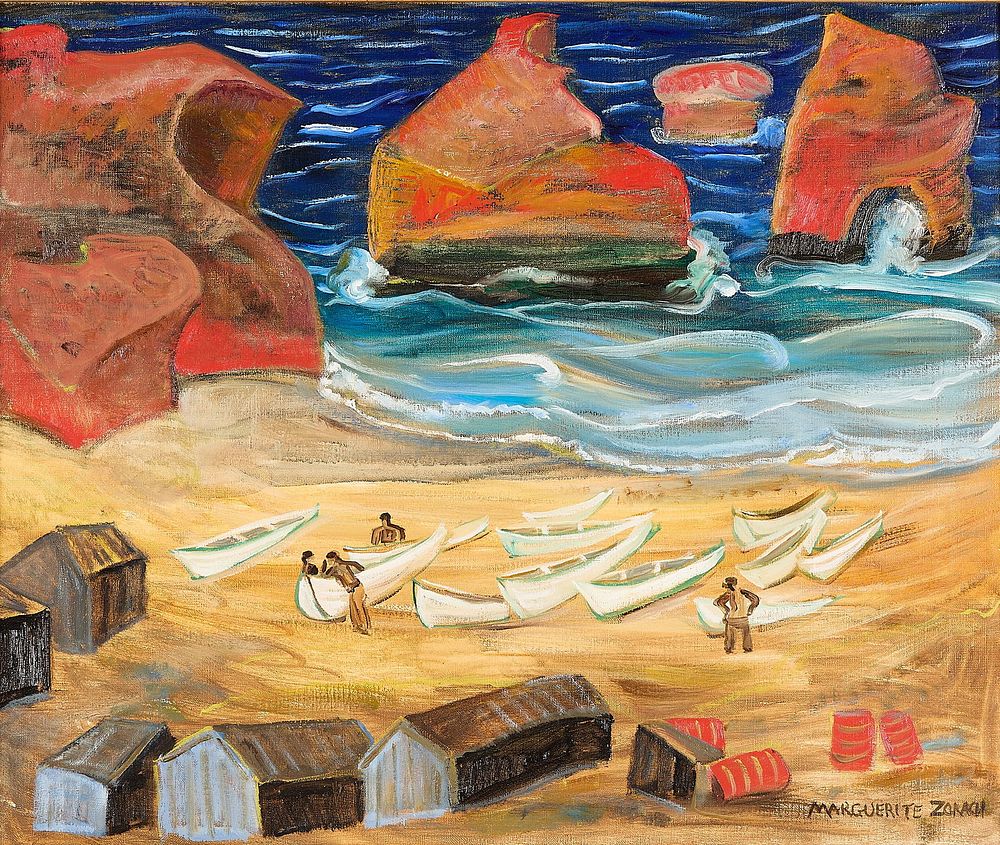
Bidspirit auction | Marguerite Zorach ”Fishermen, Magdelen Island”
Marguerite Zorach ”Fishermen, Magdelen Island” Oil - Marguerite Zorach (American, 1887-1968). Oil on canvas painting titled ”Fishermen, Magdelen Island, Canada, ” ca. late 1940s. Signed along the lower right. Inscribed ”Harbor - Magdelen Island” along the stretcher bar along the verso. Provenance: Collection of the Zorach Children (Estate no. 571); Kraushaar Gallery, New York; Private Boston Collection, 2000; Linda Hyman Fine Arts; From the Estate of Gary Fink. Lot Essay: Marguerite Thompson Zorach was a groundbreaking figure in early American modernism, best known for her bold Fauvist color palette, her embrace of Cubist forms, and her refusal to conform to traditional gender roles in the art world. Born in Santa Rosa, California, into a well-off, culturally refined family, she demonstrated prodigious artistic talent from a young age. After a brief time at Stanford University, she left for Paris in 1908 to study art, where her aunt - Harriet Adelaide Harris, a friend of Gertrude Stein - introduced her to the city’s avant-garde circles. In Paris, Zorach trained at the progressive Academie de la Palette, where she studied under Scottish Colourist John Duncan Fergusson and connected with artists like Anne Estelle Rice, Jessica Dismorr, and Anne Goldthwaite. Through these relationships and through her participation in exhibitions such as the Salon d’Automne and the Salon des Independants, she became part of a vital transatlantic network of early 20th-century modernists. Zorach played a key role in introducing modernist ideas to American audiences. She exhibited in the groundbreaking 1913 Armory Show and was closely associated with the New York avant-garde scene that flourished afterward. Alongside her husband, sculptor William Zorach - whom she met in Paris and married in 1912 - she maintained an independent and collaborative artistic practice, working across painting, textiles, and design. The couple’s Greenwich Village studio became a hub of creative exchange, and their joint exhibitions and cross-disciplinary projects challenged prevailing notions of gendered artistic roles. Marguerite was also a strong advocate for women in the arts: she served as president of the New York Society of Women Artists (1925) and participated in the Society of Independent Artists. Her work, often dismissed by male critics in her time, later came to be recognized for its experimental spirit, rich symbolism, and deeply personal themes, especially in her textile pieces, which included a monumental Rockefeller family tapestry. In addition to her painting and embroidery, Zorach was a prolific writer and educator. She published travel essays and cultural commentary in The Fresno Morning Republican during her years abroad, offering rare insight into the experiences of a woman navigating the art capitals of Europe and Asia. During the Great Depression, she created murals for the Works Progress Administration and continued to support her family through high-end textile commissions. Her influence extended into the next generation through her children, including her daughter Dahlov Ipcar, a well-known painter and illustrator. Later in life, Marguerite taught at the New School and was a summer instructor and board member at the Skowhegan School of Painting and Sculpture. She remained active in art until her death in 1968, leaving behind a legacy preserved by major institutions like the Smithsonian, the Metropolitan Museum of Art, and the Brooklyn Museum. Today, she is recognized as a pioneering force in American modernism whose work bridged fine art, design, and feminist expression. Gary C. Fink was a collector with both a lighthearted sense of humor and a serious commitment to art. Through the Museum Louvre It or Leave It, he offered Minnesotans an offbeat, thought-provoking experience; through MIA gifts, he broadened institutional collections; and through his scholarship, he continues to enable the next generation of artists. A Renaissance soul in the heart of Minnesota’s art community, Gary C. Fink was more than an astute collector - he was a spirited patron whose unconventional vision left an indelible mark on the creative landscape. Unframed; height: 20 in x width: 24 in. Framed; height: 26 3/4 in x width: 30 3/4 in x depth: 2 in. Condition: Please email us at condition@revereauctions.com for a condition report or additional photos.