Bidspirit auction | 20th c. Chinese Carved Teak
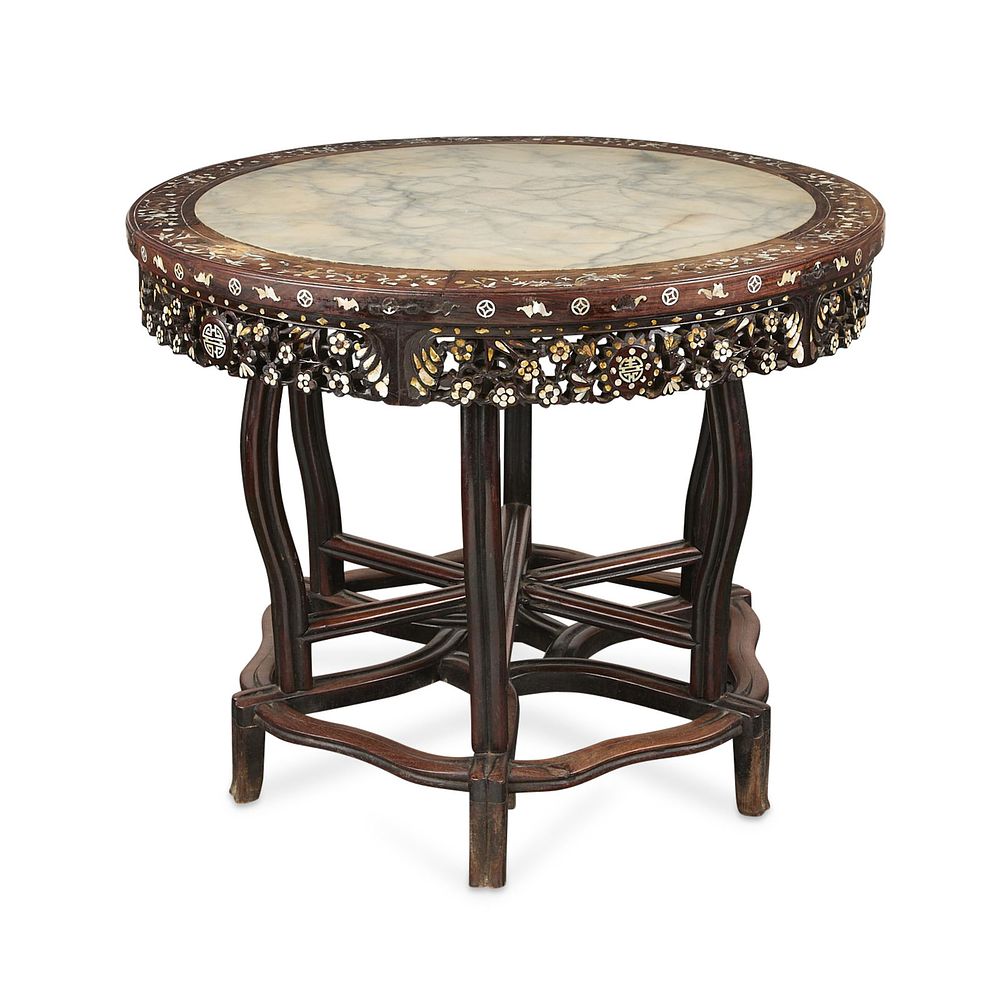
20th c. Chinese Carved Teak Wood Table with Inlay - Chinese carved teak wooden table with marble table top, mother-of-pearl inlay, and ornate marquetry throughout, early to mid-20th century. The skirt of the table is carved in the form of branches and foliate motifs interspersed with mother-of-pearl inlay depicting shou symbols, leaves, birds, and blossoming petals. The table rests upon a hexagonal frame, six shapely legs, and a floral form lower frame connecting each of the legs at the base. Once a fixture at Yuen Faung Lo, affectionately known as ”John's Place, ” this table served patrons of the iconic Minneapolis institution during the first half of the 20th century. As one of the pioneering Chinese restaurants in the city, Yuen Faung Lo was founded in the early 20th century by Woo Yee Sing. Situated on Marquette Avenue, the establishment became a beloved institution before its closure in the latter half of the century. Examples of other ephemera from Yuen Faung Lo or ”John's Place” are visible in the online collections of the Gale Family Library of the Minnesota Historical Society, including: a menu (Accession No. 2003.45.11), a photograph of the restaurant's dining room (Accession No. 2003.45.16), and a similar teak table (Accession No. 1993.7.6). Height: 33 1/4 in x diameter: 40 1/2 in. Condition: The marble table top is toned and there are light scuffs and scratches throughout, especially towards higher points of contact along the edge. Some separation to the joints throughout. There are some scratches, areas of discoloration, and signs of wear consistent with age and commercial use throughout the table top and frame including food stains and several pieces of gum along the underside of the table. There are heavy losses to the foliate form mother-of-pearl inlay along the outer rim of the table's surface; some losses to the leaf and petal form inlay along the upper band of the table's skirt. There is a loss to the wood measuring approximately six inches by one inch to one of the support rods running from the center of the table to the top of one leg; this does not affect the stability of the table and is only visible when the table top is removed. Wear along the underside of the feet. Dust and debris gathered throughout the recessed areas, especially along the carved crevices underside of the table and in the divets of the frame and legs.