Bidspirit auction | Royal Copenhagen Flora Danica Reticulated
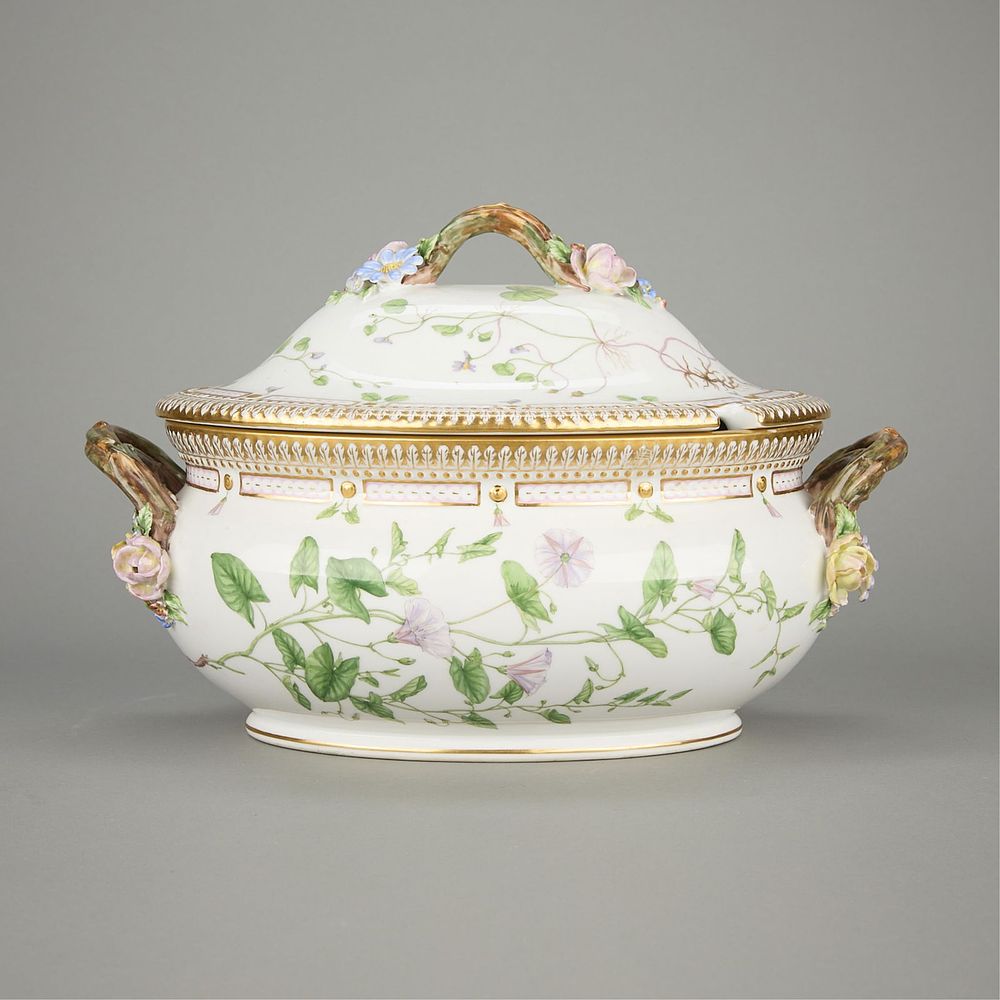
Royal Copenhagen Flora Danica Reticulated Tureen - Royal Copenhagen, Denmark. Flora Danica porcelain reticulated soup tureen with hand-painted botanical pattern, shape number ”20 3559”. Marked along the underside with Royal Copenhagen's trademark blue wave stamp and green printed marks. Inscribed with the Latin names of the plants depicted, including: ”Trifolium fragiferum L.” and ”Convolvulus arvensis L.”. The common names for each plant are ”strawberry clover” and ”field bindweed”, respectively. Lot Essay: The story of Flora Danica porcelain begins in an unexpected place--with the publication of the first complete botanical encyclopedia of Danish plants. In 1752, G.C. Oeder (1728-1791), a medical doctor and scientist, was appointed head of the newly created Royal Botanical Institution in Copenhagen. One of his first actions was to propose an ambitious project: a thorough catalog of the flora in Denmark and surrounding areas, profusely illustrated and with characteristic and taxonomic details to help the plants be financially useful to the nation. Oeder and a team of botanists spent years observing and illustrating plants in the field, and in 1861 the first volume of the Flora Danica was published. Twelve other editors presided over the project until the final volume’s publication in 1883. Flora Danica was a masterwork, notable for its contribution to the science of botany, but also for its stunning illustrations. Denmark had been a Russian ally in the Russo-Swedish War of 1788-1790. However, the Danish succumbed to pressure from Great Britain and Prussia and declared neutrality early in the conflict, failing to perform their duty as allies. Following this, King Christian VII of Denmark (1749-1808) needed a way to make amends with Empress Catherine the Great of Russia (1729-1796). He decided to give her a fabulous gift. Since Catherine was known for collecting porcelain, he decided upon a luxurious dinner service the likes of which the world had never seen. And what better subject for the decoration of this porcelain service than the illustrations from the Flora Danica, a scientific triumph and celebration of Denmark’s natural richness? In 1790, the king commissioned the Royal Danish Porcelain Manufactory (now known as Royal Copenhagen) to create a 100-setting dinner service decorated after the illustrations in the Flora Danica. Johann Christoph Bayer (1738-1812), an artist who had worked on the illustrations for the books, was hired to paint the porcelain pieces. He single-handedly painted an incredible 1,802 pieces of porcelain before production was completed in 1802. However, by the time the service was ready, Catherine the Great had died. The service stayed in Denmark, where it became a national treasure, used by the royal family on important state occasions and displayed in Denmark’s palaces and museums. In 1863, Royal Copenhagen decided to revive the pattern. In keeping with the original Flora Danica service, each piece of porcelain was painstakingly hand-molded and decorated. The pattern has continued to be made to order in this way ever since. Each piece has been hand carved, the delicate floral forms molded, glazed, painted, and gilded by a team of Danish artisans. The buyer can choose which plants they would like on their service, making each set uniquely personal. Each piece has the Latin name of the plant depicted inscribed along the underside. Each piece, through its craftsmanship and individuality, tells a story of groundbreaking scholarship, royal politics and diplomacy, and the patron of each commissioned set. (Tureen w/ lid) height: 9 1/2 in x width: 14 1/2 in x depth: 8 1/2 in. Condition: There are no major cracks or restorations to the tureen. There is a small scratch along the lid that is approximately two inches in length; the scratch is extremely faint and only visible upon close inspection. There are some chips along the petals of three of the flowers underneath the handles of the tureen and a loss to the smaller set of buds below one of the pairs of flowers. Light wear along the rim of the tureen as well as the underside of the lid, where the two come into contact. Light wear along the footrim. Light dust and minute accretions gathered throughout, particularly along the interior of the tureen.