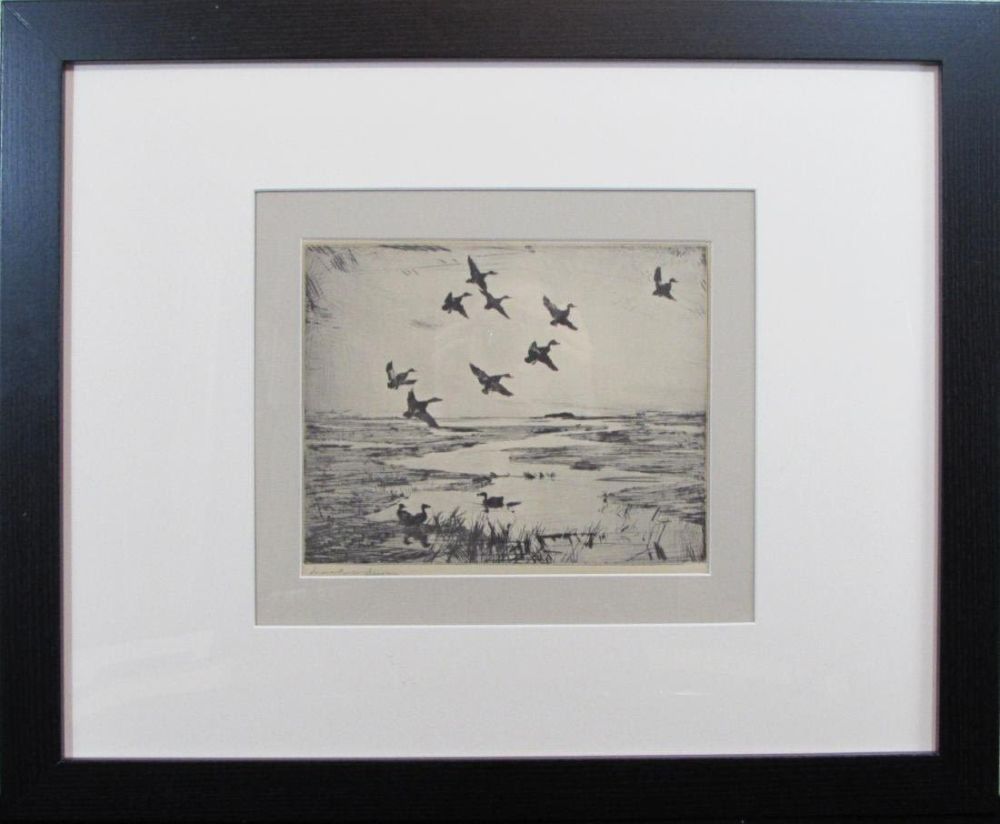
Bidspirit auction | Frank Weston Benson, etching, untitled
Frank Weston Benson, etching, untitled - This original etching by artist Frank Weston Benson features the image of ducks. In good condition, the image measures 7” x 8.75” and is pencil signed by the artist in the lower left corner of the piece. Winning bids are packaged and shipped by UPS. Shipping estimates are available upon request. Frank Weston Benson was born in Salem, Massachusetts, at a time when the wharves still bustled with maritime activity and the warehouses of the old town were filled to overflowing with the exotic goods of the China trade. Commercial plenitude was the leitmotif of Benson's youth. He lived surrounded by it in the fine, commodious house owned by his grandfather, the China-trade captain, Samuel Benson. The artist's father, George Benson, was a cotton merchant who commuted to work in Boston, fifteen miles to the southwest. When Frank Weston Benson died in Salem, eighty-nine years later, the nuclear age had already begun. In the interim Benson lived a long, eventful, and happy life, financially secure, surrounded by a loving family, and presiding, along with a close circle of collegial friends, over the art-life of Boston. Benson's father expressed initial doubt over his eldest son's plan to be an artist, but, persuaded by Benson's mother, gave him the wherewithal to try. In 1880, Benson enrolled at the School of the Museum of Fine Arts in Boston, where his fellow students included the friends and colleagues of a lifetime-Edward Simmons, Willard Metcalf, Ernest Fenellosa, William Bicknell, Edmund C. Tarbell, Robert Reid, and Joseph Lindon Smith. They all studied with the school's founding teachers, Otto Grundmann and Frederick Crowninshield. For his twenty-first birthday, Benson's parents gave him a ticket to Paris and one-thousand dollars to buy as much art education as that sum could obtain. Benson spent the years 1883 to 1885 in Europe, sharing Paris quarters with his school chum and fellow-artist, Joseph Lindon Smith, studying during the winter at the Academie Julian with Gustave-Rodolphe Boulanger and Jules-Joseph Lefebvre, and spending the summer of 1884 in Concarneau, Brittany. When Benson returned to Salem in 1885, he struggled to establish himself as a portrait artist. There was no cultural latitude for a son of Salem to be anything less than self-supporting. Benson's Salem family was comfortable, to be sure, but not rich, their fortunes grounded in the mercantile activities of early nineteenth-century Massachusetts, not in the railroad building and manufacturing that created enormous wealth after the Civil War. Throughout his career Benson earned a living from his art, paying careful heed to finances and always mindful of the need to support his large family. Indeed, when Benson's younger brother John announced his desire also to be an artist, George Benson, the paterfamilias, ruled that one artist in the family was sufficient, with the result that John trained as an architect and did not return to painting until late in life after a successful career in business. In 1887, Benson accepted a teaching position at the Portland School of Art in Portland, Maine, but remained only until 1888, when he again returned to Salem to marry a childhood friend, Ellen Peirson, and set up a studio in Boston. In the late spring of 1889, Benson was offered a teaching position at his alma mater, the Boston Museum School, where he began an affiliation that would last until 1912. The twin foundations of Benson's early success were his work as a teacher and as a first-rate professional portraitist. The canvases on which his historical reputation rests, however, come from the second phase of his career when he exhibited as a member of The Ten, from 1897 until 1919. The Hilltop is the iconic work of this period. After World War I, as the modernist style gradually gained ascendancy in America, Benson withdrew from portraiture and figure painting and made a specialty of etchings, watercolors, and occasional oils of wildlife and sporting subjects. This reflected his lifelong love of the coasts, marshes, and hills of New England, as well as his passion for bird hunting and fishing. It also secured a niche away from the controversies of the art world, a specialized area where his skill and commitment to his subjects continued to find ready appreciation and patronage. Benson maintained a studio in Boston until 1944 and painted until the end of his long life. A fertile combination of talent, application, sound training, and good fortune combined to make Benson the very model of a successful New England artist. From 1899 to 1903, Frank Weston Benson and his young family spent their summers in Dublin, New Hampshire. In the late nineteenth century, Mount Monadnock played landscape muse to a summer colony of artists settled in Dublin under the leadership of Abbott Handerson Thayer (1849-1921). (For an excellent discussion of Dublin as an artists' colony, see Barbara Ball Buff, The Dublin Colony,