Bidspirit auction | Sha'arei Dura, with an elucidation
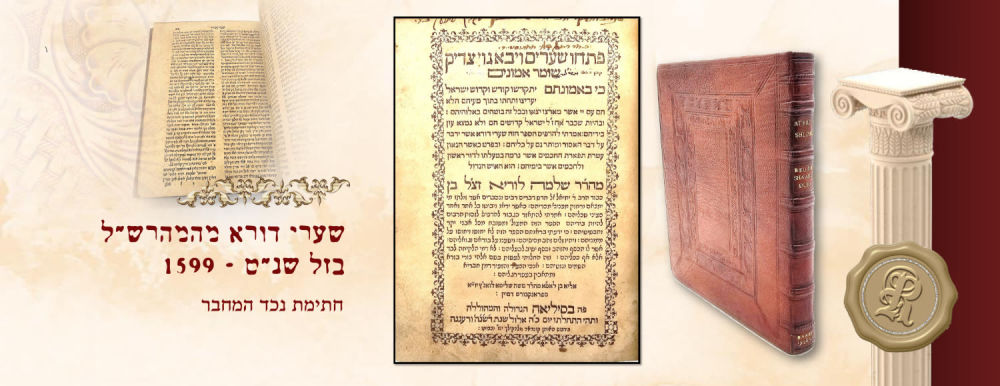
Sha'arei Dura, with an elucidation by Rabbi Shlomo Luria. Basel, [1599]. One of the first editions. Rare. Signature of the author's grandson Rabbi Asher Luria - Sha'arei Dura, with an elucidation by Rabbi Shlomo Luria. Basel, [1599]. One of the first editions. Rare. פתחו שערים ויבוא גוי צדיק שומר אמונים, Sha'arei Dura, Issur Veheiter [by Rabbi Yitzchak halevi of Düren], with Chidushei Rabbi Shlomo ben Rabbi Yechiel Luria and with th einnovations of the copyist, Rabbi Eliya Luntz, on Hilchos Nidah. Conrad Woldkilch Press, Basel, [1599]. Rare. FIRST EDITION. Signatures on title including Asher Luria. ff. 99. Trimmed, browned, f. 54 repaired. Modern blind-tooled morocco. Sm. 4to. Vinograd, Basle 194; Prijs, Basle 164. R. Asher Luria (d. 1907), a descendant of the Maharshal, was a Torah scholar of Mogilev, Belarus. He was the son-in-law and disciple of R. Shlomo Zalman son of R. Hillel Rivlin of Shklow. An extremely prosperous man, dealing in forest logging, R. Asher was an illustrious figure combining wealth and prominence in Torah. In 1867, he published commentaries and additions to his father-in-law's book Divrei Shlomo, two parts (Warsaw-Vilna, 1868-1888). In 1890, he printed in Vilna his book Shtei Halechem with the Lechem Shemen commentary, on the laws of Rosh Chodesh, Pesach, Yom Tov and Chol HaMoed. In Shtei Halechem, the author brings a summary of the teachings of the Beit Yosef, and an abstract of the words of the Rishonim which are not quoted by the Beit Yosef, whilst his own novellae are printed under the title of Lechem Shemen. In 1891, he immigrated to Jerusalem, where he printed his book Or Yekarot on Mishnayot - Tractates Kelim, Ohalot and Nega'im of Order Taharot. The upper part of the page features a summary of the commentaries of the Rishonim, and in the lower part, Biurim VeChiddushim - commentaries and novellae. He frequently quotes the writings of the Gaon of Vilna in his books, and occasionally quotes commentaries from his father-in-law's writings. In his books, it is apparent that he followed the study methodology of the Gaon of Vilna and his disciples.