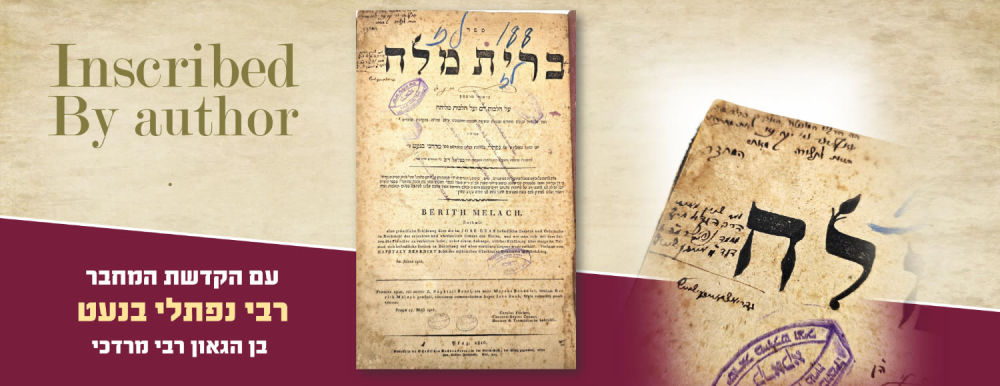
Bidspirit auction | Personal inscribed by the author!
Personal inscribed by the author! Sefer Brit Melach, with approbation from the author’s father, Rabbi Mordechai Bennett. First edition, Prague 1816 - Personal inscribed by the author! Sefer Brit Melach, with approbation from the author’s father, Rabbi Mordechai Bennett. First edition, Prague 1816 Sefer Brit Melach on halachot of blood and salting, by the gaon Rabbi Naftali Bennett, son of the gaon Rabbi Mordechai Bennett, Av Beit Din of Niklasbourg, who also wrote a warm approbation for his son’s work, in which he praises him and tells him about other gedolim (the Rav of Leifnik and more) who saw the work and praised it. First edition, from the lifetime of the author and his father. 67 leaves. Introduction by the author. Stains, BENET (BENEDICT), NAPHTALI BEN MORDECAI: Author and rabbi; born at the end of the eighteenth century; died October, 1857, at Schafa, Moravia, where he was rabbi. He was the author of the following works: (1) ”Berit Melaḥ” (Covenant of Salt), Prague, 1816, a collection and explanation of the precepts in regard to the laws of salting the meat, in order to remove the blood (Yoreh De'ah, 69-78); (2) ”Misped Gadol” (Great Mourning), Vienna, 1830, a eulogy on the death of his father, Mordecai Benet; (3) ”Emunat Yisrael” (Israel's Faith), Prague, 1832, a Jewish catechism in Hebrew and German; (4) ”Imre Shefer” (Goodly Words, Gen. xlix. 21), Presburg, 1840, a funeral oration on Moses Sofer; (5) ”Torat Dat Mosheh we-Yisrael” (Doctrine of the Law of Moses and Israel), Prague, 1826, on the principles of the Jewish religion. The catechism became very popular and passed through several editions. Though Benet's stand-point was strictly orthodox, he did not carry his orthodoxy to extremes, as can be seen from a correspondence with Isaac Samuel Reggio on the question of future punishment (”Kerem Ḥemed, ” i. 9), in which he shows himself vacillating on this point. Benet's ”Torat Dat Mosheh we-Yisrael” is also written from a moderate orthodox point of view; but he accepted his father's views in opposing the Reform movement, and assails Aaron Chorin as a man actuated by personal motives in advocating reform. Bibliography: Fürst, Bibl. Jud. i. 103;