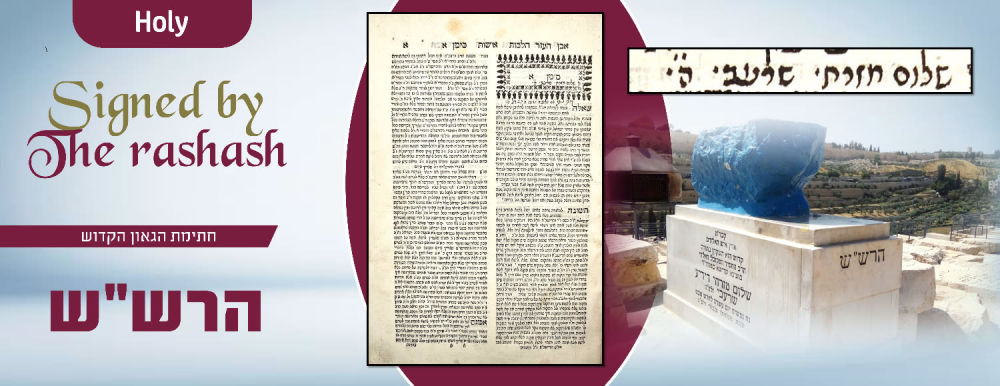
Bidspirit auction | Signature of Rabbi Shalom Mizrachi
Signature of Rabbi Shalom Mizrachi Sharabi – The Rashash - Petach Beit David, responsum on Even Ha-Ezer and Choshen Ha-Mishpat, by Rabbi Yosef Ben David Ben Shabtai of Salonika. Salonika, 1746. Part B of Sefer Beit David (Part A is on Orach Chaim and Yoreh De'ah). - Missing the title page R. Shalom Mizrachi Sharabi – the Rashash (1720-1777) was born in Sharab, Yemen and lived in Sanaa. Already as a young man, he was an outstanding Torah scholar and kabbalist, though modest and self-effacing. In his youth, he was faced with a difficult challenge, which brought him to vow to immigrate to Jerusalem. He left Yemen, travelling through Bombay, Baghdad and Damascus, until finally reaching Jerusalem. There, he sought employment as a servant in the home and Beit Midrash of R. Gedaliah Hayyun – dean of the Beit El yeshiva for kabbalists, concealing his greatness. He would wait on the Torah scholars of the yeshiva, quietly absorbing their teachings. When they were posed questions which they didn't know the answer to, he would secretly write the answer and leave it in the Beit Midrash. When R. Gedaliah Hayyun discovered the extent of his Torah knowledge and holiness, he took him as a husband for his daughter Chanah. After R. Gedaliah's passing in 1751, the Rashash was appointed to succeed him as dean of the Beit El yeshiva for kabbalists. He established a society for kabbalists named Chevrat Ahavat Shalom. The members of the society were bound together with specific conducts and regulations they adopted, and with mutual responsibility. Amongst the members of the society were the Chida, R. Yom Tov Algazi, R. Gershon of Kitov (brother-in-law of the Baal Shem Tov), and others. His disciple the Chida describes his holiness, his exceptional knowledge and understanding of the kabbalah of the Arizal, and his work in arranging the kavanot of the Arizal on prayer (Shem HaGedolim, Maarechet Gedolim, letter Shin). Of particular fame is the siddur he compiled, known as Siddur HaRashash, which contains the kabbalistic kavanot on the prayers according to the Arizal, which has since become the primary source for kabbalistic kavanot in prayer.