Bidspirit auction | Rare! On Rabbi Mordechai Menachem
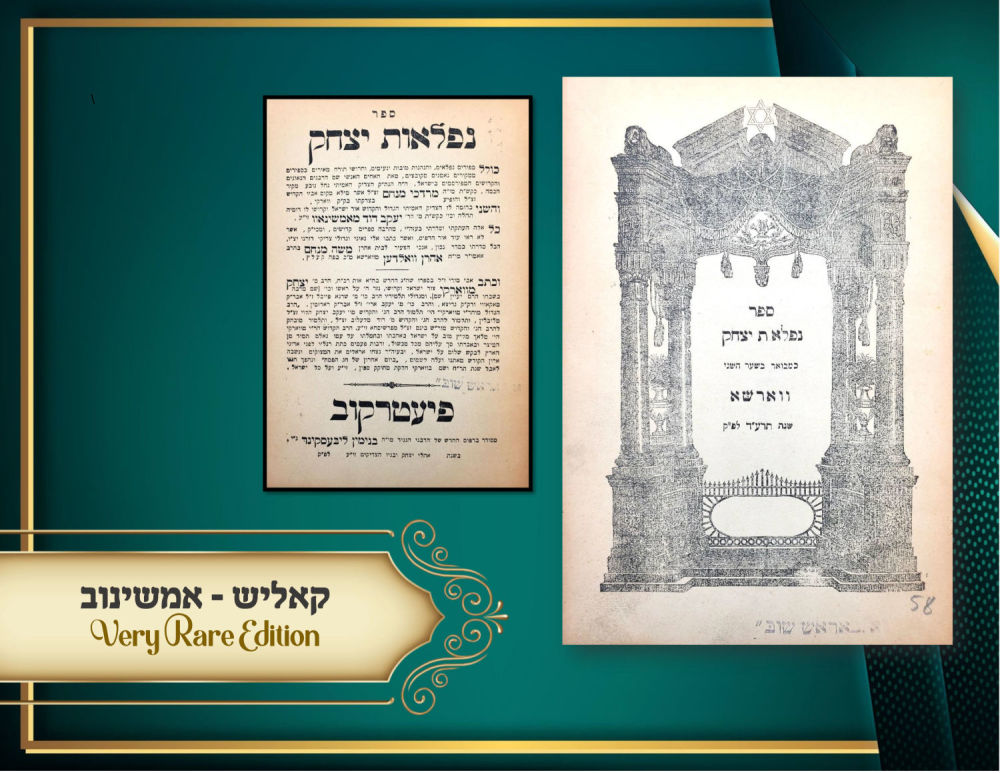
Rare! On Rabbi Mordechai Menachem of Kalish, and Rabbi Yaakov David of Amshinov - Descriptive work on the history of Hasidism in Poland and its leaders by Moses Menahem Mendel ben Aaron Walden. An unusual feature of the book is that the first two title pages, one with the book name within an architectural frame and the second more detailed, both give the title as Nifla’ot Yitzhak, yet the header for the text of the book and the title under which it is known is Ohel Yitzhak. The detailed title page states that it is wondrous tales, good and pleasant customs, Torah novealle, enlightening like sapphire, from the rabbis, ge’onim, holy and well known in Israel. A second paragraph refers to Walden’s father, Aaron Walden, author of Shem ha-Gedolim he-Hadash. Ohel Yitzhak is in two parts, the second part concluding with addenda to the first part. The text is in two columns in rabbinic type. Included are tales about R. Jacob Isaac ha-Hozeh (the Seer) of Lublin. R. Moses Menahem Mendel Walden published several works on the history of Hasidism in Poland, including, in addition to Ohel Yitzhak, Beit ha-Hayyim (1930–31) on rabbis who died in Kielce; Ve-Khabbed Av, supplements to Shem ha-Gedolim he-Hadash (1923); Nifle'ot Yizhak (1914), on the brothers Mordecai Menahem and Jacob David Kalish; and Nifle'ot ha-Rabbi (1911), also on Ha-Hozeh of Lublin. His father, Aaron ben Isaiah Nathan Walden (1838–1912) was a Hasid of R. Menahem Mendel of Kotsk and R. Isaac Meir Alter of Gur. For many years he worked as proofreader at Ephraim Baumritter's publishing house in Warsaw. He became particularly well known for his bio-bibliographical work, Shem ha-Gedolim he-Hadash, following the same structure and augmenting the Shem ha-Gedolim of R. H.J. D. Azulai. He also published R. Simeon b. Isaac ha-Levi Oshenburk's Devek Tov on Rashi's commentary on the Pentateuch with many emendations (1895); a new edition of R. David b. Solomon ibn Abi Zimra's (Radbaz) responsa, Parts 1–7 (1882); R. Moses Alshekh's commentary on the Five Scrolls (1862); and Mikdash Me'at (1890–93), an anthology of the aggadah on the Psalms in five parts. He died in Kielce.