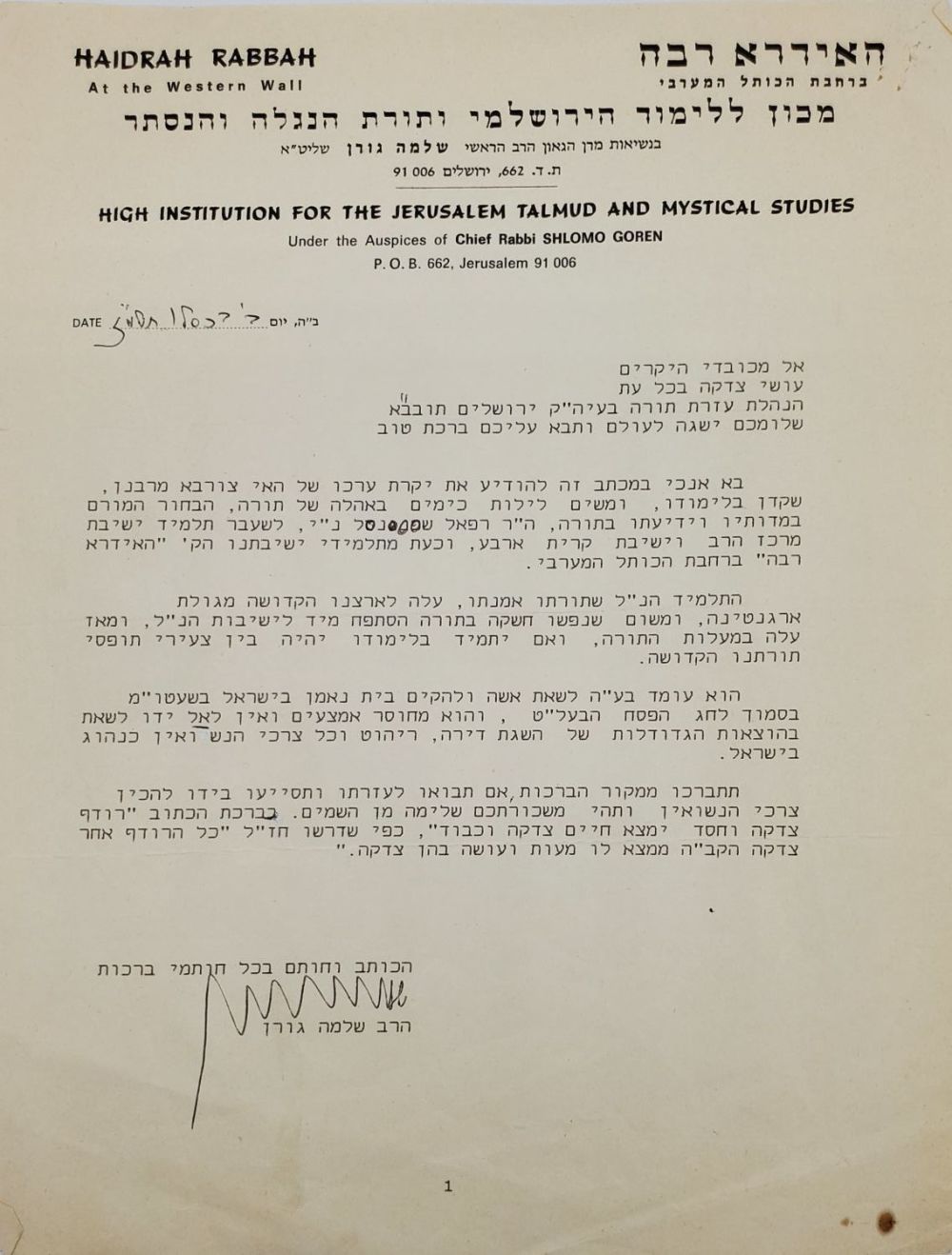
Bidspirit auction | מכתב מהגאון רבי שלמה גורן
מכתב מהגאון רבי שלמה גורן - מכתב מהגאון רבי שלמה גורן Shlomo Goren (Hebrew: שלמה גורן; February 3, 1917 – October 29, 1994), was an Orthodox Religious Zionist rabbi in Israel, a Talmudic scholar and foremost authority on Jewish law (Halakha). He founded and served as the first head of the Military Rabbinate of the Israel Defense Forces and subsequently as the third Ashkenazi Chief Rabbi of Israel from 1973 to 1983, after which he established a yeshiva in Jerusalem, which he headed until his death. He served in the Israel Defense Forces during three wars, wrote several award-winning books on Jewish law, [1] and was appointed Chief Rabbi of Tel Aviv in 1968. Contents Goren was born in Zambrów, Poland to Abraham and Haya Tzipora Goronczik. The family immigrated to the British Mandate of Palestine in 1925. The family was among the founders of Kfar Hasidim, a village of religious Jews near Haifa where Goren grew up.[2] Education As a young boy he was sent to Jerusalem to study at the Etz Chaim yeshiva. Later he became the youngest student to enter the prestigious Hebron yeshiva in Jerusalem at age 12, where he was identified as a prodigy. His first book, dealing with Temple sacrifices, was published when he was 17 years old.[3] He received rabbinic ordination at age 17.[2] Goren studied philosophy, mathematics and classics at the Hebrew University from 1940 until 1944.[2] Military career Goren on left, saluting, at the grave of Uri Ilan (1955) Goren's career was characterized by a commitment to the Religious Zionist values of his youth. He volunteered for the Haganah in 1936, and served as a chaplain for the Jerusalem area during the 1948 War of Independence, during which he tested for and qualified as an IDF paratrooper. Goren was a Chaplain of the Carmeli Brigade during the war. Immediately after the War of Independence, he engaged, often at great personal risk, in the collecting of the bodies and giving proper burial to soldiers whose remains had been left in the field. He strongly opposed the idea of separate religious and secular units and worked for the integration of all soldiers in united army units. He was the most prominent halakhist involved in rulings for religious soldiers regarding their army service. Goren was eventually promoted to the rank of Brigadier-General. Following the establishment of the State of Israel, Goren was appointed Chief Rabbi of the Military Rabbinate of the IDF with the rank of Major-General, a position he held until 1968. Rabbi Goren used the opportunity to help establish and organize the military chaplaincy's framework, streamlining processes to get soldiers accommodations for kosher food and prayer services. Goren personally wrote a new prayerbook to accommodate the different prayer styles used by various ethnic groups serving in the army.[citation needed] Goren also served in the 1956 Suez Crisis and the 1967 Six-Day War, where he was promoted to a full General. Goren was on hand during the conquest of East Jerusalem on 7 June 1967, where he gave a prayer of thanksgiving broadcast live to the entire country. Shortly afterward Goren, blowing a shofar and carrying a Torah scroll, held the first Jewish prayer session at the Western Wall since 1948. The event was one of the defining moments of the war, and several photographs of Goren, surrounded by soldiers in prayer, have since become famous around the world and particularly in Israel. The most famous photograph shows Goren blowing the shofar against the background of the Western Wall.[4] Controversy A poster signed by prominent rabbis exhorting people to not to rely on Goren's halakhic rulings (1972) Goren attracted many admirers through his passion for Religious Zionism and his combining Zionist activism with a commitment to Judaism and Jewish scholarship. However, his uncompromising personality later resulted in him becoming a polarizing and controversial figure in Israeli politics.[citation needed] Goren called the vehement attacks on him a ”moral and religious scandal.”[5] Halakha Goren spent most of his term as Chief Rabbi of Israel attempting to reconcile Jewish religious teachings with modern problems of the state, including advancements in technological progress and various high-profile conversion cases. Goren often clashed with his more conservative rabbinical colleagues.[6] One example of Goren's desire to adapt Halakha to changing realities in science was his controversial stance on Kiddush Levana, the monthly blessing over the new moon. A prayer customarily added after the blessing contains the words ”just as I dance before you and am unable to touch you.” Goren said that since the Americans landed on the moon in 1969, this line should be changed to reflect that it is, in fact, possible to touch the moon.[7] Goren visiting a soldier in the Hospital, 1969 Religious-Zionist activism Temple Mount Six Day War. Shlomo Goren, who is surrounded by IDF soldiers,