Bidspirit auction | An Assortment of Antique Burmese
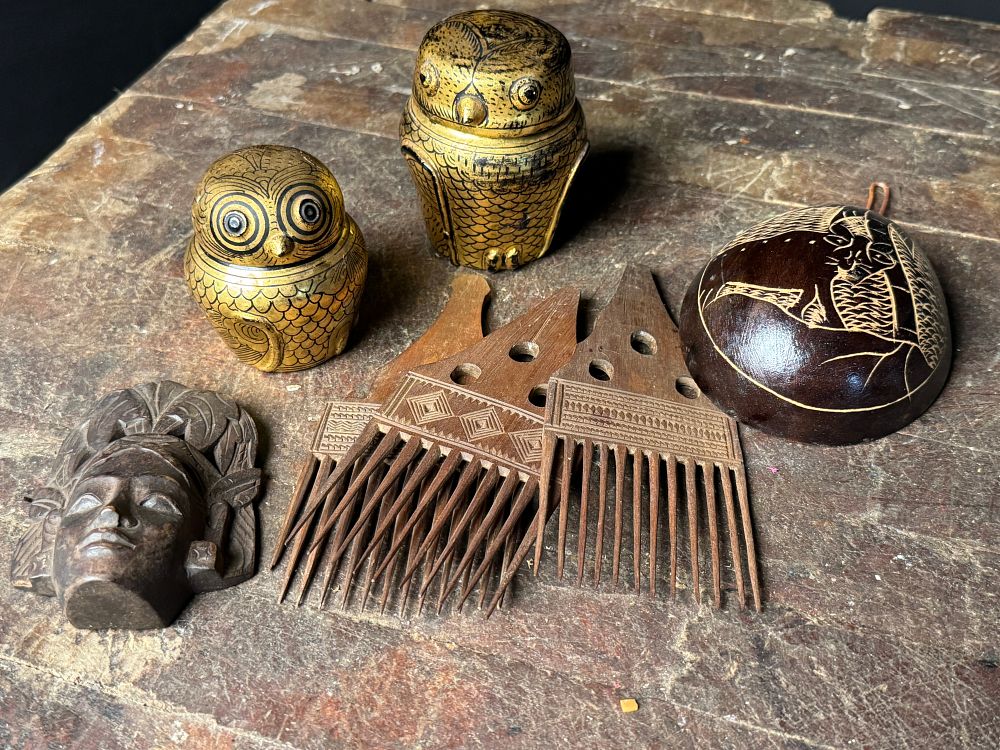
An Assortment of Antique Burmese Lacquerware, African Carved Wood Combs, and Southeast Asian Decorative Arts - This lot comprises a diverse collection of antique global folk art and ethnographic accessories. Included is a pair of owl-form nesting vessels from Myanmar, featuring a hand-painted gold pigment inscription on the base of the larger owl reading HAND MADE BURMA. The vessels are constructed with a lacquer finish over a presumed wood or bamboo base, utilizing the shwe zawa technique of gold leaf application with hand-etched black line work depicting stylized concentric eyes and scale-like feather patterns. The collection further includes a group of three hand-carved hardwood hair combs of West African origin, featuring geometric chip-carved handles with diamond, chevron, and triangular motifs, each pierced with three circular apertures. Also present is a small relief-carved dark-stained hardwood mask or decorative head depicting a face with closed eyes and an ornate headdress, featuring an incised inscription on the reverse reading IBANG CODOT. Completing the group is a polished and engraved half coconut shell bowl or wall hanging, featuring a leather cord and fine line incisions depicting a profile figure in a decorative headdress against a cross-hatched background. As these items are antique, they exhibit a range of characteristic surface wear consistent with age and use. The Burmese lacquer owls show visible wear to the gold leaf at the rims and joints, with scattered surface scratches and minor losses to the lacquer on the bases (photos 2, 4, and 5). The African wood combs show irregular spacing of the hand-carved tines, with a small chip noted at the tip of one tine on the diamond-patterned comb (photo 10). The dark-stained mask exhibits surface wear and thinning of the finish on the high relief points of the face and headdress (photo 6). The engraved coconut shell shows minor surface scuffing to the exterior and natural fiber variations to the interior (photos 8 and 9).