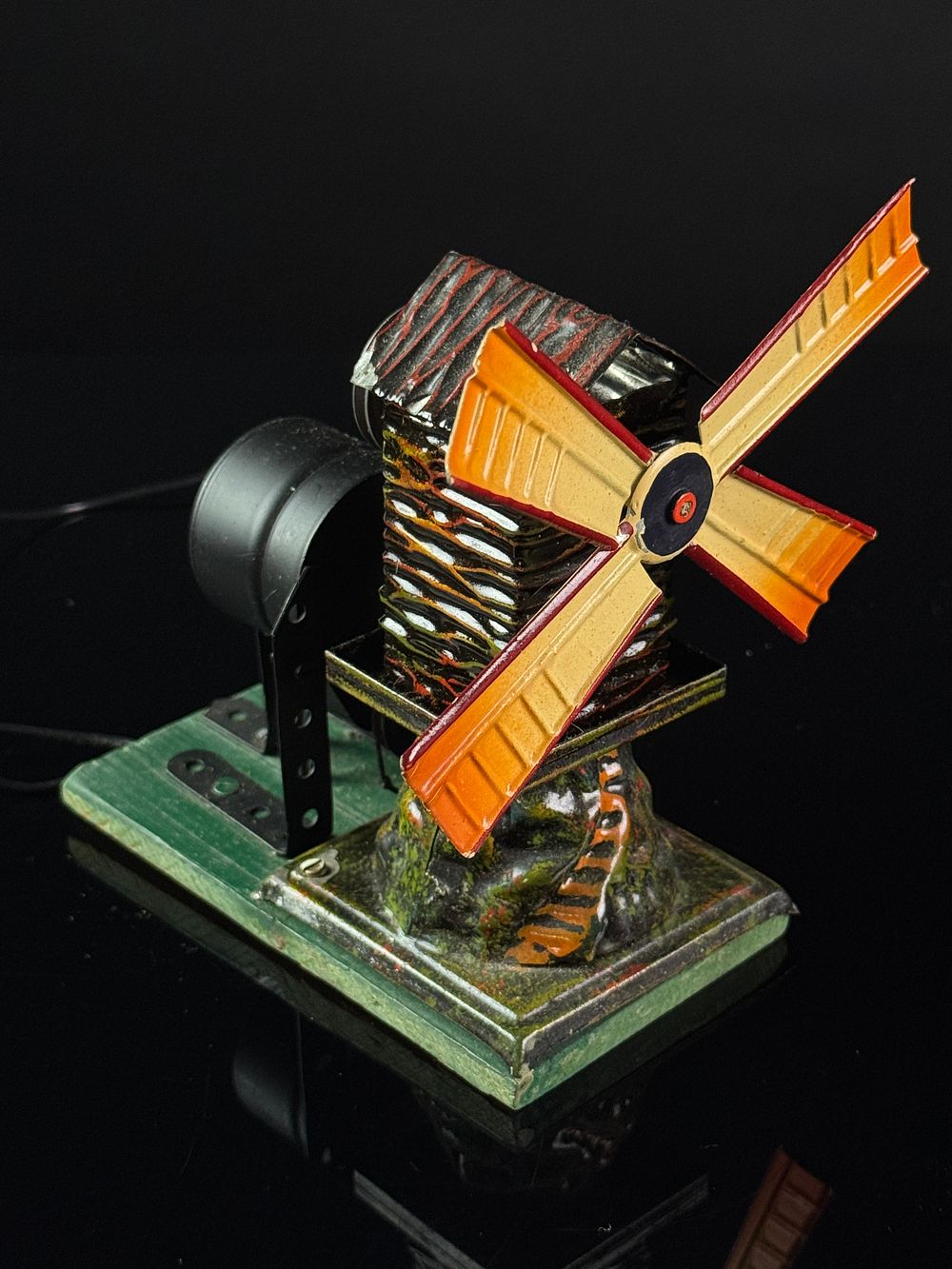
Bidspirit auction | Mid-Twentieth Century Electrified Animated Windmill
Mid-Twentieth Century Electrified Animated Windmill Accessory - This electrified animated model windmill accessory is constructed from lithographed tin-plate mounted to a painted wood base. The windmill features a four-sail fan finished in cream and orange lithography with red borders, attached to a central hub. The main tower is composed of horizontally ribbed tin-plate with a multi-colored finish in tones of red, yellow, and green. A secondary tin-plate structure, possibly representing a water pump or mill house, is situated behind the main tower. The assembly is secured to a green-painted rectangular wooden base using black perforated metal support straps reminiscent of early construction toy sets. The device is powered by a synchronous electric motor manufactured by the R. W. Cramer Co. The motor housing is made of a black molded material, likely bakelite or plastic. A variety of technical specifications and manufacturer details are molded into the motor housing in a circular arrangement. The top curve reads CENTERBROOK, CONN. Below this, the text indicates MOTOR, followed by OTHER PAT. PENDING and TYPE. The bottom curve of the housing reads R. W. Cramer. Additional molded technical data includes SYNCHRONOUS, U. S. PAT 2.436 AND 2.492, DATE, R. P. M. 1 1/2, CY 60, V 115, and W 2.5. A small Underwriters Laboratories (UL) logo is also visible on the housing. The internal wiring consists of black insulated leads that exit through a central hole in the underside of the wooden base. The tin windmill house section measures approximately 2 inches in width at the base. Measurements taken across the base of the tower section (photo 6). The lithographed tin surfaces exhibit significant wear, including scattered scratches, paint loss, and surface oxidation, most notably on the edges of the sails and the ribbed tower (photo 1, 5). The red paint on the roof shows heavy scuffing and loss (photo 2). The green paint on the wooden base is worn at the corners and edges, revealing the underlying wood (photo 4). The tin sails are slightly misshapen and bent (photo 5). The electrical system is incomplete and in non-working condition, as the primary power cord has been cut, leaving only internal leads and a short segment of black cord (photo 4). The motor and mechanical drive have not been tested for functionality.