Bidspirit auction | An Assortment of Alva Museum
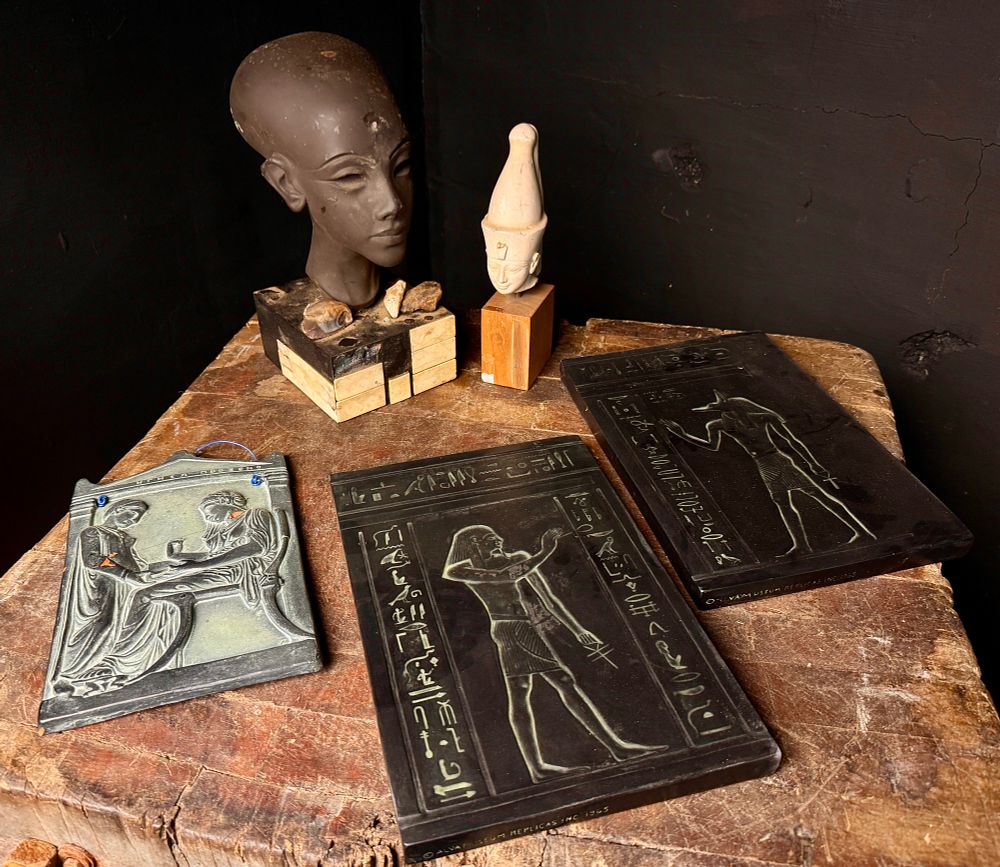
An Assortment of Alva Museum Replicas and Other Mediterranean Style Sculpture - This assortment of decorative sculpture includes several Egyptian and Greek style pieces in various cast materials. The primary items are a pair of resin wall plaques produced by Alva Museum Replicas, Inc., finished with a dark basalt-like patina and green-tinted incised details. The first plaque (FM-12) portrays a male figure in a traditional Egyptian pose holding an ankh, while the second (FM-13) depicts the jackal-headed god Anubis. Both plaques bear a green-tinted inscription on the side edge reading © ALVA MUSEUM REPLICAS INC 1965. The reverse of each plaque features a yellow adhesive label titled Ceremonial Relief, providing archaeological context regarding the original 26th Dynasty basalt sarcophagus of Taho at the Louvre Museum. A gold adhesive label is also present on the reverse, stating REPRODUCED FROM THE ORIGINAL AT THE LOUVRE PARIS and noting collaboration with the Special Services Department of the French National Museums. The group also includes a small Greek relief plaque depicting two draped figures. The reverse of this plaque bears an impressed mark in a small cartouche reading MADE IN GREECE. Freestanding sculptures include a large dark-finished head of an Amarna-period princess mounted on a black and white tiered composite base accented with three stone fragments, and a smaller white-finished head of a pharaoh wearing the Deshret (Red Crown) mounted on a square wooden plinth. A folding wooden ruler confirms the dimensions of the larger plaques. Large Plaques: 11 7/8 inches h x 7 7/8 inches w. The Greek plaque shows significant structural damage including a vertical crack extending through the center of the figures and another across the lower section, with visible orange-colored adhesive repairs to the surface (photo 9). It also has a missing upper-left corner tip and two small holes drilled at the top for a blue wire hanger (photo 9). The Amarna princess head exhibits multiple white surface scuffs and chips to the cranium and facial features, and the base shows accumulated dust and wear to the tiered sections (photo 14). The pharaoh head has a small orange residue stain on the chin (photo 13). The two large Alva Museum plaques show general surface dust and light handling wear but no significant structural damage.