Bidspirit auction | 15th to 19th Century Collection
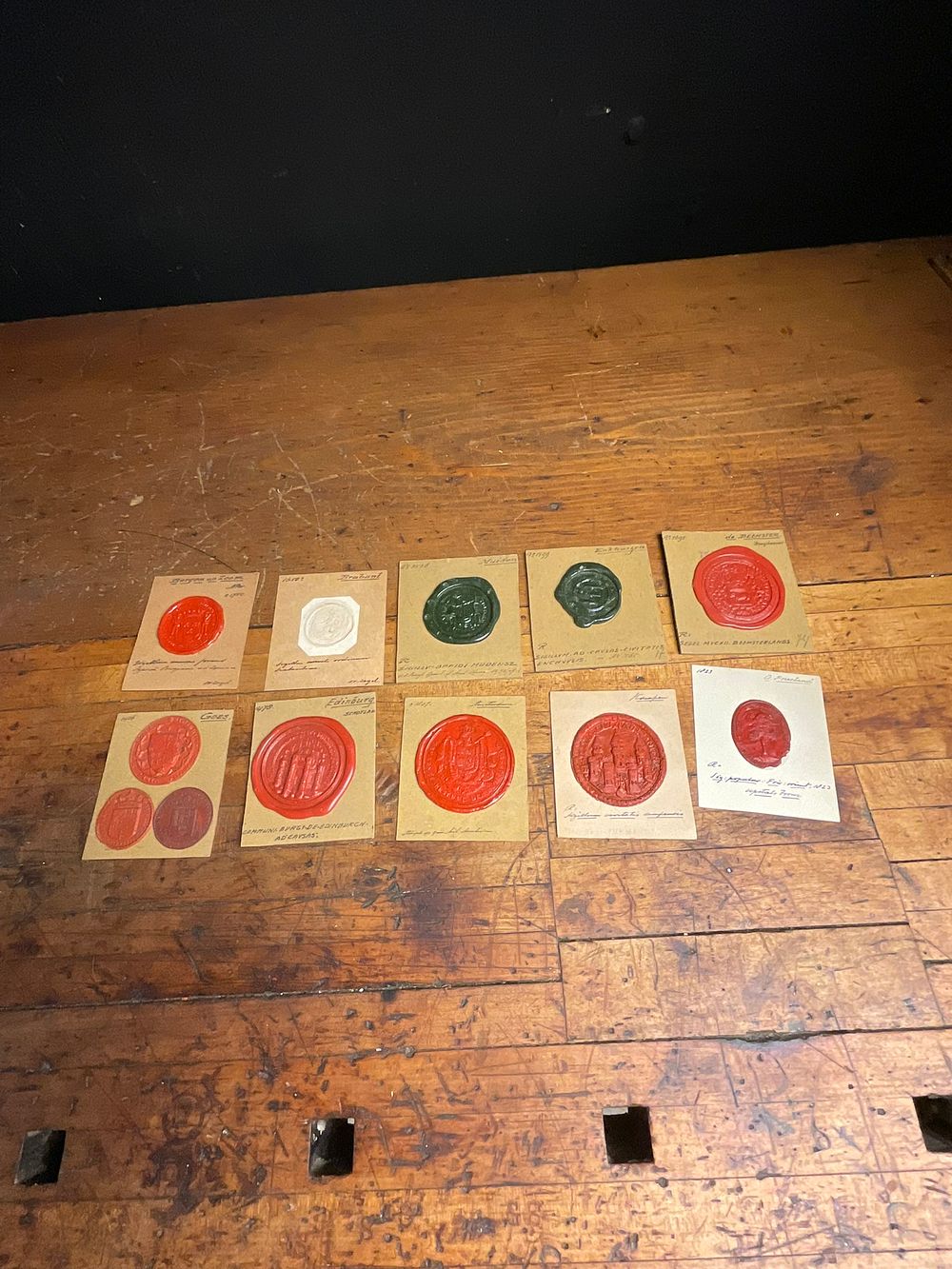
15th to 19th Century Collection of Ten Dutch, Scottish, and German Municipal Wax Seal Impressions - A collection of ten separate archival mounting cards featuring historical wax seal impressions (cerae) from various municipal and regional entities, dating from 1416 to 1823. The collection primarily focuses on the Netherlands, with additional specimens from Scotland and East Friesland. Each specimen is mounted on cardstock and accompanied by detailed handwritten ink notations identifying the location, date, and transcribing the Latin or vernacular inscriptions found on the seals. The seals are executed in red, dark green, and white paper-covered wax. The collection includes: Bergen op Zoom (Netherlands): Red wax seal, circa 1750, inscribed Sigillum causae forum Oppidi Bergennii ad Zoman. Brabant (Netherlands): Paper-covered white wax seal featuring a lion rampant, circa 1650, inscribed Sigillum consilii ordinum brabantiae. Muiden (Netherlands): Dark green wax seal depicting a medieval cog ship, inscribed SIGILLV - OPPIDI - MUDENSZ. Enkhuizen (Netherlands): Dark green wax seal depicting a ship, inscribed SIGILLVM - AD - CAVSAS - CIVITATIS ENCHVYSIS 1565. De Beemster (Netherlands): Red wax seal depicting a bull, circa 1612/1695, inscribed SEGEL MVCXII. BEEMSTERLANDS. Goes (Netherlands): Three impressions in red and maroon wax, including a 1416 design and a later seal featuring a swan inscribed GEMEENTE BESTUUR VAN GOES. Edinburgh (Scotland): Large red wax seal depicting a castle, circa 1478, inscribed COMMUNI. BURGI-DE-EDINBURGH. AD CAUSAS. Amsterdam (Netherlands): Large red wax seal with the municipal coat of arms, circa 1807, inscribed GEMEENTE BESTUUR DER HOOFDSTAD. Kampen (Netherlands): Large red wax seal depicting a multi-towered fortification, inscribed Sigillum civitatis campensis. O. Friesland (East Friesland): Oval red wax seal depicting the Upstalsboom tree, dated 1823, inscribed Sig: popular: Fris: orient: 1823 upstals boom. The set is housed in a protective mylar dust jacket cover. The collection is in good archival condition. The wax seals exhibit varying degrees of age-related fine cracking, most notably visible on the Amsterdam (photo 9) and Edinburgh (photo 10) specimens. The mounting cards show light toning and minor corner wear consistent with age and handling. The handwritten ink notations remain dark and highly legible across all cards. One red seal on the O. Friesland card shows a small loss to the bottom right edge (photo 7).