Bidspirit auction | 16th to 18th Century Dutch
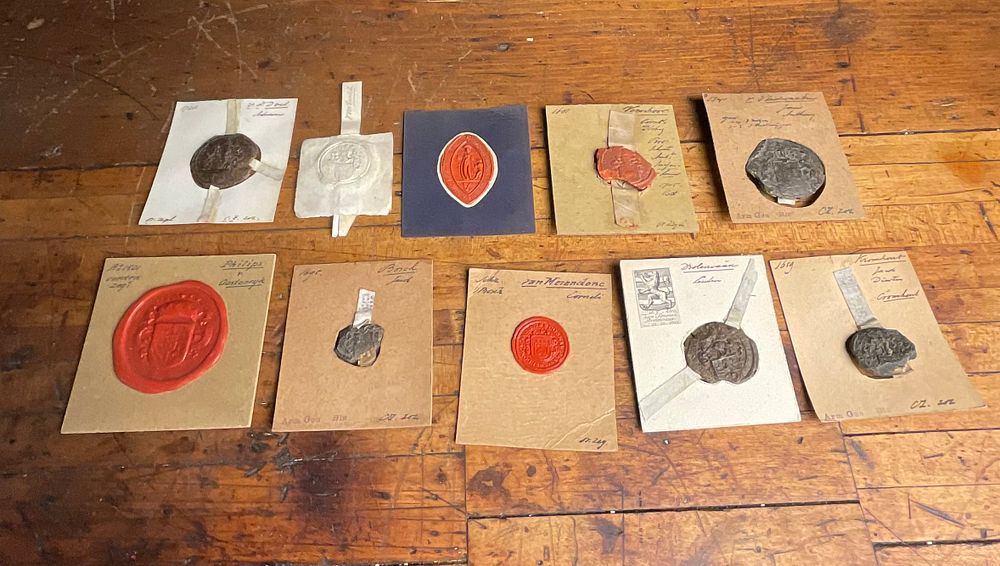
16th to 18th Century Dutch Heraldic Wax Seal Collection - A collection of antique wax and paper-press seals, primarily of Dutch origin, dating from 1501 through 1741. The assortment serves as a sigillographic study, documenting the armorial bearings of prominent individuals and families. The seals are individually mounted on card stock with detailed handwritten annotations in Dutch, providing genealogical and historical context. The collection includes: * **1501 Red Wax Seal:** A large armorial ”contrazegel” (counter-seal) for Philip I of Castile, also known as Philip the Handsome (Philips v. Oostenrijk). The seal displays a detailed coat of arms surmounted by a crown. * **1659 Dark Wax Seal:** Mounted on tan card, identified as belonging to Jan Dierte Kromhout. * **1695 Dark Wax Seal Fragment:** A partial seal identified as ”Bosch Jacob,” featuring a small attached paper tab with a matching inscription. * **1713 Dark Wax Seal:** Associated with Abraham Simonsz Drolenvaux of Leiden. The card includes a printed illustration of the family crest, a lion rampant on a striped field. * **1720 Dark Wax Seal:** Attributed to Adriaan v. d. Does. * **1741 Dark Wax Seal:** Identified as Jan Anthony v. Underwater, showing an intricate armorial design with a crown and supporters. * **Undated Red Vesica Seal:** A pointed oval wax seal mounted on black card depicting a standing ecclesiastical or noble figure, surrounded by a Gothic script legend starting with ”S'”. * **Cornelis van Merendonc Red Wax Seal:** A circular seal with a readable legend in the border: ”CORNELIS VAN MERENDONC,” featuring a grid-patterned shield. * **Verchoor Red Wax Seal:** Dated ”1601” in the upper left, showing a coat of arms with three fleur-de-lis. * **Imhoff Paper-Press Seal:** A blind-embossed white paper seal showing a finely detailed coat of arms, mounted with a vertical paper strip bearing the name ”Imhoff.” The mounting cards vary in color (tan, white, and black) and feature systematic cataloging notations such as ”N. Zegel,” ”C.Z. 202,” and ”Arm Gen Blz,” suggesting they were once part of a larger formal heraldic archive. The collection shows varying degrees of preservation consistent with age. The red wax seals, particularly the Philip of Castile (Photo 7) and the Van Merendonc (Photo 9) examples, remain largely intact with high-relief details. The darker wax seals show more significant signs of age; the 1695 Jacob Bosch seal (Photo 8) is fragmented, and the 1741 Underwater seal (Photo 6) and 1713 Drolenvaux seal (Photo 10) exhibit surface cracking and minor perimeter losses. The mounting cards show typical age-related toning, minor edge wear, and some old adhesive staining from the mounting strips (Photo 1). The paper-press seal (Photo 3) remains in good condition with sharp embossed details.