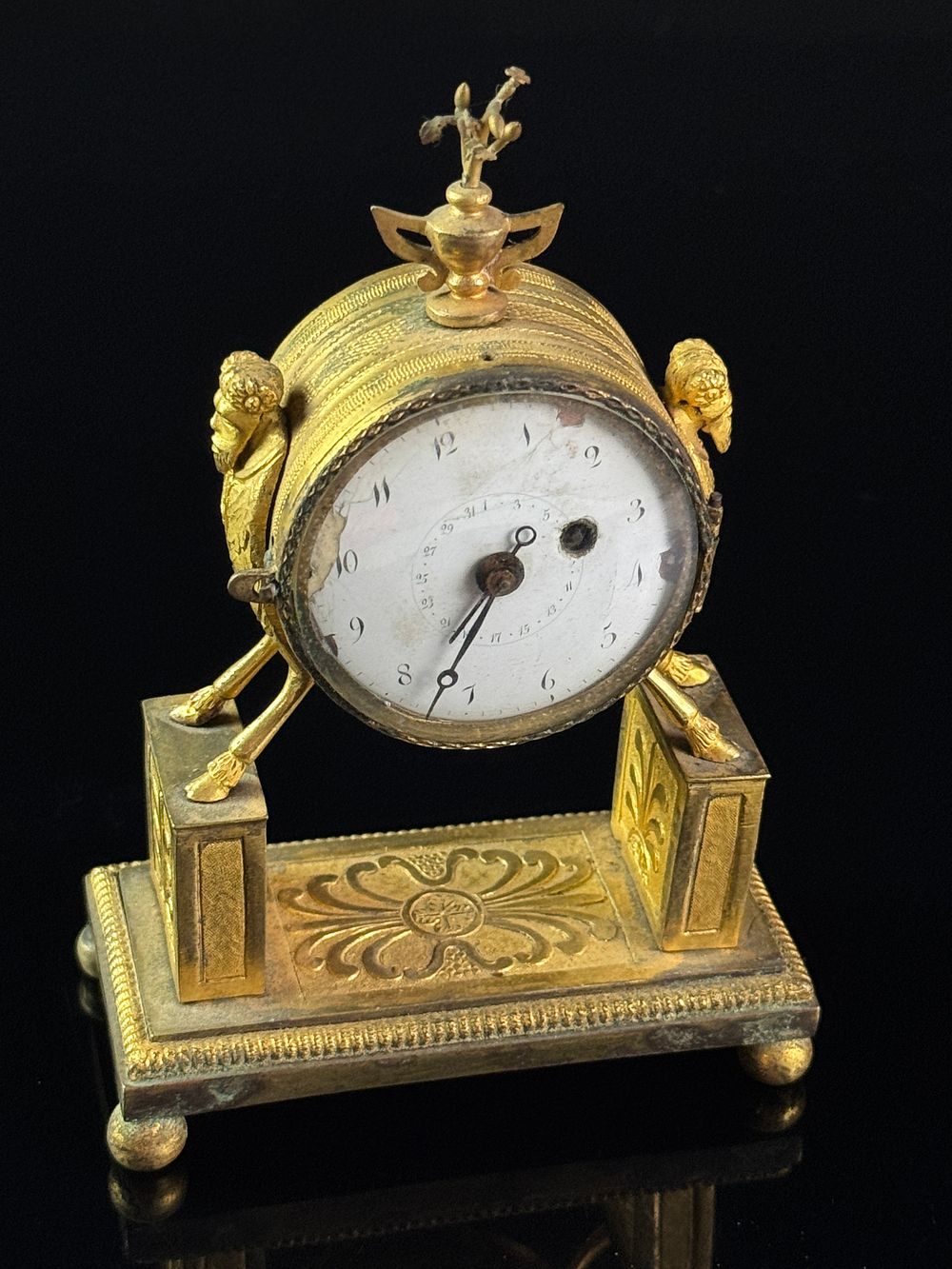
Bidspirit auction | French Neoclassical Gilt Metal Mantel
French Neoclassical Gilt Metal Mantel Clock with Charles Le Roy Movement - This neoclassical figural mantel clock features a movement by the prominent Parisian maker Charles Le Roy. The drum-form case is constructed of gilt metal and is supported by two fauns or satyrs with goat-like legs and hooves resting on rectangular pedestals. The assembly is mounted to a larger rectangular base decorated with neoclassical relief motifs, including a central rosette and floral swags, and is surmounted by a twin-handled urn finial. The movement is a mechanical fusee type with a verge escapement and a decorative pierced balance cock, featuring a silvered regulator dial numbered 1 through 4. The white enamel dial displays black Arabic numeral hour markers from 1 to 12 and an inner ring for the day of the month from 1 to 31. It includes three hands: an hour hand, a minute hand, and a central date indicator hand. The back plate of the movement features an engraved script on the upper curve reading Chles Le Roy, characters at the bottom center reading A PARIS, and characters on the right side reading No 7711. These marks correspond to the work of the master Parisian horologist Charles Le Roy. The years of production that Charles Le Roy worked in Paris include the late 18th century and early 19th century, covering the transition from the Louis XVI to the Empire period. Height: Approximately 5.4 inches to the top of the finial assembly. The enamel dial has significant damage, including large chips and losses exposing the underlying copper plate at the 1, 3, 4, 9, 10, and 12 o clock positions (photos 3, 8). Extensive spiderweb cracking is visible across the dial face (photo 8). The glass crystal is missing from the case (photo 1). The gilt finish displays overall surface wear, tarnish, and small areas of green oxidation or verdigris (photos 1, 10). The top urn finial is bent and has a piece of string or wire wrapped around the upper element (photo 9). The movement is detached from the case (photo 2). One of the clock hands is bent (photo 3). The rear pierced cover is present but loose (photo 4). The mechanical condition is untested and the clock is sold for restoration.