Bidspirit auction | A Comprehensive Collection of 19th
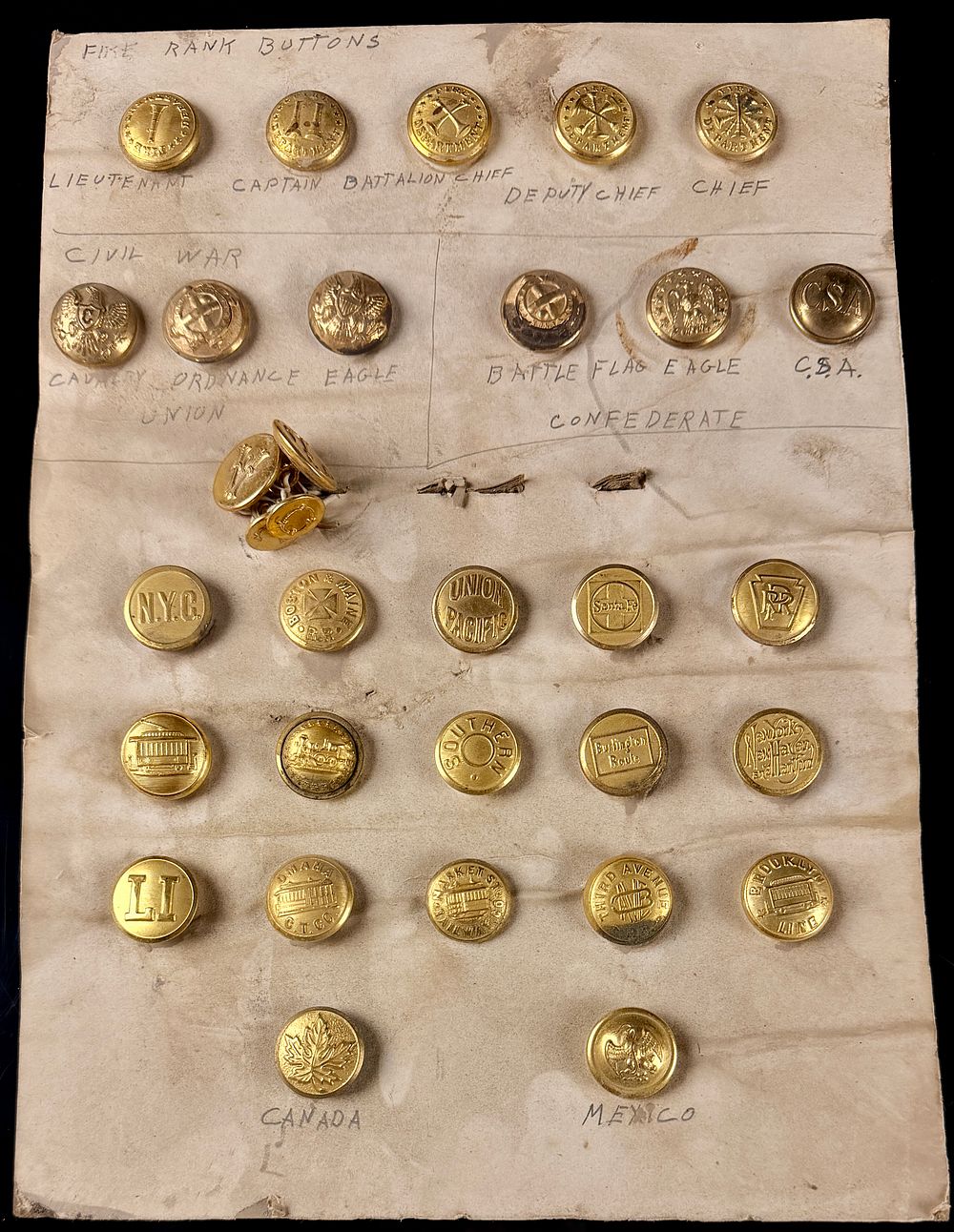
A Comprehensive Collection of 19th and Early 20th Century Uniform Buttons on Original Display Board - A large collection of assorted stamped brass uniform buttons, mounted on a heavily toned paper display board with handwritten descriptive labels. The collection is categorized into several sections, including municipal service, military, transportation, and international buttons. The first section contains fire department rank buttons featuring designs for Lieutenant (single trumpet), Captain (parallel trumpets), Battalion Chief (crossed axes), Deputy Chief (crossed axes and three stars), and Chief (crossed axes and five stars). The American Civil War section is divided into Union and Confederate categories. Union buttons include Cavalry (eagle with C shield), Ordnance (crossed cannons), and a General Service eagle. Confederate buttons include a crossed cannon variant labeled Battle Flag, a Confederate-style eagle, and a block letter CSA button. The transportation section comprises three rows representing North American railroad and streetcar lines, including New York Central (NYC), Boston and Maine RR, Union Pacific, Santa Fe, Pennsylvania Railroad (PRR monogram in a keystone), Southern, Burlington Route, New York New Haven and Hartford, Long Island (LI), Omaha City Transit Co., Market St. Railway Co., Third Avenue Ry., and Brooklyn Line. Several buttons in this section feature pictorial designs of steam locomotives and streetcars. The international section includes a Canadian maple leaf button and a Mexican national emblem button featuring an eagle perched on a cactus with a snake. A small cluster of approximately four additional buttons is pinned to the center of the board, including one with a script V design. The board measures approximately 12 inches by 9 inches. The mounting card is in poor to fair condition, showing significant overall toning, staining, creasing, and edge wear. Several original mounting holes are empty, indicating missing buttons. The buttons themselves exhibit a wide range of preservation; some retain bright gilding or silvering, while others show heavy dark oxidation, surface wear, and verdigris consistent with age and use. Backmarks cannot be inspected as the buttons are affixed to the board.