Bidspirit auction | Extremely Rare Bennington Scroddled Earthenware
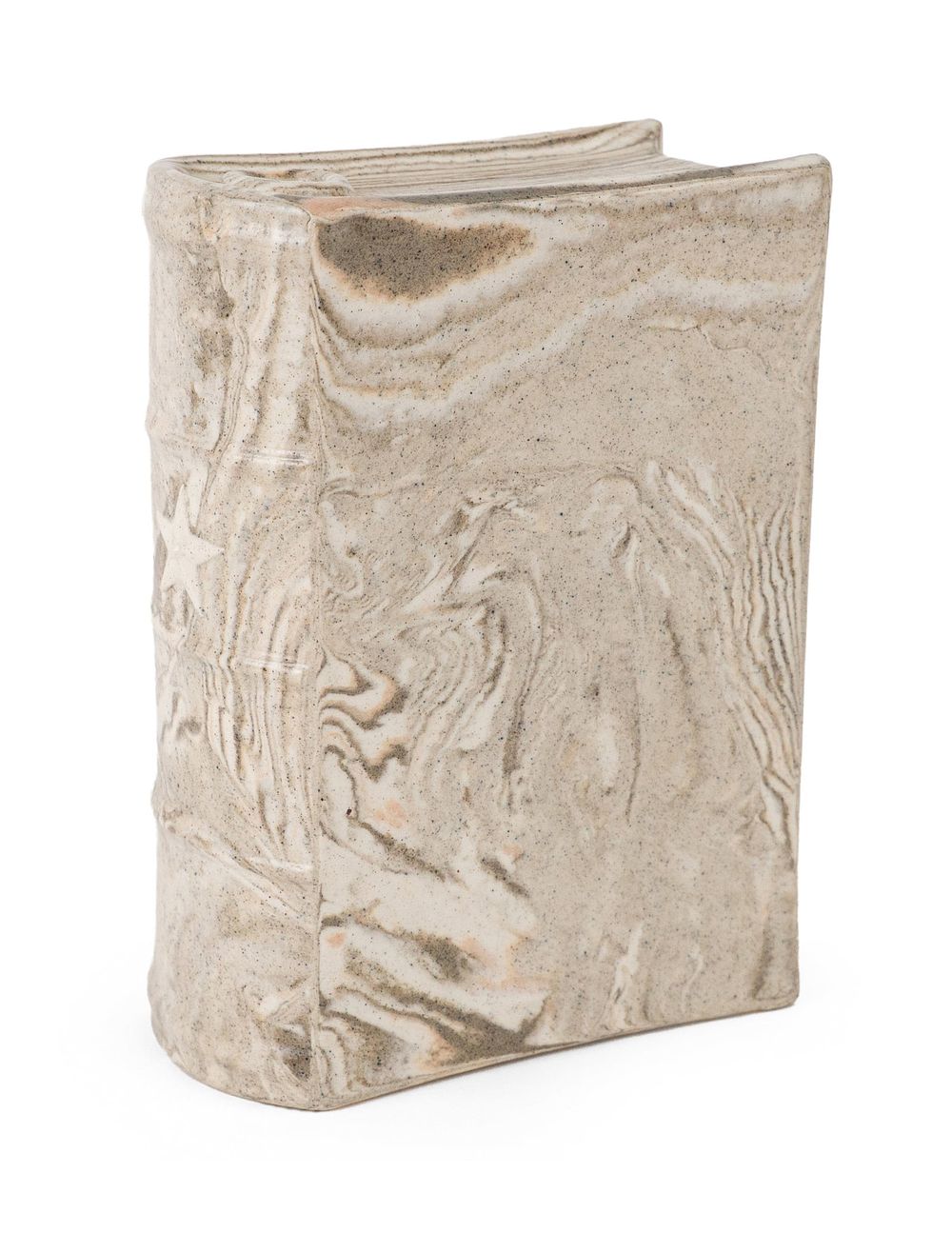
Extremely Rare Bennington Scroddled Earthenware Figural Book Flask with Applied Star - Extremely Rare Bennington Scroddled Earthenware Figural Book Flask with Applied Star Thin clear glaze over swirled and streaked white, gray, pink, and brown scroddled clay body, the thick-walled bottle built with mixed and unmixed clay layers including slabs laid to delineate the pages; applied white-clay sprig-molded star to spine, applied white-clay pad mark on underside bearing a ”Mark E” stamp which reads ”Fenton's Works; / Bennington, / Vermont”. Lyman, Fenton & Co. (The United States Pottery Co.), Bennington, VT. 1849-1858. Dimensions: 5 3/4” H, 4 1/4” x 2” base. Condition: Undamaged with one minor in-the-firing loss or glaze pop to lowermost extremity of one base corner following the curvature of the scroddled clay. Provenance: The Stradling Study Collection. Catalogue Note: A tour de force of clever craftsmanship in 19th century molded pottery. Christopher Webber Fenton's variegated ”lava ware” or ”scroddleware” (an American answer to agateware) has long been recognized as one of Bennington's most ambitious and desirable products (Spargo 1926, pg. 185-189). The technique was only very rarely applied to figural objects like book flasks and judging by the few extant examples in the Bennington Museum, the resulting flasks were usually quite drab in color. The present example exists in stark contrast to the others, with vivid marbled coloring throughout and even a healthy dose of pink clay included. A comparable example is known (at the Bennington Museum, object no. ”1957.87”), which incorporates the same clay. It shares the exceptional addition of an applied star on the spine and a ”unique” use of the ”Fenton's Works” mark, suggesting that the two flasks were probably made by the same workman, perhaps on the same day (Barret 1958, p. 315). That flask also shares its masterful use of ”laid agateware” techniques tp delineate the pages: on both flasks, the top, bottom, and fore edges were pressed with very specifically constructed slabs of clay (composed of numerous stacked layers of alternating colors) cut into rectangles of the correct width to fit the appropriate pieces of the mold. The technique was accomplished quite the same as it was done in 18th century Staffordshire - for an illustration of the techniques used by the English potters, see ”Swirls and Whirls: English Agateware Technology” in the 2003 edition of Ceramics in America (Erickson and Hunter 2003, figs. 37-38). The potter's work using stacked agateware slabs in cross-section to effectively create ”pages” on this solid agate book flask is both meticulous and ingenious - more than almost any other piece of Bennington ware, the present flask illustrates the great degree of technical perfection to which the ceramic art was brought by Fenton and his workmen at his Bennington factory's peak in the early 1850s. Auctioneer's Note: We are thrilled to bring the Stradling Study Collection to market in partnership with Connor Rush of SFR Antiques, whose help and scholarship enabled the completion of this session's catalogue. A bibliography for the sale can be found here: ( https://bit.ly/3RYodeh ). For questions about lots 1 through 111 in this sale, or for help accessing the bibliography, please reach out to connor@nyeandcompany.com. Condition: Condition reports are not provided in catalog descriptions. The absence of a condition report does not guarantee that the lot is in good condition or free from damage and wear. We encourage you to request a condition report and/or additional photos prior to bidding on any lot. We also recommend asking for a shipping quote before bidding. CASH, CASHIER CHECK, MONEY ORDER, AND WIRE TRANSFER ARE THE ONLY METHODS OF PAYMENT ACCEPTED FOR JEWELRY.