Bidspirit auction | American Black-Glazed Relief-Molded Diamond Redware
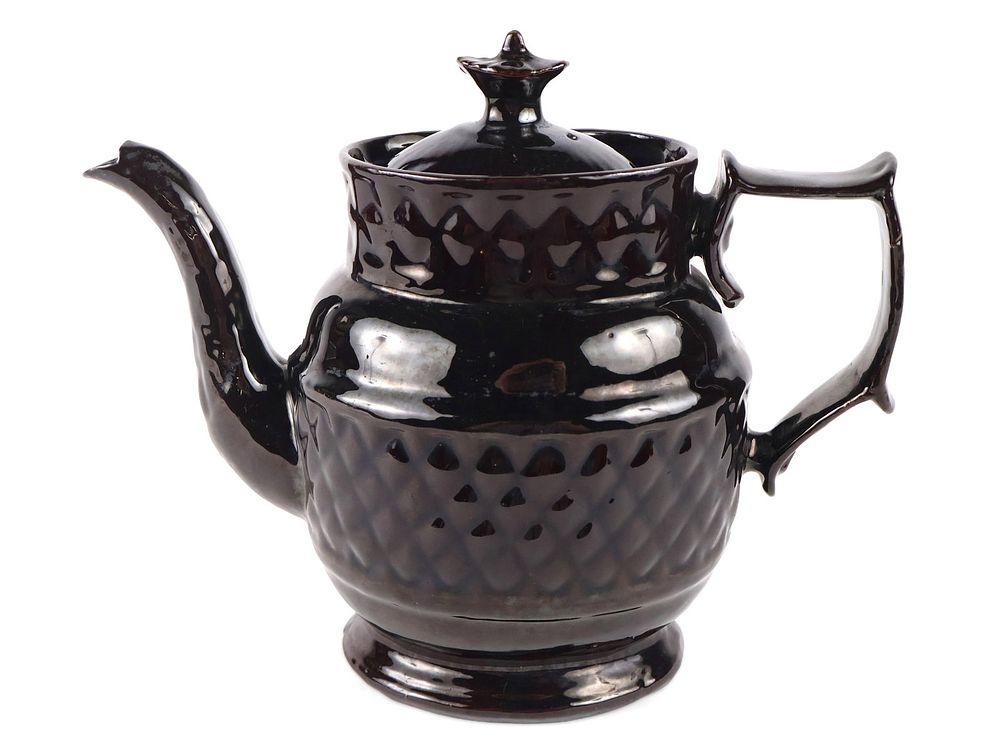
American Black-Glazed Relief-Molded Diamond Redware Oval Coffee Pot (Probably Philadelphia, PA) - American Black-Glazed Relief-Molded Diamond Redware Oval Coffee Pot (Probably Philadelphia, PA) Lustrous metallic black/dark-brown glaze over red earthenware body, exaggeratedly high-styled oval form relief-molded with a wide band of diamonds or ”Pineapple” pattern around the body which is echoed around the tall oval collar and around the spout; applied angled three-spurred handle with reinforcing lift at its upper attachment and diamond-shaped faux rivets on either end, flared oval foot with recessed fully-glazed underside showing signs of buff clay stilts/kiln furniture. First half 19th century. Dimensions: 9 1/4” H, 5” x 3 7/8” base. Condition: Coffee pot: Very good condition with a chip to lower edge of handle, a small broken and glued section to end of spout, and flaking to inner rim where cover rests. Cover: Virtually undamaged with a small flake to finial. Cover does not share the Diamond pattern (it has fine ribbing instead) but appears to be from the same manufacturer as the pot. Provenance: The Stradling Study Collection. From the private collection of Dr. Jane Perkins Claney (Bryn Mawr, PA). Catalogue Note: Lots 24 through 34 in this sale are primarily from the collection of ceramics scholar and author Jane Perkins Claney (1931-2018). It is believed that these pieces were generally acquired at flea markets and antique shows in the suburban Philadelphia area. Claney assembled the group in hopes of making the pieces available for in-depth study by future researchers - an earnest hope which is shared by Diana, who became the group's caretaker a number of years ago. Scholarship of the past decade has already vastly increased our knowledge of the previously-overlooked American-made ”black-glazed” refined redwares of the early 19th century - the diversity within Claney's thoughtfully-curated group shows that this area is indeed quite ripe for study by those interested in the early 19th century Philadelphia ceramics industry. This extravagant coffee pot (or perhaps large teapot) relates closely to a half-gallon pitcher at Colonial Williamsburg (object no. ”2022-53”) which was formerly in the collection of Susan H. Myers (former Smithsonian Curator of Ceramics and Glass and author of Philadelphia ceramics bible ”Handcraft to Industry”). It also relates to two other pots in the present sale (lots 27 and 29). They all share the same black glaze, similar styles of decoration (in the case of the present lot, diamonds), and a distinctive three-spurred handle. Myers suggested that Thomas Haig might have been making such pieces based on Haig's entry of ”One Black half gallon Pitcher (diamond)” at the Franklin Institute Exhibition in 1825 (Myers 1980, p. 32). But it is also worth noting that nearly a decade prior, similar ”diamond” molded pieces were being made by David Seixas - most famously, a green-glazed pitcher said to have been made in 1816 from a mold which had been in use even earlier than that date (Miller 2019, figs. 8 and 10). And in the other direction, Haig's sons James and Thomas Jr. were still advertising ”diamond pitchers” for sale as late as 1834 under a heading for their ”Black and Red China Ware” (info courtesy of Crocker Farm, reproduced in their Summer 2020 auction, lot 219). In the same ad, the Haigs offer ?Oval coffee pots? in two sizes, as well as ?large oval teapots?, although no other description is given for these wares. Even the Miller family was producing pottery in molds (pattern not known) as early as 1821 - apparently on a much larger scale than Haig's operation at that time - and it is likely that a number of other Philadelphia potters were experimenting with such ware, too (Myers 1980, p. 93). With so many potters making similar pieces over such a long span of time, it may be difficult to definitively attribute any such pieces to a particular maker, at least not without deeper investigation. But still, this fascinating and alluring ware, an important staple of the Philadelphia pottery industry which ”remained in regular production at least until midcentury”, stands on its own merit, and the myriad forms do a nice job illustrating its ”adaptability to changing market demands” as the century progressed (ibid, p. 13). Auctioneer's Note: We are thrilled to bring the Stradling Study Collection to market in partnership with Connor Rush of SFR Antiques, whose help and scholarship enabled the completion of this session's catalogue. A bibliography for the sale can be found here: ( https://bit.ly/3RYodeh ). For questions about lots 1 through 111 in this sale, or for help accessing the bibliography, please reach out to connor@nyeandcompany.com. Condition: Condition reports are not provided in catalog descriptions. The absence of a condition report does not guarantee that the lot is in good condition or free from damage and wear.