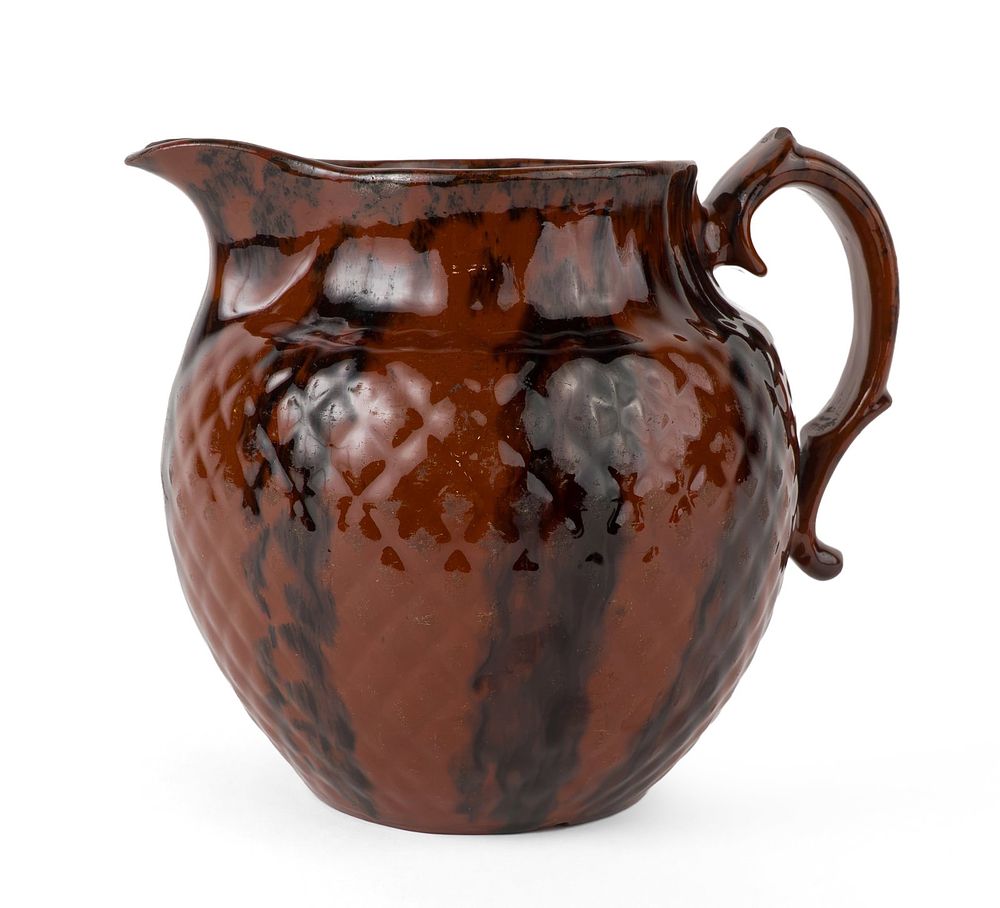
Bidspirit auction | Rare Philadelphia, PA Relief-Molded Redware
Rare Philadelphia, PA Relief-Molded Redware Pitcher, attributed to Haig - Rare Philadelphia, PA Relief-Molded Redware Pitcher, attributed to Haig Vertically banded sponged manganese beneath a clear lead glaze over deep red earthenware body, globular form relief-molded with diamonds all around the body meeting with vertical flutes above the shoulder, upswept unpatterned spout, applied molded spurred handle with reinforcing lift at its upper attachment, recessed fully-glazed underside. First half 19th century. Dimensions: 8 1/2” H. Condition: Excellent overall condition with moderate to heavy wear across high points of molded design, and a few flakes/shallow chips to spout and handle's thumbrest. Two chips to footring caused by removal of kiln stilts, as made. Provenance: The Stradling Study Collection. Purchased from George R. Hamell (New York), 10/01/2007. Catalogue Note: Clay color, glazing, and decoration point to Philadelphia - this style of sponged manganese, in vertical or horizontal bands (probably rouletted), is often considered a hallmark of redwares produced by the Haig family of potters at their Northern Liberties Pottery, which was run by Thomas Haig Sr. until his death in 1831 and afterwards by his sons James and Thomas Jr. (Myers 1980, pg. 63-64). That attribution stems from a similarly-sponged redware pitcher, purchased from the Haig family by Edwin Atlee Barber, which now resides at the Philadelphia Museum of Art (accession no. ”1892-78”). Mold-wise, in the context of Philadelphia ceramics, the present piece is linked to David Seixas through the combination of this particular diamond design with this particular handle. The same combination appears most famously on a green-glazed pitcher said to have been made at Seixas? factory in 1816 (Miller 2019, figs. 8 and 10). It is understood however that Seixas did not originate his diamond pitcher?s design, which was copied directly from English examples of the period (Blakey and Blakey 1993, p. 29). Moreover Seixas may have acquired his green pitcher's mold when he bought the Washington Pottery ?lock stock and barrel? - this idea is possibly supported by the discovery of diamond-molded sherds in early-19th century Philadelphia archaeological contexts which may be examples of Philadelphia queensware (Cress et al. 2017, p. 89). The ?flutes over diamonds? body design (with a different handle) is also seen on a black-glazed half-gallon pitcher at Colonial Williamsburg (object no. ”2022-53”) which was formerly in the collection of Susan H. Myers (former Smithsonian Curator of Ceramics and Glass and author of Philadelphia ceramics bible ”Handcraft to Industry”). Myers suggested that Thomas Haig might have been making such pieces, which are ?similar in form to the Seixas example?, on the basis of Haig's entry of ”One Black half gallon Pitcher (diamond)” at the Franklin Institute in 1825 (Myers 1980, p. 32). It is worth noting that a decade later, in the May 12th 1834 issue of The Commercial Intelligencer, Haig's sons James and Thomas Jr. were still advertising ”diamond pitchers” for sale under a heading for their ”Black and Red China Ware” (info courtesy of Crocker Farm Auctions, reproduced in their Summer 2020 auction, lot 219). The Stradlings felt that the Haig family?s known use of the diamond motif on pitchers - and the distinctive style of glazed decoration - combined to suggest a Haig attribution for the present piece. It is conceivable that the Haigs could have acquired the pitcher?s body and handle molds after Seixas? factory closed in 1822, a ?passing of the torch? in some sense if so, since Seixas himself probably acquired the mold secondhand. It is also possible that the Haig factory?s potters copied an existing Seixas piece to create the molds for their version - this might account for the fact that the present pitcher is a bit smaller than the green-glazed Seixas example. Although the circumstances of the design?s transfer may not be known, the piece fits excellently into the Haigs' attributed oeuvre and it easily earns a place in the hall of fame of 19th century Philadelphia redware. Auctioneer's Note: We are thrilled to bring The Stradling Study Collection to market in partnership with Connor Rush of SFR Antiques, whose help and scholarship enabled the completion of this session's catalogue. A bibliography for the sale can be found here: ( https://bit.ly/3RYodeh ). For questions about lots 1 through 111 in this sale, or for help accessing the bibliography, please reach out to connor@nyeandcompany.com. Condition: Condition reports are not provided in catalog descriptions. The absence of a condition report does not guarantee that the lot is in good condition or free from damage and wear. We encourage you to request a condition report and/or additional photos prior to bidding on any lot. We also recommend asking for a shipping quote before bidding. CASH, CASHIER CHECK, MONEY ORDER,